
Generation
Article 9 of 20 · Generation and storageGeothermal energy explained for businesses
Direct answer
Geothermal energy, also called aardwarmte in Dutch, is sustainable heat drawn from deeper layers of the earth. Warm water is pumped up through one well, after which a heat exchanger extracts the heat; the cooled water is returned through a second well into the same layer, which warms up again on its own. This supplies heat for greenhouses, buildings and industry.
- Clear definition
- Data-driven assessment
- Risks and opportunities visible
- Practical next steps
Geothermal energy explained: scattered information versus Energy Intelligence
The Netherlands has a large heat demand, much of which is still met with natural gas. Geothermal energy offers an alternative that fits that demand, because it delivers heat directly rather than electricity. Think of a horticultural business wanting to heat its greenhouses without a gas boiler, or a heat network supplying a residential area. Geothermal heat therefore matters mainly to growers, heat companies and heat-intensive industry looking for a sustainable, steady heat source.
- Geothermal energy pumps warm water up from a deep layer, extracts the heat through a heat exchanger, and returns the cooled water in a closed circuit.
- The heat suits collective use: horticulture under glass, heat networks for homes and buildings, and parts of industry.
- In the Netherlands, exploring for and producing geothermal heat falls under the Mining Act; the State Supervision of Mines oversees safety.
Insight
Traditional approach
Information is scattered across portals, documents, invoices or separate spreadsheets.
Modern approach
Data, context and interpretation are brought together into a clear decision picture.
Decision-making
Traditional approach
Choices are made based on averages, assumptions or occasional analyses.
Modern approach
Scenarios, KPIs and current measurement data make the trade-off more concrete and repeatable.
Follow-up
Traditional approach
Actions often stay non-committal or disappear into separate reports.
Modern approach
Follow-up actions, monitoring and reporting are linked to the same energy data.
How does geothermal energy work?
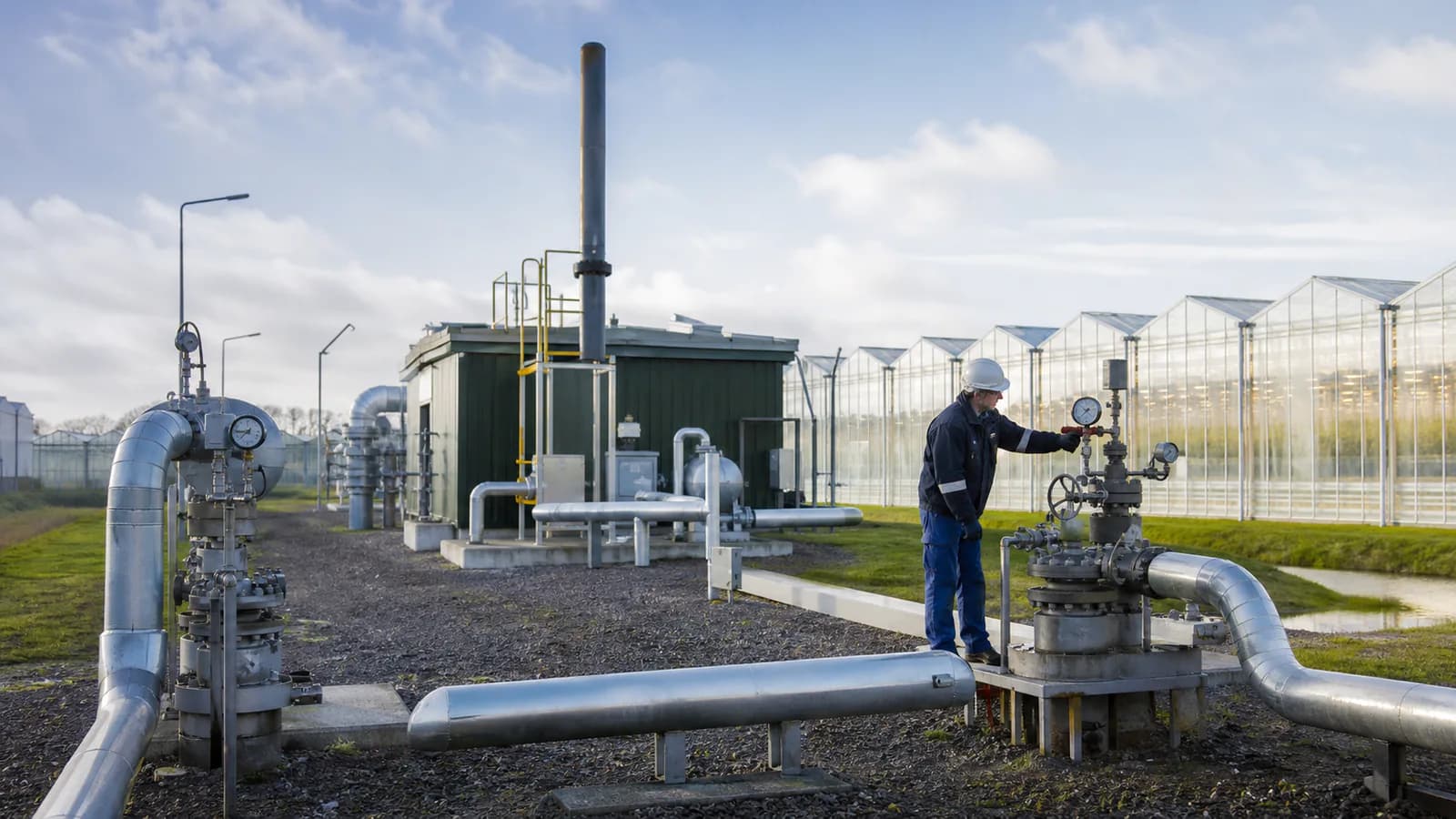
With geothermal energy, warm water is pumped up from a deeper layer of the earth through a production well. Above ground the water releases its heat through a heat exchanger. The pumped water itself stays in a closed circuit and never touches the heat network. After cooling, it returns through a second well, the injection well, into the same layer, where it warms up again on its own. This pairing of a production and an injection well is called a doublet. The extracted heat then warms the water that flows through the heat network to the users. As a rule, the deeper the layer, the warmer the water it holds.
- A production well pumps warm water up; an injection well returns the cooled water.
- The combination of both wells is called a doublet.
- A heat exchanger transfers the heat; the deep water stays in a closed circuit.
- The heat travels through a heat network to homes, greenhouses or businesses.
What is geothermal energy suited for?
Geothermal energy delivers heat, not electricity, and is therefore mainly a solution for a heat demand. In the Netherlands it is used for horticulture under glass, for heat networks that warm homes and buildings, and for parts of industry. It is a source for collective use: one production installation supplies several users. Do not confuse geothermal energy with shallow ground-source energy or thermal storage, also known as WKO in Dutch. That draws heat and cold from much shallower layers and needs a heat pump to reach usable temperatures, which suits a single well-insulated building. Geothermal energy drills deeper and delivers heat at a higher level, suited to larger, collective heat networks.
- Geothermal energy delivers heat, not electricity.
- Typical users are horticulture under glass, heat networks for homes and heat-intensive industry.
- It is a collective source: one installation serves several buildings.
- Shallow WKO is different: it sits much shallower and needs a heat pump.
What should you watch out for?
Geothermal energy requires deep drilling, and that is only possible where the subsurface is suitable. Programmes such as SCAN map where that is the case. Exploration and production fall under the Dutch Mining Act. You apply for permits with the ministry; the State Supervision of Mines advises on this and oversees safety for people and the environment. The supervisor looks, among other things, at the risk of earth tremors, at unintentionally striking oil or gas, and at possible contamination. In exceptional cases geothermal energy can cause light tremors; that risk is limited but is monitored and weighed in the permit. In addition, expect a substantial upfront investment in construction, maintenance and later removal of the installation.
- Deep drilling is only possible where the subsurface is suitable.
- The Mining Act governs exploration and production; permits go through the ministry.
- The State Supervision of Mines advises and oversees safety.
- The seismic risk is limited but monitored; the upfront investment is high.
Curious what this looks like with your own data?
In a no-obligation call, a specialist looks at your meters, sites and energy questions with you. Response within one business day.
Search the knowledge base
Find the answer to your question.
Search using your own words. Abbreviations and spelling variants are recognised, so EMS also finds the articles on energy management systems.
Topic