
Optimising contracted capacity: a guide for businesses
Direct answer
Optimising contracted capacity means aligning the value in your connection and transport agreement with the electricity you actually draw or feed back. You agree this contracted transport capacity with your grid operator. The value sets the maximum power you may use at any moment on a Dutch grid connection.
- Clear definition
- Data-driven assessment
- Risks and opportunities visible
- Practical next steps
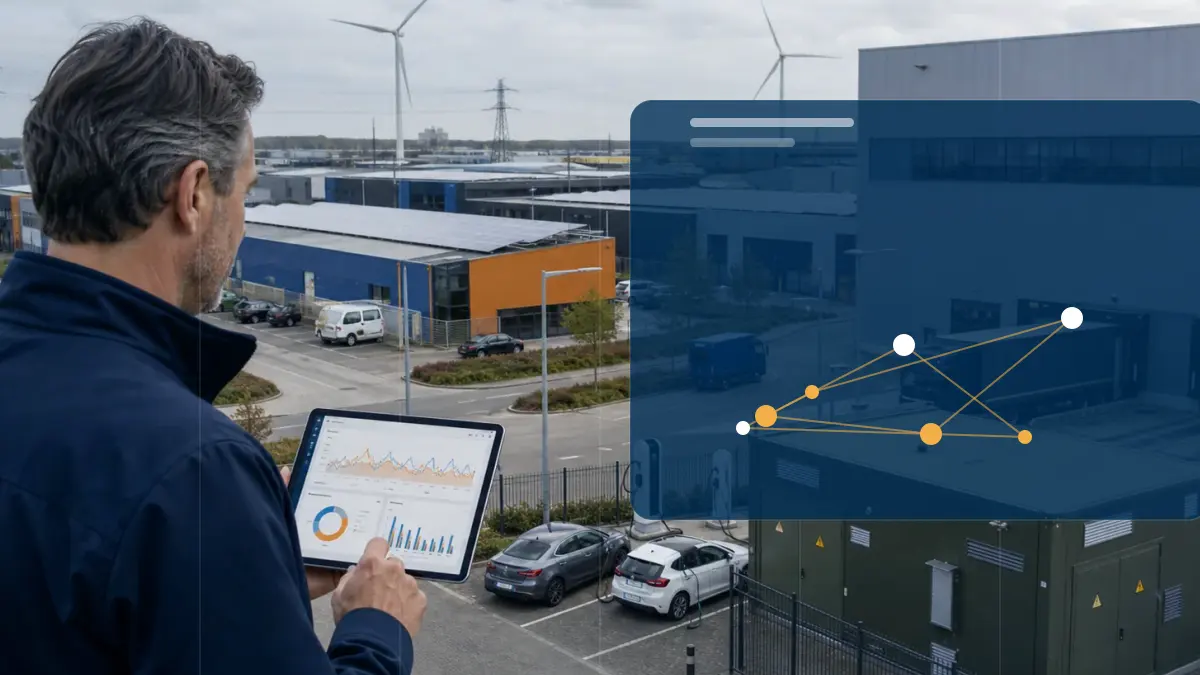
Optimising contracted capacity: scattered information versus Energy Intelligence
A large business connection reserves a fixed amount of power on the grid, even if you rarely use it in full. Picture a firm that runs fewer machines after a renovation but still pays for its former peak. If you do not match the reserved value to your real use, you hold grid capacity that another user in the region may need. Optimising is about that alignment.
- Contracted transport capacity is the maximum power you may draw or feed back at any moment, recorded in your connection and transport agreement.
- Large business users change the value through their grid operator's portal, such as Mijn Liander or Mijn Enexis Grootverbruik.
- If you lower the value, you cannot simply raise it again; in congestion areas an increase runs through a formal request.
Insight
Traditional approach
Information is scattered across portals, documents, invoices or separate spreadsheets.
Modern approach
Data, context and interpretation are brought together into a clear decision picture.
Decision-making
Traditional approach
Choices are made based on averages, assumptions or occasional analyses.
Modern approach
Scenarios, KPIs and current measurement data make the trade-off more concrete and repeatable.
Follow-up
Traditional approach
Actions often stay non-committal or disappear into separate reports.
Modern approach
Follow-up actions, monitoring and reporting are linked to the same energy data.
What is contracted transport capacity?
Contracted transport capacity is the maximum electrical power your organisation is entitled to. You agree that value with your grid operator and record it in a connection and transport agreement. It applies to large business connections, larger than 3x80 amperes. It sets how much you may draw or feed back at a peak moment, not how much energy you consume across a year. If you exceed the value, it can cause disruptions on your own connection or on that of others on the same grid.
- The value is a power limit, not an annual consumption figure.
- It applies to connections larger than 3x80 amperes.
- You agree it with the grid operator in a connection and transport agreement.
- Exceeding it can cause disruptions for you and other connected users.
How do you adjust the value?
Large business users change their contracted transport capacity through their grid operator's portal. With Liander this runs through Mijn Liander, with Enexis through Mijn Enexis Grootverbruik. You select the connection and choose the option to change the capacity. A reduction has consequences: Liander states that after a reduction you cannot simply raise the value again. If you increase capacity in an area with transport scarcity, that follows a formal procedure. Enexis also notes that during a renovation you may temporarily deactivate the connection without lowering the value.
- Changes run through your grid operator's large-user portal.
- After a reduction, raising the value again is not automatic.
- In areas with transport scarcity, more capacity requires a formal request.
- During a renovation you may sometimes temporarily deactivate the connection.
Why grid operators steer on real use
When forecasting grid load, operators must account for all contracted capacity, even capacity a customer does not use. Reserved but unused capacity can cause an area to count as full prematurely. The ACM has therefore adopted a code decision, known as GOTORK, that lets a grid operator reduce demonstrably unused and unnecessarily contracted transport capacity. This applies only in congestion areas and only to connections on the medium, high or extra-high voltage grid, after consultation with the connected user. In addition, connected users in congestion areas can no longer raise their capacity by exceeding the agreed value. They request extra transport rights formally.
- Operators also count capacity you reserve but do not use.
- GOTORK lets an operator reduce demonstrably unused capacity, only in congestion areas.
- In congestion areas, informally exceeding the value no longer applies.
- You then request extra transport rights through a formal procedure.
Curious what this looks like with your own data?
In a no-obligation call, a specialist looks at your meters, sites and energy questions with you. Response within one business day.
Search the knowledge base
Find the answer to your question.
Search using your own words. Abbreviations and spelling variants are recognised, so EMS also finds the articles on energy management systems.
Topic