
What is climate change?
Direct answer
Climate change is a long-term shift in the average weather on Earth, at present mainly a warming caused by human activity. The Earth is now more than one degree warmer than in the period 1850-1900. The cause is the emission of greenhouse gases such as CO2, released when fossil fuels are burned.
- Clear definition
- Data-driven assessment
- Risks and opportunities visible
- Practical next steps
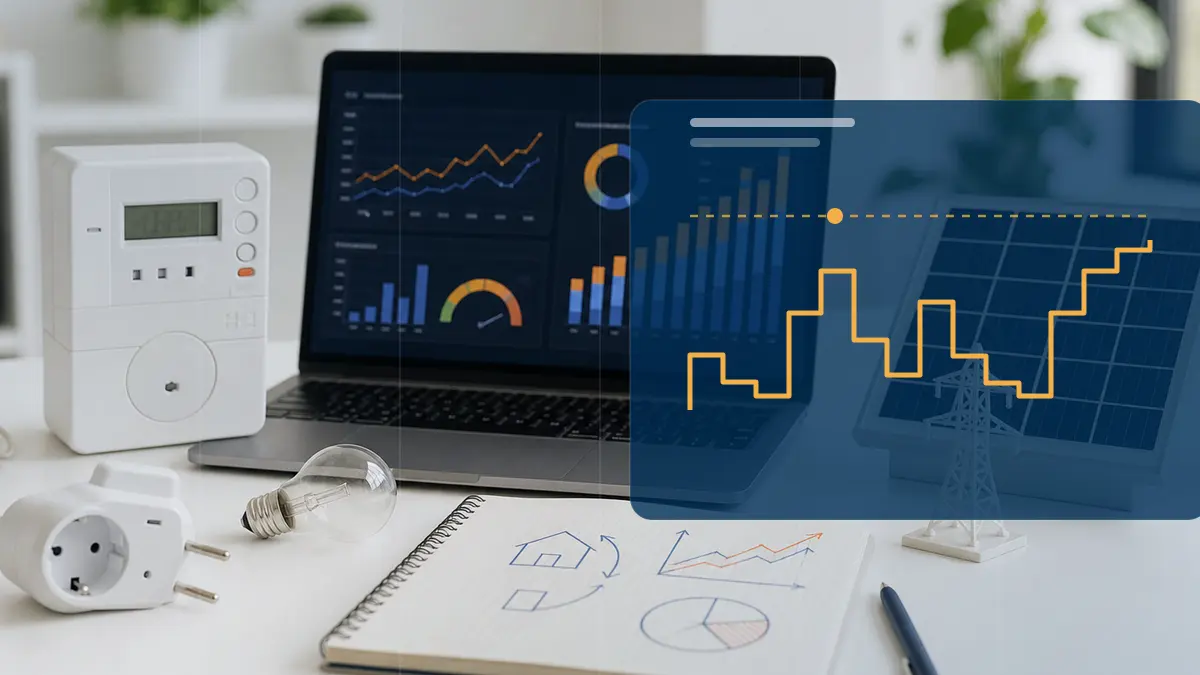
What is climate change: scattered information versus Energy Intelligence
The weather differs from day to day, but climate is the average weather pattern over decades. That average is now shifting worldwide, and you notice it close to home: a farmer sees crops wither in a longer drought, a municipality sees streets flood more often after a heavy shower. Climate change is not a distant concern. For businesses it translates into new risks, new rules and expectations from customers and financiers around CO2.
- It is a change over decades; a few cold or warm days say nothing about it, that is weather.
- The greenhouse effect is the mechanism: greenhouse gases such as CO2 trap warmth in the atmosphere, and more of these gases means more warming.
- The effect is noticeable in the Netherlands too, with a rising sea level along the coast and more heat, drought and heavy downpours.
Insight
Traditional approach
Information is scattered across portals, documents, invoices or separate spreadsheets.
Modern approach
Data, context and interpretation are brought together into a clear decision picture.
Decision-making
Traditional approach
Choices are made based on averages, assumptions or occasional analyses.
Modern approach
Scenarios, KPIs and current measurement data make the trade-off more concrete and repeatable.
Follow-up
Traditional approach
Actions often stay non-committal or disappear into separate reports.
Modern approach
Follow-up actions, monitoring and reporting are linked to the same energy data.
How does climate change work?
The Earth stays warm because greenhouse gases in the atmosphere retain part of the sun's warmth. Without that natural greenhouse effect it would be far colder. The problem is that human activity adds extra greenhouse gases, chiefly CO2. This is released when coal, oil and gas are burned for electricity, heat and transport. More greenhouse gases means more warmth is retained, and so the Earth warms up. The Dutch weather institute KNMI points out that the speed at which the Earth has warmed since the middle of the last century is unprecedented. The IPCC, the climate panel of the United Nations, concludes that human activity has unequivocally caused this warming.
- Greenhouse gases such as CO2 retain the sun's warmth in the atmosphere.
- Human activity adds extra CO2 to the air by burning fossil fuels.
- More greenhouse gases means more retained warmth and therefore warming.
- The Earth is now more than one degree warmer than in the period 1850-1900.
What does the Netherlands notice?
Climate is the average weather over a long period, weather is what you see outside today. A cold week therefore does not disprove the warming; it is about the trend over decades. In the Netherlands that trend is visible. The KNMI measures a rising sea level along the coast, which increases pressure on dikes and flood defences. The weather is also becoming more extreme: longer spells of heat and drought, alternating with heavier rain showers that overload sewers and waterways. For a low-lying country with a great deal of water, that is a real issue. The KNMI translates the global warming into climate scenarios that show which way things may go for the Netherlands.
- Weather is today's situation; climate is the average over decades.
- The sea level along the Dutch coast is rising and increases pressure on flood defences.
- The weather is becoming more extreme, with more heat, drought and heavy showers.
- The KNMI climate scenarios sketch possible futures for the Netherlands.
What does this mean for your organisation?
For businesses, climate change has two sides. The first is mitigation: lowering your own CO2 emissions by saving energy and switching to sustainable sources. The second is adaptation: protecting yourself against the physical consequences, such as flooding on your site, heat stress or disruptions in your supply chain. On top of that comes regulation. The Dutch government steers with climate policy towards lower emissions, and a growing number of companies must map and report their emissions and climate risks. Customers, banks and insurers also ask about it more often. Climate change is therefore not only an environmental theme, but also a matter of cost, continuity and accountability.
- Mitigation: lowering your CO2 emissions through energy saving and sustainable energy.
- Adaptation: making your site and operations resilient against water, heat and drought.
- Regulation: the government steers towards lower emissions and requires reporting.
- Customers, banks and insurers increasingly ask about your climate approach.
Curious what this looks like with your own data?
In a no-obligation call, a specialist looks at your meters, sites and energy questions with you. Response within one business day.
Search the knowledge base
Find the answer to your question.
Search using your own words. Abbreviations and spelling variants are recognised, so EMS also finds the articles on energy management systems.
Topic