
Difference between kW and kWh: a guide for businesses
Direct answer
The difference between kW and kWh: the kilowatt (kW) is a unit of power and tells you how hard a device draws electricity at a given moment. The kilowatt-hour (kWh) is a unit of energy and adds up how much has been used over time. A 1 kW device running for one hour uses 1 kWh. Power is the speed, energy is the distance travelled.
- Clear definition
- Data-driven assessment
- Risks and opportunities visible
- Practical next steps
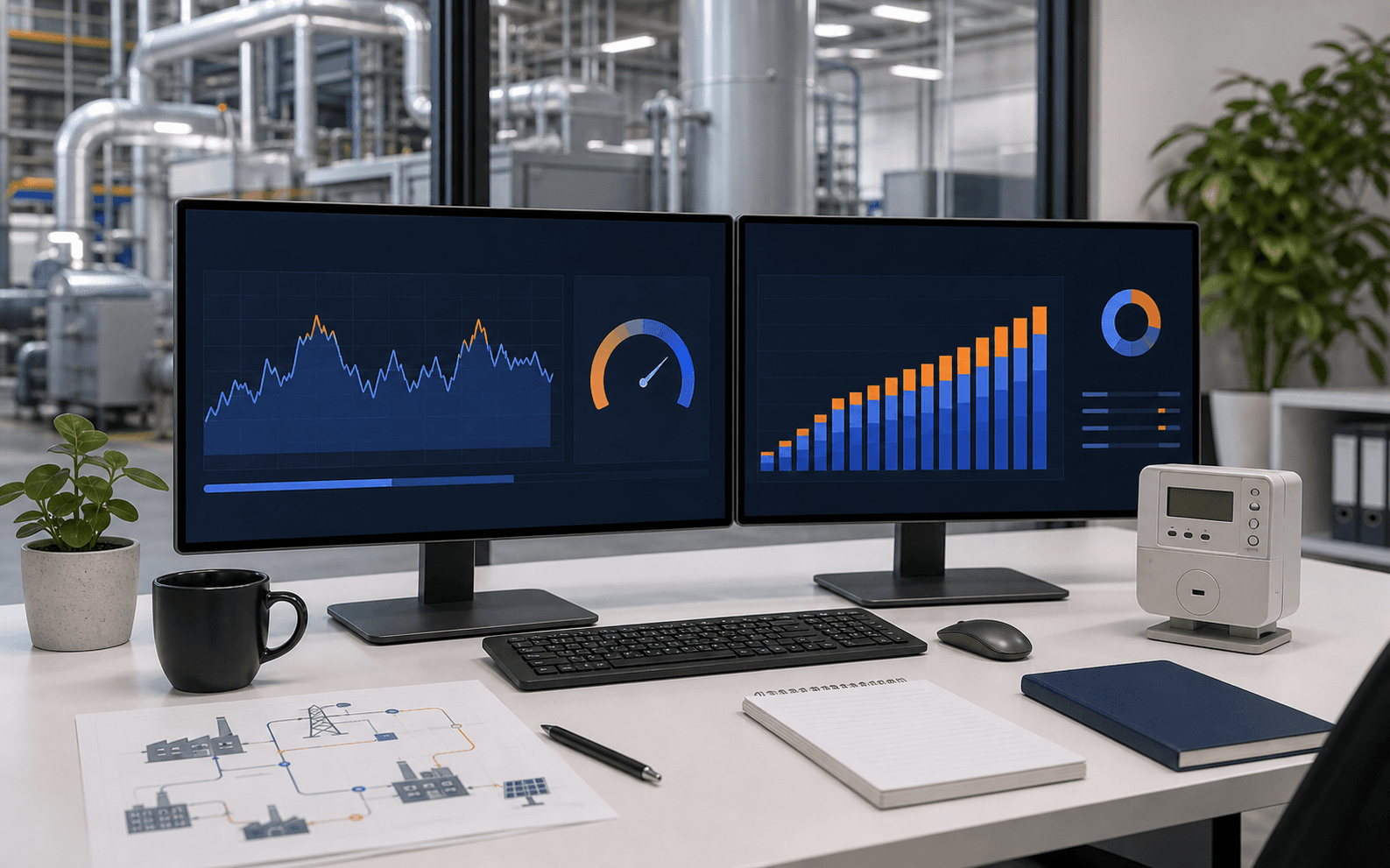
Difference between kW and kWh: scattered information versus Energy Intelligence
Anyone reading an energy bill or a connection contract meets both units without ever seeing the difference explained. Yet they describe two different things. Picture a water tap: the kW is how far you open the tap, the kWh is how much water ends up in the bucket. For a household that difference seems small, but for a business with a large consumer connection it decides which part of the costs you can influence with what.
- kW measures power: the instantaneous rate at which electricity is drawn or delivered, like the flow of an open tap.
- kWh measures energy: the total over a period, like the amount of water that has run into the bucket.
- The rule: power in kW times duration in hours gives energy in kWh; 2 kW for 3 hours is 6 kWh.
Insight
Traditional approach
Information is scattered across portals, documents, invoices or separate spreadsheets.
Modern approach
Data, context and interpretation are brought together into a clear decision picture.
Decision-making
Traditional approach
Choices are made based on averages, assumptions or occasional analyses.
Modern approach
Scenarios, KPIs and current measurement data make the trade-off more concrete and repeatable.
Follow-up
Traditional approach
Actions often stay non-committal or disappear into separate reports.
Modern approach
Follow-up actions, monitoring and reporting are linked to the same energy data.
What do kW and kWh actually mean?
The watt is the unit of power: energy per second. A kilowatt is one thousand watts. Power tells you how hard something is working right now. A 2 kW kettle draws far more power the moment it is on than a 60 watt laptop charger. The kilowatt-hour is the unit of energy and is created by multiplying power by time. If that power runs for longer, the energy adds up, even when the power stays low. A 10 watt LED lamp burning all night uses more energy than the kettle running for two minutes. That is why your meter records kWh, not kW.
- kW is power: the instantaneous rate, comparable to speed or the flow of a tap.
- kWh is energy: power added up over time, comparable to distance travelled or the bucket contents.
- From kW to kWh: multiply the power by the number of hours it runs.
- Your smart meter counts in kWh, because that is what you actually consume or feed back.
Why does this distinction matter for your business?
On a commercial energy bill the two units stand for two different cost types. Your supplier charges the delivered energy per kWh: these are the supply costs, tied to how much you consume over the month. On top of that you pay grid costs to the grid operator, and a large share of these depends not on your consumption but on your connection. For a large consumer connection your connection value or contracted transport capacity, expressed in kW or kVA, sets a fixed part of those costs. So you pay for the space you reserve on the grid, even in months when you draw few kWh. Two businesses with the same annual consumption can therefore face very different grid costs if their peak power differs.
- Supply costs follow your kWh: how much energy you draw over the period.
- Part of the grid costs follows your kW: the power your connection is allowed to pass.
- Your connection value or contracted transport capacity reserves grid space, regardless of how much you use.
- A high brief peak in kW can drive up grid costs, even with modest consumption in kWh.
When do you watch kW and when kWh?
If you want to lower supply costs, you steer on kWh: use less energy, more efficient equipment, or shift consumption to cheaper moments. If you want a grip on grid costs or on grid congestion, you steer on kW: lower your simultaneous peak power by not running heavy loads at the same time. That last part is called peak shaving or load balancing. In areas with grid congestion the contracted transport capacity is scarce as well, so managing your peak in kW can matter more than the total consumption in kWh. To weigh this up properly you need insight into both: your consumption pattern in kWh over time, and your highest power peaks in kW.
- Steering on kWh mainly lowers supply costs and energy purchasing.
- Steering on kW mainly lowers grid costs and helps with grid congestion.
- Lowering peak power means spreading heavy loads over time, not necessarily using less.
- Insight into both quantities together shows where your largest costs sit.
Curious what this looks like with your own data?
In a no-obligation call, a specialist looks at your meters, sites and energy questions with you. Response within one business day.
Search the knowledge base
Find the answer to your question.
Search using your own words. Abbreviations and spelling variants are recognised, so EMS also finds the articles on energy management systems.
Topic