
How a solar panel works?
Direct answer
A solar panel converts sunlight directly into electricity. Its cells contain silicon; sunlight knocks electrons loose in that silicon, which sets a direct current flowing. An inverter then converts that direct current into the alternating current your installation and the grid use. So a solar panel generates power without fuel and without moving parts.
- Clear definition
- Data-driven assessment
- Risks and opportunities visible
- Practical next steps
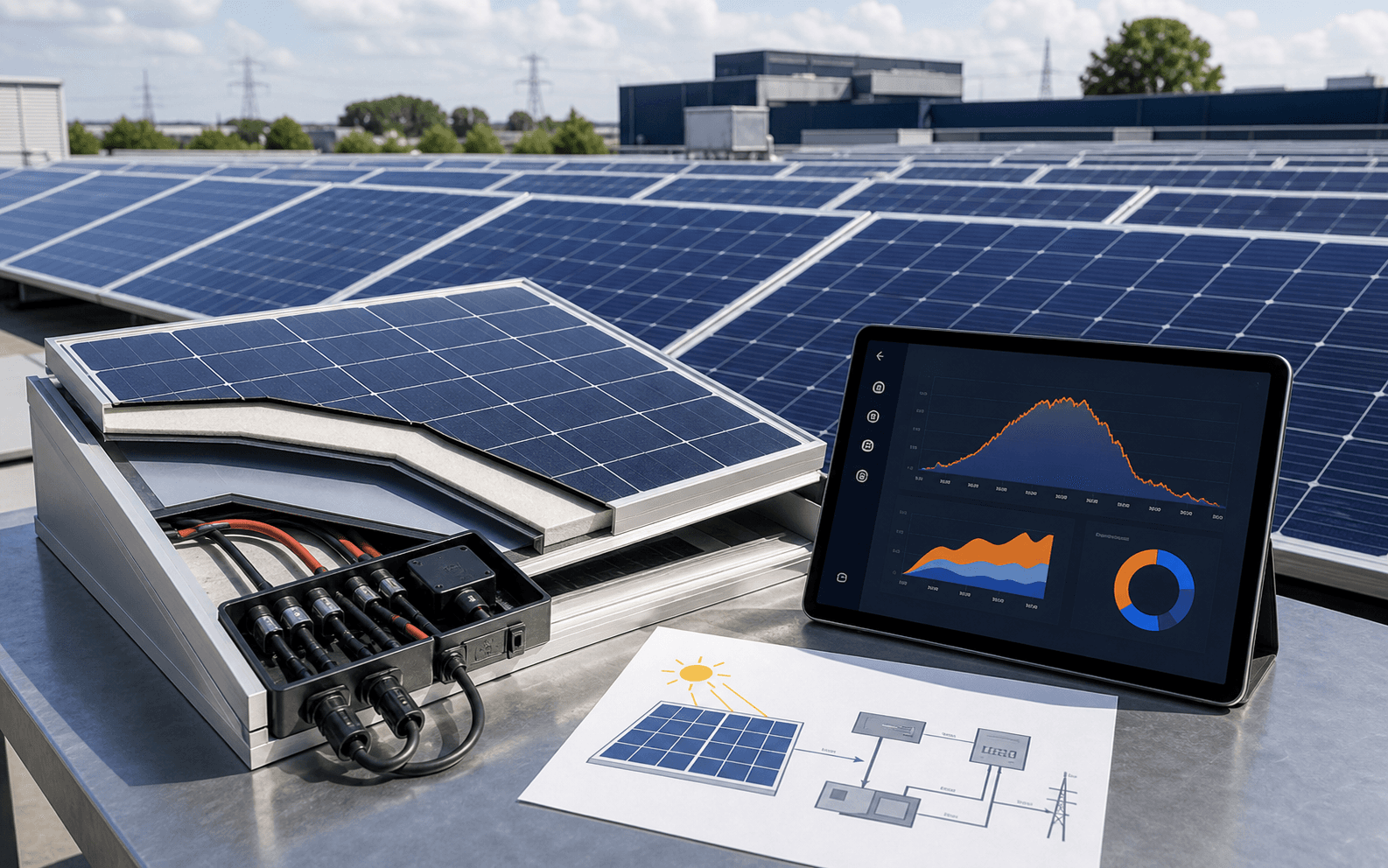
How a solar panel works: scattered information versus Energy Intelligence
Solar panels now sit on millions of Dutch roofs, from homes to industrial halls. Yet many people are unsure what actually happens up there. Why does a sheet of glass produce power, and why is there a box on the wall in the meter cupboard? This topic becomes relevant the moment you want to generate power yourself: as a business aiming to cut the energy bill, or as the owner of a large roof wanting to use the daylight hours.
- The panel produces direct current; an inverter converts it into the alternating current your appliances and the electricity grid use.
- Panels work on daylight, so also under cloud cover, but they then deliver less power than in bright sunshine.
- A solar panel (PV) makes electricity; a solar collector on a solar water heater makes heat. These are two different systems.
Insight
Traditional approach
Information is scattered across portals, documents, invoices or separate spreadsheets.
Modern approach
Data, context and interpretation are brought together into a clear decision picture.
Decision-making
Traditional approach
Choices are made based on averages, assumptions or occasional analyses.
Modern approach
Scenarios, KPIs and current measurement data make the trade-off more concrete and repeatable.
Follow-up
Traditional approach
Actions often stay non-committal or disappear into separate reports.
Modern approach
Follow-up actions, monitoring and reporting are linked to the same energy data.
How does a solar panel work?
A solar panel is made up of solar cells, usually based on the mineral silicon. Sunlight hitting the silicon knocks electrons loose inside it. That movement of electrons creates an electrical voltage in the cell. By connecting many cells in series, a direct current begins to flow. This is called the photovoltaic effect: light is converted straight into electricity, without combustion and without moving parts. The power produced is direct current, while your appliances and the electricity grid run on alternating current. That is why there is always an inverter alongside. How much a panel delivers depends on the amount of light: more in bright sun, less under cloud, but rarely nothing at all during the day.
- Sunlight knocks electrons loose in the silicon, which creates a voltage.
- Several cells in series together deliver a usable direct current.
- No fuel is involved and there are no moving parts.
- Output varies with light intensity throughout the day.
What does the inverter do?
The inverter is the heart of a solar power installation. Your panels produce direct current, but your appliances and the public electricity grid run on alternating current. The inverter converts the direct current from the panels into alternating current, so you can use the power directly in your building or feed it to the grid. The inverter also manages the yield: it constantly looks for the point at which the panels deliver the most power given the light and temperature at that moment. On larger installations, such as a business roof, you connect several strings of panels to an inverter. Without a working inverter, an installation delivers no usable power.
- The inverter turns direct current into the alternating current the grid requires.
- Without an inverter, the generated power is not directly usable.
- It continuously extracts the best possible yield from the panels.
- On large roofs you connect several strings of panels to the inverter.
Solar panel or solar collector, and what does this mean for business?
Do not confuse a solar panel with a solar collector. A solar panel (PV) makes electricity. A solar collector is part of a solar water heater and captures solar heat to warm water; it therefore delivers heat, not power. For businesses, the electricity is what counts. If you generate your own, you use that power directly in your building and feed the surplus to the grid. On a large roof the connection capacity becomes decisive: in areas with grid congestion you may not be able to get a new connection or feed power back. For small consumers, the netting scheme still applies in 2026, letting you offset power fed back against power drawn; that scheme ends from 2027.
- A solar panel (PV) makes power; a solar collector on a solar water heater makes heat.
- You use self-generated power directly; the surplus goes to the grid.
- On large roofs, grid congestion can limit feeding back or a new connection.
- The netting scheme for small consumers still applies in 2026 and ends from 2027.
Curious what this looks like with your own data?
In a no-obligation call, a specialist looks at your meters, sites and energy questions with you. Response within one business day.
Search the knowledge base
Find the answer to your question.
Search using your own words. Abbreviations and spelling variants are recognised, so EMS also finds the articles on energy management systems.
Topic