
Large-consumer vs. small-consumer connection: a guide for businesses
Direct answer
A large consumer connection (grootverbruik) is an electricity connection heavier than 3x80 amperes; anything up to and including 3x80 amperes counts as small consumer (kleinverbruik). That threshold determines not only capacity, but also how you buy, meter and invoice energy. Large consumers fall outside the statutory small-consumer protection and arrange supply, grid management and metering themselves.
- Clear definition
- Data-driven assessment
- Risks and opportunities visible
- Practical next steps
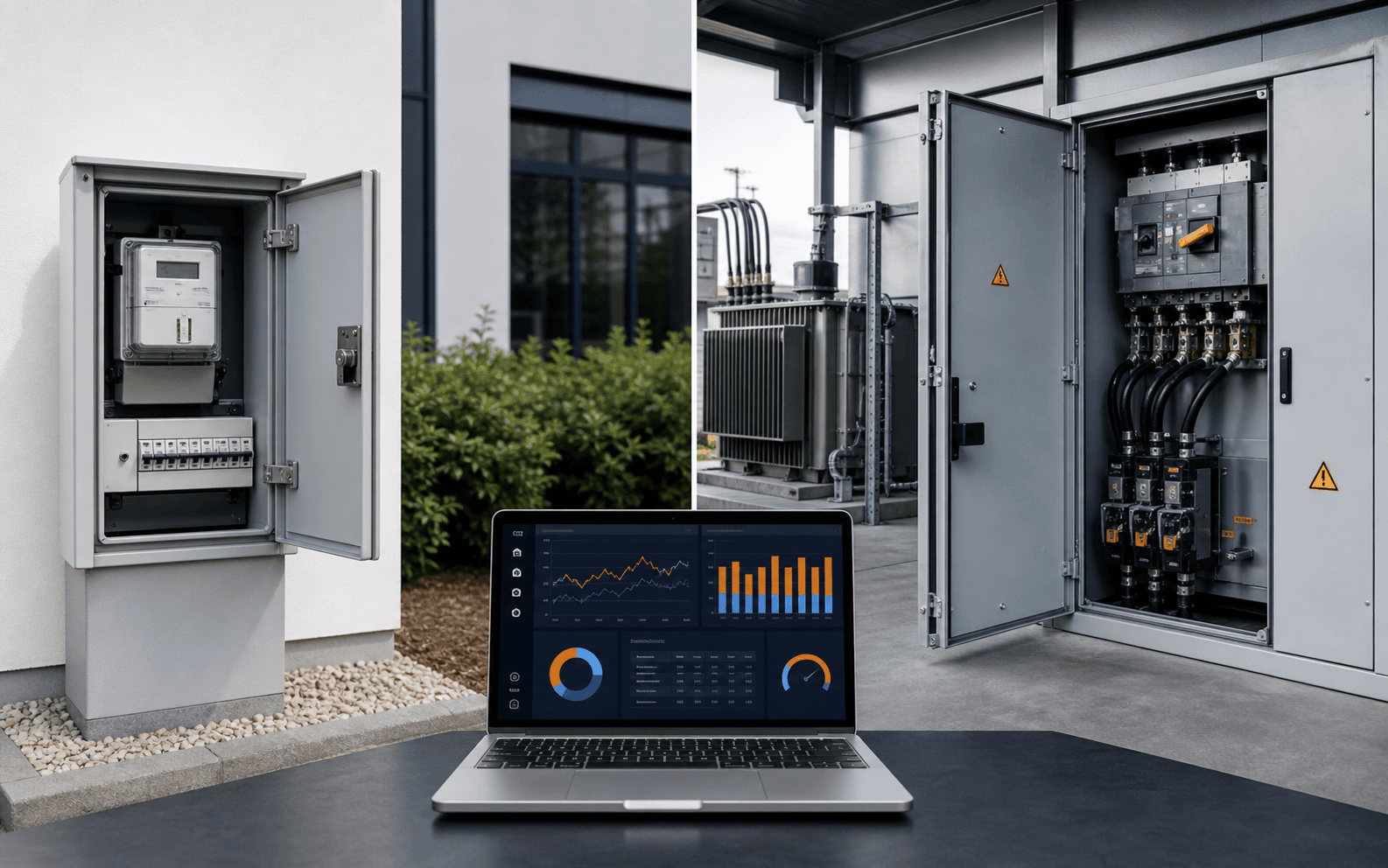
Large-consumer vs. small-consumer connection: scattered information versus Energy Intelligence
The meter cupboard of a home or a shop almost always holds a small consumer connection. When a business grows, adds production equipment or wants to install fast chargers, that connection falls short and a heavier one is needed. At that moment more changes than just the number of amperes. You move to a different part of the energy market, with different contracts, different protection and a different application process with the grid operator. This subject matters to any business owner upgrading or connecting anew.
- The boundary is the connection capacity: up to and including 3x80 amperes is small consumer, heavier than 3x80 amperes is large consumer. For gas the threshold is 40 cubic metres per hour.
- A supplier needs a licence from the Dutch regulator ACM to supply small consumers; large consumers may also contract with suppliers that do not hold such a licence.
- As a large consumer you sign separate contracts for supply, grid management and metering, with a quarter-hour meter from a metering company of your choice and multiple invoices.
Insight
Traditional approach
Information is scattered across portals, documents, invoices or separate spreadsheets.
Modern approach
Data, context and interpretation are brought together into a clear decision picture.
Decision-making
Traditional approach
Choices are made based on averages, assumptions or occasional analyses.
Modern approach
Scenarios, KPIs and current measurement data make the trade-off more concrete and repeatable.
Follow-up
Traditional approach
Actions often stay non-committal or disappear into separate reports.
Modern approach
Follow-up actions, monitoring and reporting are linked to the same energy data.
Where does the line between small and large consumer lie?
Dutch law draws the line at the capacity of the connection, not at annual consumption. For electricity, a connection up to and including 3x80 amperes is small consumer; anything above that is large consumer. For gas the threshold is a throughput capacity of 40 cubic metres per hour. An ordinary home often has a 3x25 ampere connection and sits well within small consumer. Heavier machinery, cooling, heat pumps or charging infrastructure push the requested capacity up, bringing large consumer into view. You will find the connection value on your energy invoice or in the meter cupboard; if in doubt, the grid operator determines the exact connection.
- Electricity: up to and including 3x80 amperes is small consumer, heavier is large consumer.
- Gas: up to 40 cubic metres per hour is small consumer, above that large consumer.
- Connection capacity is decisive, not annual consumption in kilowatt-hours.
- The connection value is on the invoice and in the meter cupboard; the grid operator confirms if in doubt.
What does large consumer mean for your contracts and metering?
With a small consumer connection you arrange everything through one energy contract: your supplier collects and forwards the grid charges, and you receive one invoice. The grid operator installs and reads the digital or smart meter. For large consumer this splits up. You contract supply, grid management and metering separately and receive several invoices: from the supplier, from the grid operator and from the metering company. Metering runs through a quarter-hour meter from a metering company you choose yourself. Statutory protection also differs: a supplier needs a licence from the regulator ACM to supply small consumers, whereas large consumers may also contract with suppliers that hold no such licence. That freer position offers room, but demands more control of your own.
- Small consumer: one contract, one invoice, meter installed and read by the grid operator.
- Large consumer: separate contracts for supply, grid management and metering.
- A quarter-hour meter from a chosen metering company records consumption per quarter of an hour.
- Large consumers fall outside the licensing rule that protects small consumers.
What should you watch for with a large consumer connection?
You apply for a heavier connection with your regional grid operator, who assesses whether it is technically possible and physically adjusts the connection. Allow for lead time, and for waiting lists in areas with grid congestion where the network is full. Because you arrange supply, grid management and metering yourself, it pays to size the connection capacity carefully: too heavy raises the fixed grid charges needlessly, too light constrains growth. Record who signs which agreement and when contracts expire, because without active renewal the small-consumer protection lapses. Since 1 January 2026 the Energy Act formally refers to a small and a large connection, and to a system operator instead of a grid operator; the practice and the 3x80 ampere threshold remain the same.
- Apply for the upgrade with your regional grid operator and expect lead time.
- In congestion areas a waiting list may apply for extra transport capacity.
- Size the connection capacity deliberately: too heavy costs needless fixed charges, too light constrains growth.
- Under the Energy Act this is a small or large connection since 2026; the threshold does not change.
Curious what this looks like with your own data?
In a no-obligation call, a specialist looks at your meters, sites and energy questions with you. Response within one business day.
Search the knowledge base
Find the answer to your question.
Search using your own words. Abbreviations and spelling variants are recognised, so EMS also finds the articles on energy management systems.
Topic