
Reading your energy bill: a guide for businesses
Direct answer
Reading an energy bill means separating three fixed blocks: supply costs for your energy supplier, grid costs for your regional grid operator, and taxes for the government. Supply costs follow your consumption in kilowatt-hours and cubic metres; the grid costs and taxes are largely independent of how much you use. That is how you see exactly what you pay for.
- Clear definition
- Data-driven assessment
- Risks and opportunities visible
- Practical next steps
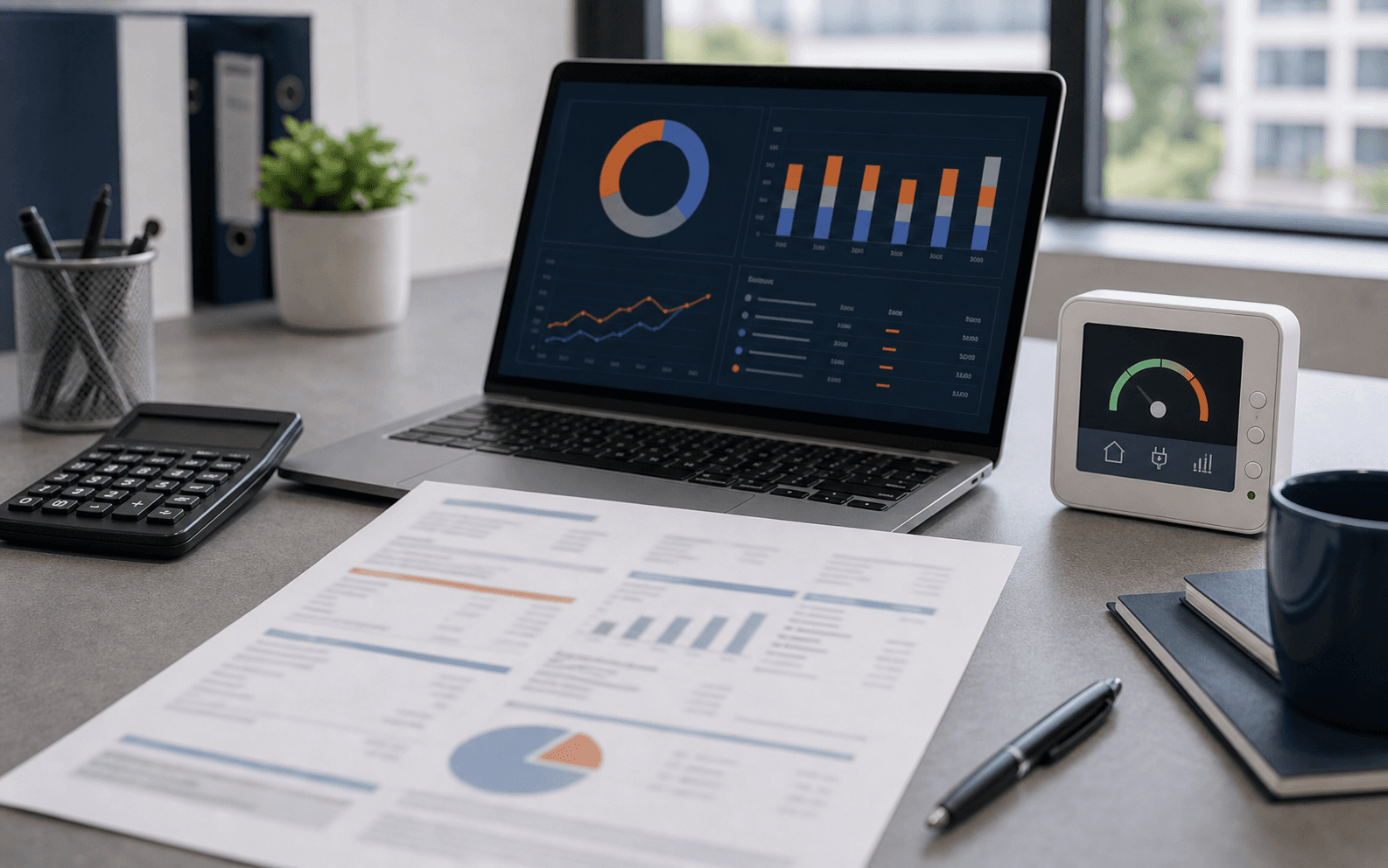
Reading your energy bill: scattered information versus Energy Intelligence
A Dutch business energy bill mixes rates, fixed amounts and levies, while two different parties are built into it. A business owner opening the annual statement wants to know which part follows consumption and which part returns regardless. This matters to any facility manager or finance lead who wants to control costs, compare a contract or check a statement. Once you know the structure, you immediately recognise where each item belongs.
- Supply costs consist of a rate per kilowatt-hour and cubic metre times your consumption, plus a fixed supply charge to the supplier.
- Grid costs are fixed amounts paid to the regional grid operator, such as the capacity tariff and metering costs; the regulator ACM sets each year how high they may be.
- Taxes consist of energy tax per unit consumed and 21 percent VAT over the whole bill; the energy tax reduction appears as a credit per connection.
Insight
Traditional approach
Information is scattered across portals, documents, invoices or separate spreadsheets.
Modern approach
Data, context and interpretation are brought together into a clear decision picture.
Decision-making
Traditional approach
Choices are made based on averages, assumptions or occasional analyses.
Modern approach
Scenarios, KPIs and current measurement data make the trade-off more concrete and repeatable.
Follow-up
Traditional approach
Actions often stay non-committal or disappear into separate reports.
Modern approach
Follow-up actions, monitoring and reporting are linked to the same energy data.
Which main items make up the bill?
The bill splits into three blocks. The first is supply costs: a rate per kilowatt-hour of electricity and per cubic metre of gas, multiplied by your consumption, plus a fixed supply charge. This block goes to your energy supplier. The second block is grid costs for your regional grid operator. These are fixed amounts that are independent of your consumption, such as the capacity tariff for transport and the cost of the meter. The third block is taxes: energy tax on your consumption and 21 percent VAT on the entire bill. The regulator ACM sets each year how high the grid costs may be.
- Supply costs: consumption in kilowatt-hours and cubic metres times the rate, plus the fixed supply charge.
- Grid costs: fixed amounts to the grid operator, including the capacity tariff and metering costs.
- Taxes: energy tax per unit consumed, with 21 percent VAT on top.
- The ACM sets the maximum grid costs each year; they differ per grid operator.
Why do two parties appear on one bill?
Two different parties are built into the bill: your energy supplier and your regional grid operator. The supplier sells you the energy and sets the supply rates, which you choose yourself and can compare. The grid operator manages the cables and pipes in your region, is a given for your location and has regulated tariffs. With a small consumer connection, the supplier collects the grid costs on behalf of the grid operator, so you receive one bill. With a large consumer connection, you sign separate contracts with the supplier, the grid operator and a metering company, and receive the items separately. That distinction explains why part of the bill is negotiable and part is not.
- The supplier delivers the energy and sets the supply rates, which you can compare.
- The grid operator manages the network in your region and uses tariffs regulated by the ACM.
- With small consumption, the supplier collects the grid costs on behalf of the grid operator: one bill.
- With large consumption, billing runs through separate contracts and separate items.
How do you read the taxes and feed-in?
The tax block contains the energy tax, a levy per kilowatt-hour and per cubic metre. It uses a tiered rate: the higher the annual consumption, the lower the rate per unit over the higher tiers. The bill also shows the energy tax reduction, formerly called the tax credit. This is a fixed credit per connection with a residential function, offset as a negative amount. On top of the whole bill comes 21 percent VAT, so also over the energy tax itself. If you feed power back into the grid with solar panels, your feed-in appears separately. For small consumers, netting currently still applies: the kilowatt-hours fed back are offset against your consumption.
- Energy tax is a levy per kilowatt-hour and cubic metre, through a tiered rate.
- The energy tax reduction is a fixed credit per connection, shown as a negative amount on the bill.
- 21 percent VAT applies to the entire bill, including the energy tax.
- Feed-in is listed separately; for small consumers, netting against your consumption currently still applies.
Curious what this looks like with your own data?
In a no-obligation call, a specialist looks at your meters, sites and energy questions with you. Response within one business day.
Search the knowledge base
Find the answer to your question.
Search using your own words. Abbreviations and spelling variants are recognised, so EMS also finds the articles on energy management systems.
Topic