
What is energy flexibility?
Direct answer
Energy flexibility is the ability to shift or adjust your electricity consumption, generation or storage over time in response to a signal, such as the price, the load on the grid or the balance on the system. You then use less at busy moments and more when there is room. This helps a full grid and lets you use low prices.
- Clear definition
- Data-driven assessment
- Risks and opportunities visible
- Practical next steps
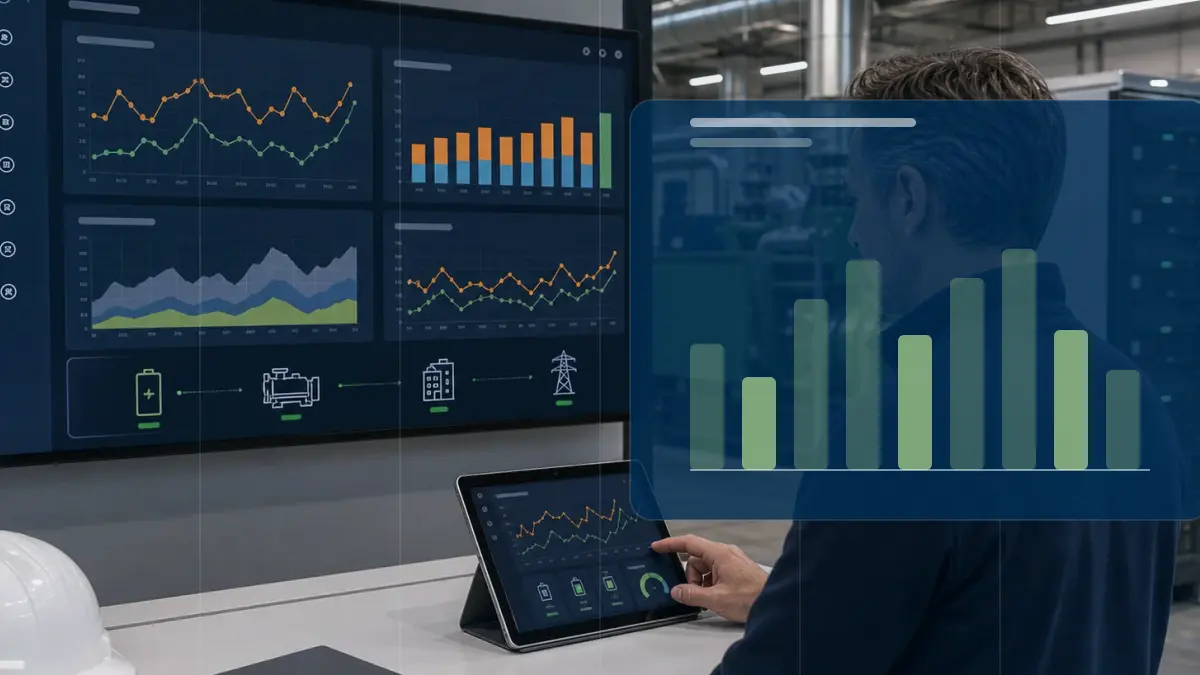
What is energy flexibility: scattered information versus Energy Intelligence
The Dutch electricity grid is reaching its limits in many places, while solar and wind deliver a variable supply. As a result, it is not only how much power you use that matters, but also when. A cold store that shifts its compressors by a few hours, or a company that charges a battery when the price is low, responds to that rhythm. This is relevant for any large consumer in a busy grid area and for companies with a dynamic electricity contract.
- You adjust when you consume, generate or store based on an external signal: the electricity price, a request from the grid operator, or the imbalance on the national grid.
- Flexibility becomes valuable because solar and wind supply varies and much of the Dutch grid is full; shifting consumption relieves the grid and follows the cheap hours.
- A company delivers flexibility by shifting processes, charging and discharging a battery, or adjusting its own generation such as a combined heat and power unit.
Insight
Traditional approach
Information is scattered across portals, documents, invoices or separate spreadsheets.
Modern approach
Data, context and interpretation are brought together into a clear decision picture.
Decision-making
Traditional approach
Choices are made based on averages, assumptions or occasional analyses.
Modern approach
Scenarios, KPIs and current measurement data make the trade-off more concrete and repeatable.
Follow-up
Traditional approach
Actions often stay non-committal or disappear into separate reports.
Modern approach
Follow-up actions, monitoring and reporting are linked to the same energy data.
How does energy flexibility work?
Energy flexibility is about shifting or adjusting your energy use in response to an outside signal. That signal can be the electricity price, which varies by the hour with the supply of solar and wind. It can also be a request from your grid operator to draw less power at peak moments. And it can be the imbalance on the national grid, which the transmission operator TenneT has to resolve every quarter of an hour. You respond by shifting consumption to another moment, reducing it temporarily, or increasing it when there is room. Importantly, the energy delivered over the day often stays the same; only the timing changes. In this way you relieve the grid and use the cheap hours.
- The signal comes from the market (price), the grid operator (congestion) or TenneT (imbalance).
- You shift consumption in time, reduce it temporarily, or increase it when there is room.
- Often the total energy per day stays the same; only the timing changes.
- The grid is relieved and expensive peak hours are avoided.
Why is flexibility becoming more valuable?
Two developments make flexibility important. First, a growing share of power comes from solar and wind, which varies strongly with the weather. Controllable power plants absorb those swings less, so demand has to move along. Second, the grid is full in many places: the demand for transport is greater than the cables can handle. This is called grid congestion. Grid operators use flexibility through congestion management, where large consumers adjust their consumption at peak moments in return for a payment. At the same time, a dynamic electricity contract makes the hourly price visible, so that shifting also pays financially. In this way your flexibility helps keep the system in balance and makes better use of scarce grid capacity.
- Solar and wind supply varies, so demand has to move more with the supply.
- In many places the grid is full; this is called grid congestion.
- Through congestion management large consumers adjust their peak consumption in return for a payment.
- A dynamic electricity contract makes the hourly price visible, which makes shifting worthwhile.
How does a company deliver flexibility?
A company delivers flexibility in three ways. The first is shifting processes: running a cold store, a pump or a production line at another moment, within the limits of the process. The second is storage: a battery charges when power is cheap or plentiful and discharges at peak moments, without stopping your process. The third is adjusting your own generation, for example a combined heat and power unit that you switch on or off at the right moment. Always start with your energy profile: when do you consume or deliver, and how much room is there. The room to shift is limited by your processes and your technology. Not every process can wait, and not every installation can switch quickly.
- Shift processes: run cooling, pumps or production at another moment.
- Use storage: charge a battery at a low price and discharge it at peak moments.
- Adjust your own generation: switch a combined heat and power unit on or off at the right moment.
- Map your energy profile first; process freedom and technology set the limits.
Curious what this looks like with your own data?
In a no-obligation call, a specialist looks at your meters, sites and energy questions with you. Response within one business day.
Search the knowledge base
Find the answer to your question.
Search using your own words. Abbreviations and spelling variants are recognised, so EMS also finds the articles on energy management systems.
Topic