
What is a smart meter?
Direct answer
A smart meter (slimme meter) is a digital energy meter that automatically sends your meter readings to your grid operator and energy supplier at a distance. You no longer submit readings yourself and no meter reader visits. In the Netherlands the smart meter measures your electricity use and, alongside a modern gas meter, your gas use as well. With solar panels it also records what you feed back into the grid.
- Clear definition
- Data-driven assessment
- Risks and opportunities visible
- Practical next steps
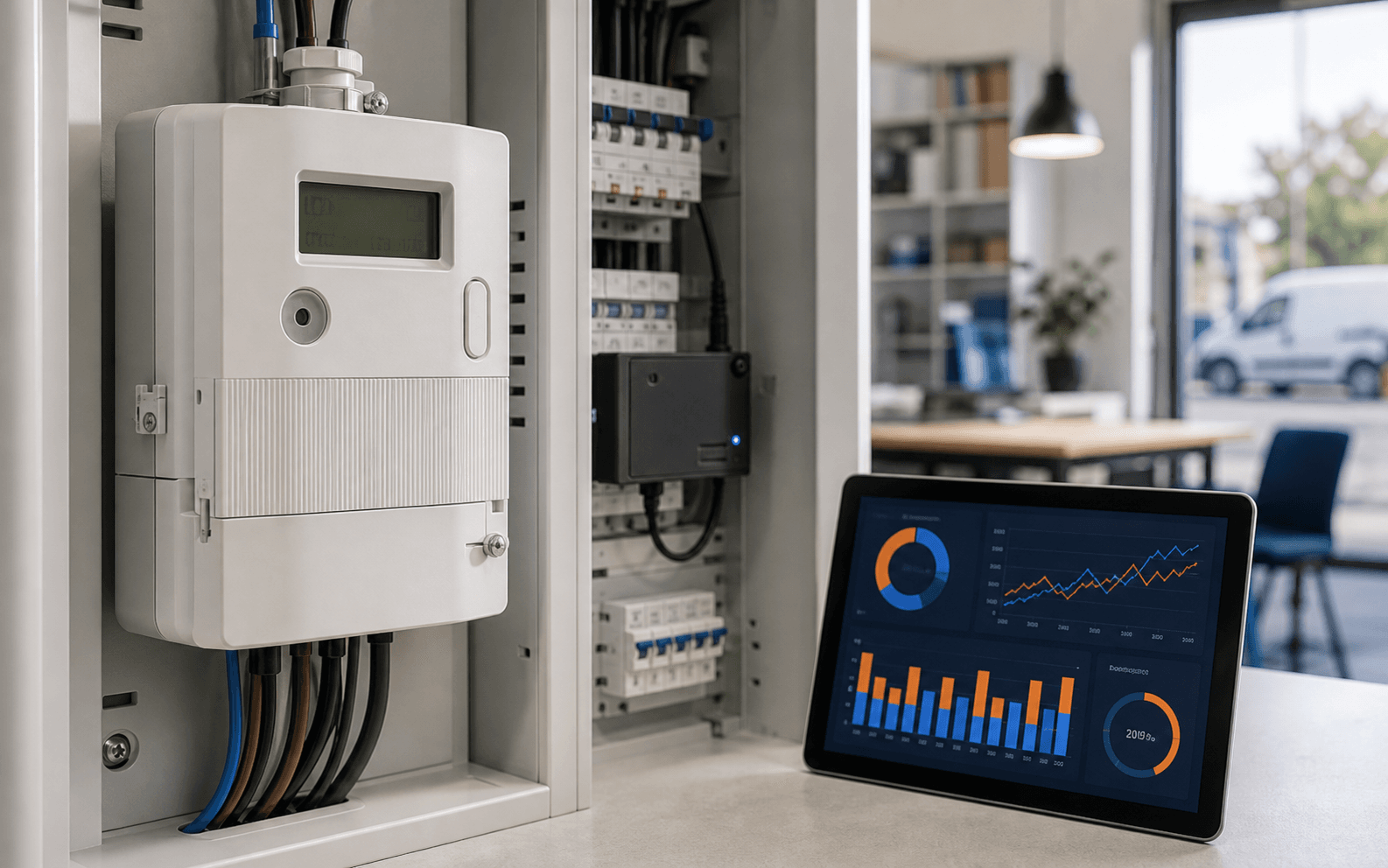
What is a smart meter: scattered information versus Energy Intelligence
When an old rotating-disc or digital meter is replaced, the grid operator often offers a smart meter. A familiar picture: you used to receive a card each year to submit your readings, or someone rang the bell to read the meter. That disappears with a smart meter. The topic matters to anyone with a meter cupboard, from a resident to a business owner who wants to know where their energy is going.
- A smart meter measures your consumption and feed-in and sends the readings; it does not switch any appliances on or off itself.
- Through the P1 port you can connect your own energy display and follow your consumption live in an app or on a screen.
- You may refuse a smart meter, have its communication switched off, or have it set to administratively off; this is free and reversible later.
Insight
Traditional approach
Information is scattered across portals, documents, invoices or separate spreadsheets.
Modern approach
Data, context and interpretation are brought together into a clear decision picture.
Decision-making
Traditional approach
Choices are made based on averages, assumptions or occasional analyses.
Modern approach
Scenarios, KPIs and current measurement data make the trade-off more concrete and repeatable.
Follow-up
Traditional approach
Actions often stay non-committal or disappear into separate reports.
Modern approach
Follow-up actions, monitoring and reporting are linked to the same energy data.
What does a smart meter do and not do?
A smart meter reads your electricity use and passes on the readings of a modern gas meter. If you have solar panels, it also records the electricity you feed back into the grid. The meter sends those readings automatically and at a distance to your grid operator and energy supplier, so you do not have to submit anything yourself. An important misconception: the meter only measures, it controls nothing. It does not switch appliances on or off and does not operate your washing machine or charging point. Your energy supplier uses the readings to produce a monthly cost and consumption overview and to draw up the annual bill.
- Measures your electricity use and passes on the reading of a modern gas meter.
- Also records the electricity you feed back into the grid if you have solar panels.
- Sends the readings automatically and at a distance to grid operator and supplier.
- Does not control any appliances; the meter measures, it operates nothing.
What can you do yourself with the P1 port?
Besides the connections the grid operator uses, the smart meter has a P1 port intended for you. It is a small connection point, similar to a telephone socket, to which you can connect your own energy display or manager. Such a device or service reads the meter in real time and shows your electricity and gas use in an app, on a website or on a screen. You then see, moment by moment, what you are using, far more detailed than the monthly overview from your supplier. The P1 port keeps working even if you have the meter set to administratively off. The data it produces is yours and does not leave your meter cupboard by itself.
- The P1 port is the connection point on the meter that you may use yourself.
- Connect an energy display to it and follow your consumption live.
- You see your use moment by moment, more granular than the monthly overview.
- The P1 port keeps working, even when the meter is set to administratively off.
Mandatory, and what does that mean for your privacy?
Under Dutch energy legislation a digital meter is the standard, but you have a choice. If you do not want a smart meter, you can have an ordinary digital meter installed; that one does not send readings automatically. If you already have a smart meter, you can have its communication function switched off or have it set to administratively off. When it is administratively off, the grid operator reads no readings and you submit them yourself; you then receive no monthly overview from your supplier. The grid operator charges nothing for this and you can switch the remote reading back on later. For a business the trade-off is often the reverse: the granular quarter-hour data is exactly the basis for energy monitoring.
- A digital meter is the standard, but you may refuse a smart meter.
- You can have the communication switched off or set the meter to administratively off.
- When administratively off, the grid operator reads nothing; you submit readings yourself.
- Refusing or switching off is free and can be reversed later.
Curious what this looks like with your own data?
In a no-obligation call, a specialist looks at your meters, sites and energy questions with you. Response within one business day.
Search the knowledge base
Find the answer to your question.
Search using your own words. Abbreviations and spelling variants are recognised, so EMS also finds the articles on energy management systems.
Topic