
What is a kilowatt-hour kWh?
Direct answer
A kilowatt-hour (kWh) is a unit of energy: the amount of electricity a 1,000-watt appliance uses in one hour. You calculate a kilowatt-hour by multiplying power (in kilowatts) by time (in hours). It is the unit in which your energy supplier bills your electricity use, and in which your meter reading adds up the electricity you have consumed.
- Clear definition
- Data-driven assessment
- Risks and opportunities visible
- Practical next steps
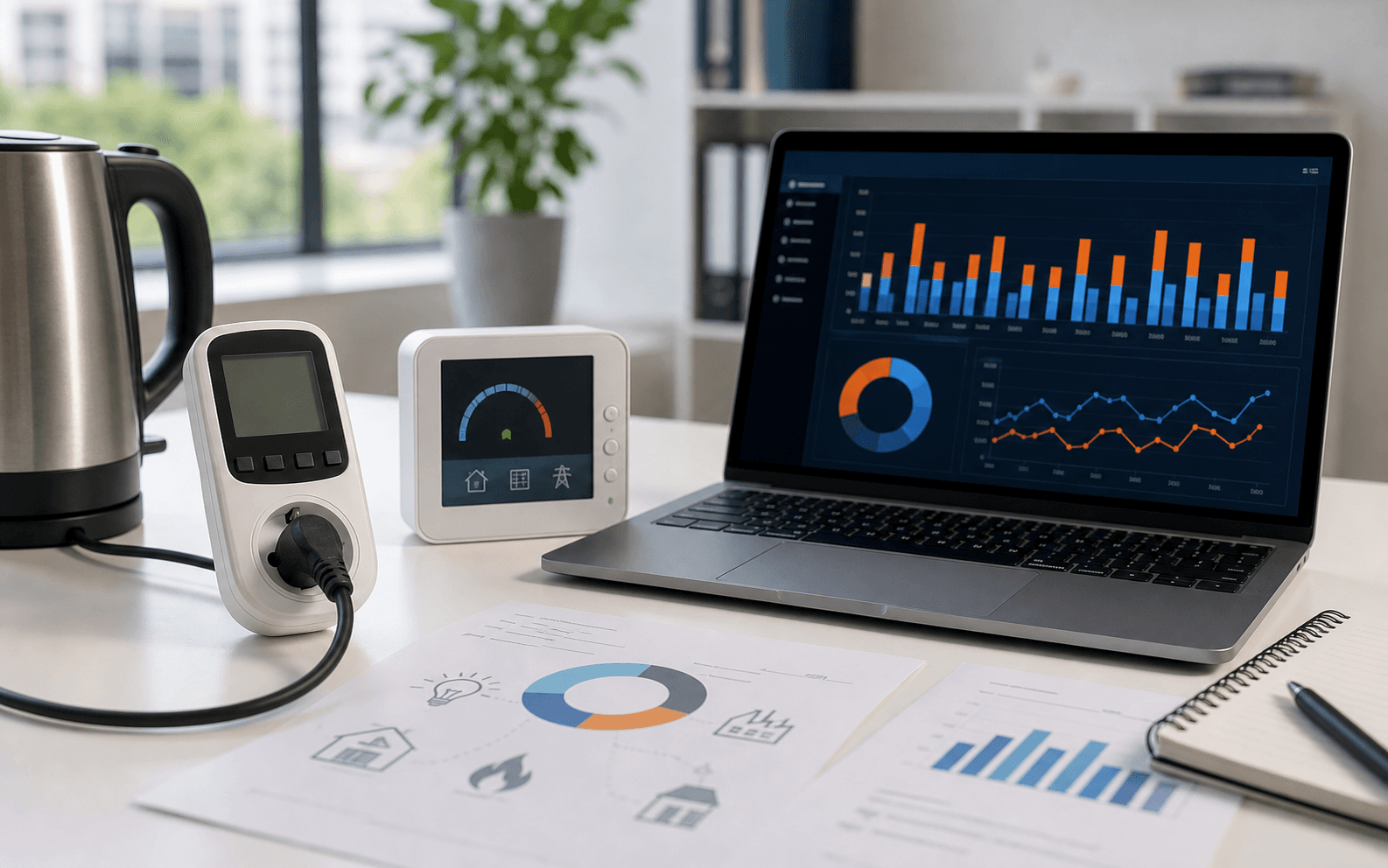
What is a kilowatt-hour kWh: scattered information versus Energy Intelligence
The unit kWh appears on almost every energy bill and every electricity quote. Yet many business owners are unsure what that number actually represents. Suppose you leave a 1,000-watt coffee machine on for an hour. You have then used exactly 1 kilowatt-hour. Anyone who wants to understand, manage or compare their consumption cannot avoid this unit. It is the accounting unit for practically everything to do with electricity.
- 1 kilowatt-hour is a 1,000-watt appliance running for one hour, or a 100-watt appliance running for ten hours.
- The formula is simple: power in kilowatts times the running time in hours gives consumption in kilowatt-hours.
- Your energy bill and your meter reading settle electricity in kilowatt-hours; gas is settled in cubic metres.
Insight
Traditional approach
Information is scattered across portals, documents, invoices or separate spreadsheets.
Modern approach
Data, context and interpretation are brought together into a clear decision picture.
Decision-making
Traditional approach
Choices are made based on averages, assumptions or occasional analyses.
Modern approach
Scenarios, KPIs and current measurement data make the trade-off more concrete and repeatable.
Follow-up
Traditional approach
Actions often stay non-committal or disappear into separate reports.
Modern approach
Follow-up actions, monitoring and reporting are linked to the same energy data.
How do you calculate a kilowatt-hour?
A kilowatt-hour comes from two things together: how much power an appliance draws and how long it runs. Power is expressed in watts or kilowatts; 1,000 watts equals 1 kilowatt. Time is expressed in hours. Multiply the two and you have consumption in kilowatt-hours. A 2,000-watt heating element running for half an hour uses 2 kilowatts times 0.5 hours, so 1 kilowatt-hour. A 10-watt LED lamp burning for a hundred hours arrives at the same 1 kilowatt-hour. A small power for a long time, or a large power for a short time: the result can be the same.
- Power (kilowatts) times time (hours) is consumption (kilowatt-hours).
- 1,000 watts equals 1 kilowatt.
- A 2,000-watt appliance running for half an hour uses 1 kilowatt-hour.
- A 10-watt appliance running for a hundred hours also uses 1 kilowatt-hour.
Where do you encounter the kilowatt-hour?
You mostly encounter the kilowatt-hour on your energy bill and on your meter. The smart meter adds up every consumed kilowatt-hour in the meter reading. The difference between two meter readings is your consumption over that period. Your supplier multiplies that number of kilowatt-hours by the tariff per kilowatt-hour, and that produces the supply part of your bill. If you feed electricity back yourself, for example with solar panels, that feed-in is also counted in kilowatt-hours. On quotes, annual statements and consumption overviews, the kilowatt-hour is therefore always the measure in which electricity is expressed.
- The meter reading adds up consumption in kilowatt-hours.
- Consumption is the difference between two meter readings.
- The supply part of the bill is the number of kilowatt-hours times the tariff per kilowatt-hour.
- Feed-in from solar panels is also measured in kilowatt-hours.
What is the difference with power (kW)?
Kilowatts and kilowatt-hours are often confused, but they measure different things. A kilowatt (kW) is power: how hard an appliance draws electricity at a single moment. A kilowatt-hour (kWh) is energy: how much it has consumed over a period. A tap is a good comparison. The power is how far you open the tap, the flow rate at that moment. The energy is how much water has run through the tap in total. For your connection, power matters, because it determines the peak the grid must handle. For your energy bill, the number of kilowatt-hours matters most, because that is what you have actually consumed.
- A kilowatt is power at a single moment; a kilowatt-hour is energy over a period.
- Power determines the peak of your connection; consumption determines your bill.
- Compare power with how far the tap is open, and energy with the total amount of water.
- The same power can produce many or few kilowatt-hours, depending on the time.
Curious what this looks like with your own data?
In a no-obligation call, a specialist looks at your meters, sites and energy questions with you. Response within one business day.
Search the knowledge base
Find the answer to your question.
Search using your own words. Abbreviations and spelling variants are recognised, so EMS also finds the articles on energy management systems.
Topic