
Heat recovery (HRV): a guide for businesses
Direct answer
Heat recovery, often abbreviated as WTW in the Netherlands, is the capture of heat from outgoing air, water or flue gases and its return into your own building or process. Instead of discarding the heat, you reuse it, for example to preheat fresh ventilation air or cold water. Energy consumption drops without any change to comfort or production.
- Clear definition
- Data-driven assessment
- Risks and opportunities visible
- Practical next steps
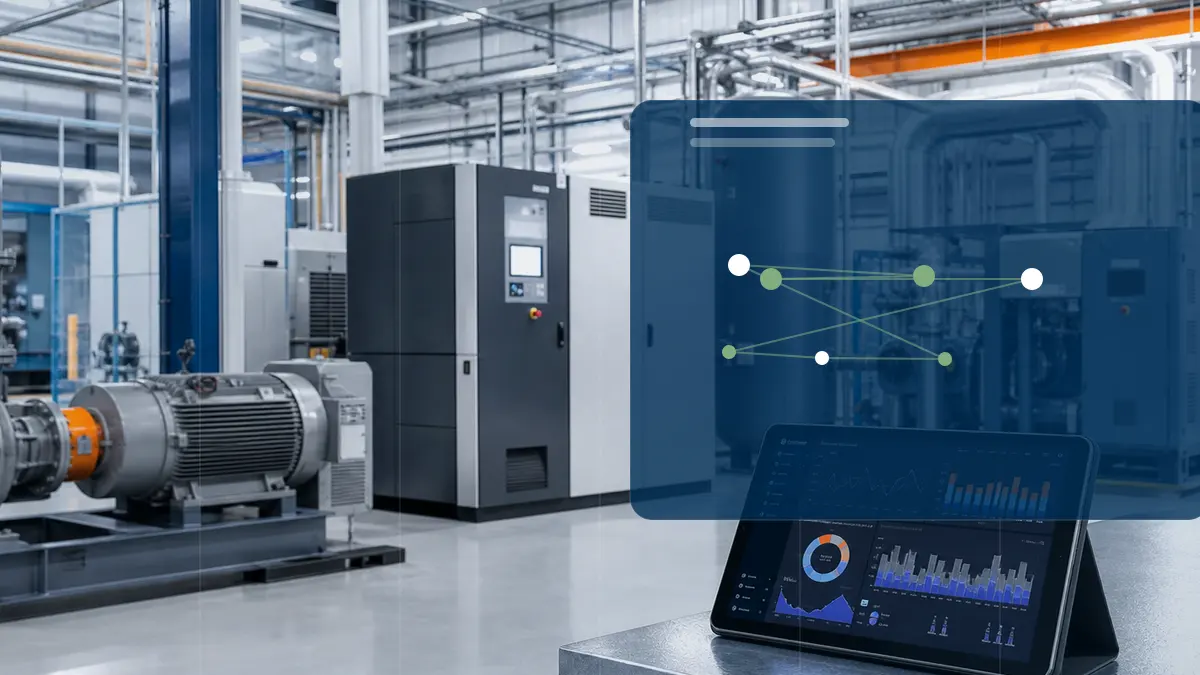
Heat recovery (HRV): scattered information versus Energy Intelligence
Every building and every production process continuously discharges heat. Ventilation blows warmed indoor air outside, shower water disappears warm into the sewer, and a compressor room often literally blows out heat. That heat has already been paid for, through the boiler, the heat pump or the electric motor. Technology exists to limit that loss. The subject is relevant across the board: offices and schools with mechanical ventilation, hospitality, sports and care facilities with high hot water use, and industry with steam boilers, compressors and cooling installations.
- A heat recovery unit in the ventilation system uses the warmth of extracted indoor air to preheat fresh outdoor air, through a cross-flow exchanger, counter-flow exchanger or thermal wheel.
- Shower water, flue gases, compressed air and process water also contain heat that a heat exchanger can recover for tap water, boiler feed water or space heating.
- Several forms of heat recovery appear on the Dutch List of Recognised Measures (EML); businesses covered by the Dutch energy-saving obligation must take such measures when they apply to their situation.
Insight
Traditional approach
Information is scattered across portals, documents, invoices or separate spreadsheets.
Modern approach
Data, context and interpretation are brought together into a clear decision picture.
Decision-making
Traditional approach
Choices are made based on averages, assumptions or occasional analyses.
Modern approach
Scenarios, KPIs and current measurement data make the trade-off more concrete and repeatable.
Follow-up
Traditional approach
Actions often stay non-committal or disappear into separate reports.
Modern approach
Follow-up actions, monitoring and reporting are linked to the same energy data.
How does heat recovery work?
The core is almost always a heat exchanger: two flows pass close to each other without mixing, and the warm flow transfers heat to the cold one. In ventilation, a heat recovery unit does this with a cross-flow or counter-flow plate exchanger, or with a slowly rotating thermal wheel. The extracted indoor air preheats the fresh outdoor air. Water works on the same principle: a shower or waste-water heat recovery device lets warm drain water flow past cold mains water. On a steam boiler the exchanger sits in the flue: an economiser preheats the boiler feed water with hot flue gases, and a flue gas condenser then extracts additional heat from the water vapour. In a compressed air compressor, almost all of the electrical energy consumed is released as heat; with compressor heat recovery you use it as warm air or as warm water.
- A heat exchanger transfers heat between two flows that never touch.
- In ventilation: a cross-flow exchanger, counter-flow exchanger or thermal wheel inside a heat recovery unit.
- In water: shower and waste-water heat recovery devices preheat cold mains water.
- On boilers: an economiser or flue gas condenser recovers heat from flue gases.
- Compressors and cooling installations yield recoverable heat as warm air or warm water.
Where are the gains, and what does the EML say?
The gains sit wherever you currently pay to warm something up that could be preheated for free. Ventilation air is the best-known case: a good counter-flow exchanger returns most of the heat in the extracted air to the supply air. Hot tap water is the second: preheated shower or process water needs less gas or electricity. Industry adds boiler feed water, plus space heating using the heat from compressors or cooling machines. Heat recovery is also not optional in the Netherlands. The Dutch energy-saving obligation currently applies to sites consuming from 50,000 kilowatt hours of electricity or 25,000 cubic metres of natural gas per year. They must take all measures that pay for themselves within five years. The List of Recognised Measures includes several heat recovery measures, among them the economiser on the steam boiler and heat recovery from compressed air.
- Preheating ventilation air strongly limits the heat loss of mechanical ventilation.
- Preheated tap water or process water needs less gas or electricity to reach temperature.
- Compressor heat can serve space heating or hot water within your own business.
- The Dutch energy-saving obligation currently applies from 50,000 kilowatt hours or 25,000 cubic metres of gas per year.
- The List of Recognised Measures contains several heat recovery measures with a payback within five years.
What should you watch out for?
Three factors determine whether heat recovery delivers what you expect in practice. First, the temperature level: recovered heat is often lukewarm rather than hot. It is fine for preheating air or water, but not for a process that requires high temperatures. Second, simultaneity: the heat must be needed at the moment it is released; otherwise a buffer tank or another destination is required. Third, fouling: greasy kitchen air, dust and waste water build up in the exchanger, reducing its performance. Plan for periodic cleaning and filter replacement. Also think of summer: then you want to get rid of the heat. A summer bypass routes the air around the exchanger, so cooler outdoor air comes straight in. If heat is structurally left over without any internal demand, supplying residual heat to external parties is a separate subject.
- Recovered heat is often low-grade: suitable for preheating, not for high process temperatures.
- Heat supply and heat demand must coincide in time, otherwise buffering is needed.
- Fouled exchangers and filters reduce performance; schedule maintenance and cleaning.
- A summer bypass prevents the heat recovery unit from recovering heat when you do not want it.
- No remaining internal heat demand: that becomes external use of residual heat, a different subject.
Curious what this looks like with your own data?
In a no-obligation call, a specialist looks at your meters, sites and energy questions with you. Response within one business day.
Search the knowledge base
Find the answer to your question.
Search using your own words. Abbreviations and spelling variants are recognised, so EMS also finds the articles on energy management systems.
Topic