
Making the food industry more sustainable: a guide for businesses
Direct answer
Making the food industry more sustainable means replacing gas-fired process heat, step by step, with savings, heat recovery and electric technologies such as industrial heat pumps and e-boilers. The sector is well suited to this: many process steps, such as cooking, pasteurising, drying and cleaning, require heat at relatively low temperatures. There is also extensive cooling, and its residual heat can be reused in the process.
- Clear definition
- Data-driven assessment
- Risks and opportunities visible
- Practical next steps
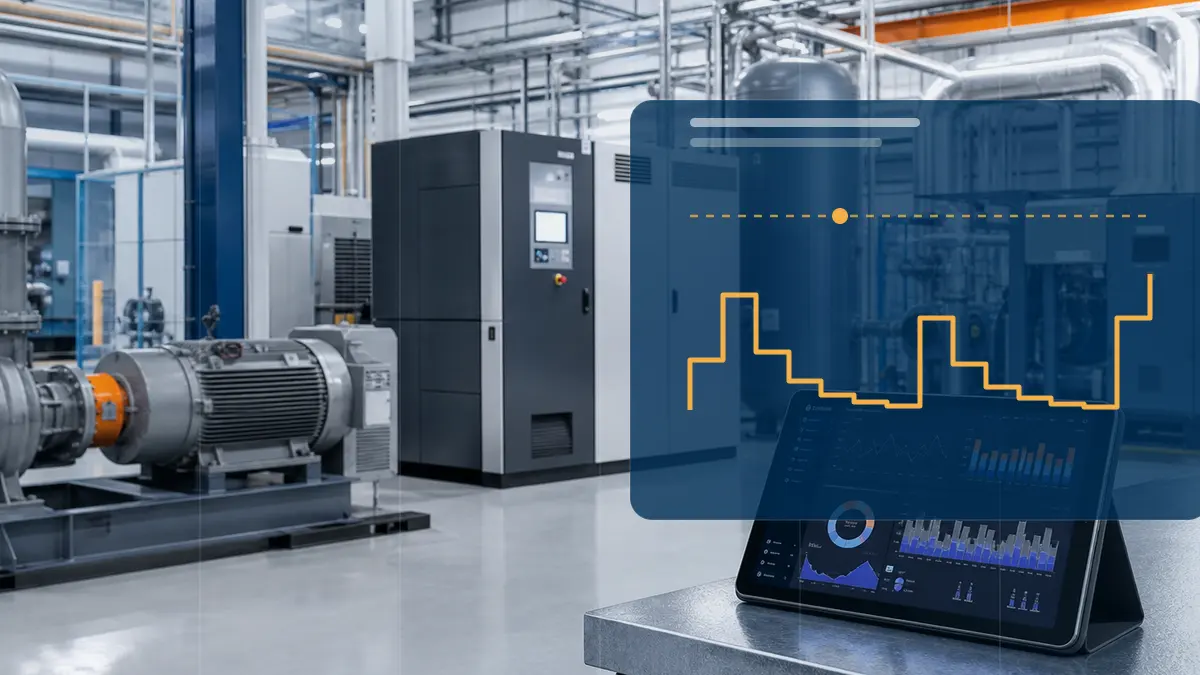
Making the food industry more sustainable: scattered information versus Energy Intelligence
In a food factory, heat and cold literally stand side by side. Steam runs to cooking vessels and cleaning installations, while cold stores and freezing tunnels operate day and night just metres away. Almost all of that heat still comes from natural gas. The pressure comes from two directions: large customers ask for a smaller footprint in their supply chain, and Dutch law demands demonstrable savings. This article explains why this sector is well placed to electrify, which routes exist and what to watch during implementation.
- Heat demand at low and medium temperatures, such as for cooking, pasteurising and drying, can be met without natural gas using industrial heat pumps and e-boilers.
- The logical order is to save energy and recover heat first, then electrify: every kilowatt-hour saved never needs to be generated or purchased.
- If your business uses more than 50,000 kilowatt-hours of electricity or 25,000 cubic metres of natural gas per year, the Dutch energy saving obligation requires all measures that pay back within five years.
Insight
Traditional approach
Information is scattered across portals, documents, invoices or separate spreadsheets.
Modern approach
Data, context and interpretation are brought together into a clear decision picture.
Decision-making
Traditional approach
Choices are made based on averages, assumptions or occasional analyses.
Modern approach
Scenarios, KPIs and current measurement data make the trade-off more concrete and repeatable.
Follow-up
Traditional approach
Actions often stay non-committal or disappear into separate reports.
Modern approach
Follow-up actions, monitoring and reporting are linked to the same energy data.
Why is the food industry well suited to electrification?
Because many process steps require heat at low or medium temperatures. Think of cooking, pasteurising, drying and cleaning installations. Mature electric alternatives exist for those temperatures, with the industrial heat pump leading the way. At the same time, the sector cools intensively: cold stores, freezing tunnels and process cooling often run continuously. That combination is favourable. A heat pump can upgrade the heat released during cooling and feed it back into the process. One installation then delivers cooling and heating at the same time. This is already happening in the Dutch dairy sector: some factories pasteurise milk with heat from a heat pump, without steam from a gas boiler. As a rule of thumb: the lower the required temperature, the more efficiently a heat pump operates and the stronger the case for electrification.
- Cooking, pasteurising, drying and cleaning require heat at low or medium temperatures.
- Industrial heat pumps are a proven alternative to gas boilers at those temperatures.
- Residual heat from cooling installations can be upgraded and reused in the process.
- Dutch dairy factories already pasteurise with heat pump heat instead of steam from a gas boiler.
Which routes are there to become more sustainable?
The order matters. Start with process optimisation: tune installations properly, close heat losses and only heat or cool when it is actually needed. Then recover heat, for example from the condensers of cooling installations, from waste water or from vapours released in drying processes. Every kilowatt-hour saved this way never needs to be electrified later. Next, deploy industrial heat pumps for the process steps at lower temperatures. For steps that require steam, an electric boiler can replace or supplement the gas boiler. Renew outdated cooling installations and use their residual heat, for example for cleaning water or space heating. Finally, solar panels on the roof cover part of the increased electricity demand. Dutch government subsidy schemes currently support many of these steps.
- Start with process optimisation: better tuning, closing losses, switching off outside production hours.
- Recover heat from cooling condensers, waste water and drying vapours.
- Industrial heat pumps cover the heat demand at lower temperatures.
- An e-boiler can supply steam where a heat pump is not sufficient.
- Rooftop solar covers part of the additional electricity demand.
What should you take into account?
The pressure to act comes from two directions. From the law: if your business uses more than 50,000 kilowatt-hours of electricity or 25,000 cubic metres of natural gas per year, the Dutch energy saving obligation applies. You must then take all measures that pay back within five years, and report on them under the accompanying information duty. From the supply chain: large customers report on their chain under European sustainability rules such as the CSRD, and ask suppliers for figures and improvement plans. During implementation, keep three things in mind. Food safety: temperatures and process times are fixed in your quality system, so every change must be validated again. Continuity: plan conversions during scheduled production stops. Grid capacity: electrification increases the demand on your connection, and in Dutch congestion areas extra transport capacity is not always immediately available.
- The Dutch energy saving obligation applies above 50,000 kilowatt-hours of electricity or 25,000 cubic metres of gas per year.
- Customers use CSRD chain requirements to ask suppliers for energy figures and improvement plans.
- Changes to heating processes must be validated again for food safety.
- Plan conversions during scheduled production stops to limit downtime.
- Check early whether your grid connection can handle the additional electricity demand.
Curious what this looks like with your own data?
In a no-obligation call, a specialist looks at your meters, sites and energy questions with you. Response within one business day.
Search the knowledge base
Find the answer to your question.
Search using your own words. Abbreviations and spelling variants are recognised, so EMS also finds the articles on energy management systems.
Topic