
Energy management in manufacturing: a guide for businesses
Direct answer
Energy management in manufacturing is the structural measuring, analysing and improving of energy use in the production process. The core: making consumption visible per machine or production line and linking it to production data, so that energy per unit of product becomes a controllable indicator. This reveals the big items, such as compressed air, drives, process heat and standby consumption, so you can tackle them directly.
- Clear definition
- Data-driven assessment
- Risks and opportunities visible
- Practical next steps
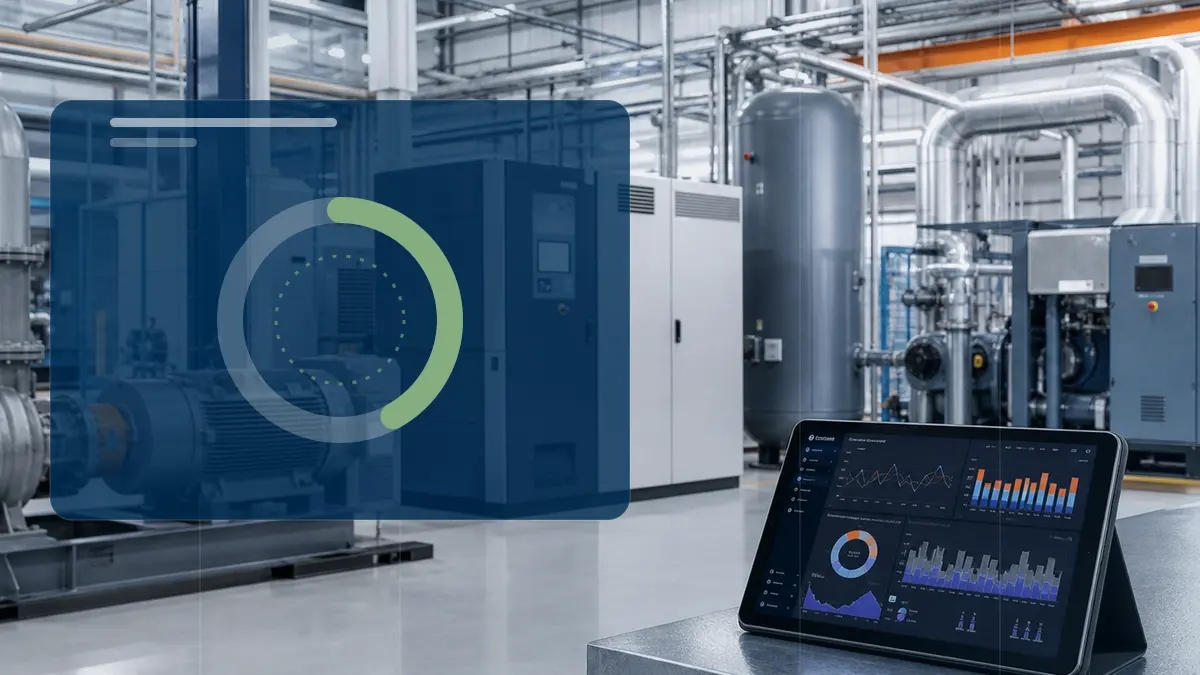
Energy management in manufacturing: scattered information versus Energy Intelligence
In many manufacturing companies, energy was long a fixed fact of life: the bill arrived and was paid. Rising costs, grid congestion and legal obligations in the Netherlands have ended that. Meanwhile, the shop floor picture is familiar: the compressor keeps running at the weekend, the extraction system stays on at night and nobody knows which line is the biggest consumer. Turning that consumption into an everyday steering figure, just like downtime or lead time, is what creates control.
- Submetering per machine or line shows where consumption really occurs; a main meter alone hides creeping loads and standby use outside production hours.
- Energy per unit of product is the key indicator: by linking consumption to production data you can see whether a line is becoming more or less efficient.
- Compressed air, drives, process heat and standby consumption are almost always the biggest items in manufacturing; the Dutch Recognised Measures List contains measures for each of these with which you can meet the energy saving obligation.
Insight
Traditional approach
Information is scattered across portals, documents, invoices or separate spreadsheets.
Modern approach
Data, context and interpretation are brought together into a clear decision picture.
Decision-making
Traditional approach
Choices are made based on averages, assumptions or occasional analyses.
Modern approach
Scenarios, KPIs and current measurement data make the trade-off more concrete and repeatable.
Follow-up
Traditional approach
Actions often stay non-committal or disappear into separate reports.
Modern approach
Follow-up actions, monitoring and reporting are linked to the same energy data.
How do you measure energy use in a production environment?
Start at the main meter, but do not stop there. A main meter only shows the total and hides where consumption originates. Submetering, meaning separate meters per machine, line or department, reveals that breakdown. Often a small share of the installations causes most of the consumption. The next step is linking to production data: how much energy does one product, one batch or one tonne of output cost. That indicator corrects for busy and quiet periods. If consumption per unit rises, something is genuinely wrong: fouling, wear or an incorrect setting. Without that link, a quiet month can easily look like a saving, while the installations have not actually started performing better.
- Submetering per machine, line or department shows where consumption originates.
- Energy per unit of product corrects for production volume and makes periods comparable.
- Measure outside production hours too: nights and weekends expose creeping loads.
- A rising indicator often points to wear, fouling or incorrect settings.
Which items deliver the most in manufacturing?
Almost every production hall shows the same big items. Compressed air is notorious: leaks and excessive working pressure cost energy continuously, even when nothing is being produced. Electric motors and drives often account for the largest share of electricity use; variable speed control and correct sizing make a difference there. Process heat and cooling are major gas and electricity items, where insulation, heat recovery and appropriate temperature settings pay off. Finally there is standby consumption: machines, extraction and lighting that keep running outside production hours. Many of these measures appear on the Dutch government's Recognised Measures List. If your site falls under the energy saving obligation, you are currently required to implement the applicable measures with a payback period of five years or less.
- Trace compressed air leaks and lower the working pressure to what the process actually needs.
- For motors and drives, look at variable speed control and correct sizing.
- Limit losses in process heat and cooling with insulation and heat recovery.
- Demonstrably switch off installations outside production hours and check the effect in the nighttime base load.
How do you embed energy management in planning and organisation?
Energy management only becomes structural once it is part of planning and organisation. In planning, you can weigh energy in the batch sequence, for example by clustering heat-up and changeover moments, and limit peaks by not starting large consumers at the same time. Some processes can run flexibly at moments when the electricity grid is under less strain. In the organisation, the consumption of a line belongs to the team operating that line, just like quality and safety. Legally, this connects to the Dutch energy saving obligation and, for sites with a large annual consumption, the investigation obligation. Those who want to go further embed it all in an energy management system under ISO 50001. One boundary remains: product quality and process safety always come first.
- Weigh energy in the batch sequence and avoid starting large consumers simultaneously.
- Place responsibility for a line's consumption with the team that runs the line.
- Check whether the energy saving obligation and the investigation obligation apply to your site.
- ISO 50001 offers a structure for embedding, but is not a precondition for starting.
- Product quality and process safety remain leading over energy targets.
Curious what this looks like with your own data?
In a no-obligation call, a specialist looks at your meters, sites and energy questions with you. Response within one business day.
Search the knowledge base
Find the answer to your question.
Search using your own words. Abbreviations and spelling variants are recognised, so EMS also finds the articles on energy management systems.
Topic