
Heat pumps as a flex source: a guide for businesses
Direct answer
A heat pump as a flexibility source is a heat pump whose running moments you shift without changing the indoor climate. Because a building and a heat or cold buffer retain heat, you can preheat or precool when prices are low or there is plenty of sun, and throttle back during a peak. In this way heat becomes a controllable load rather than a fixed one.
- Clear definition
- Data-driven assessment
- Risks and opportunities visible
- Practical next steps
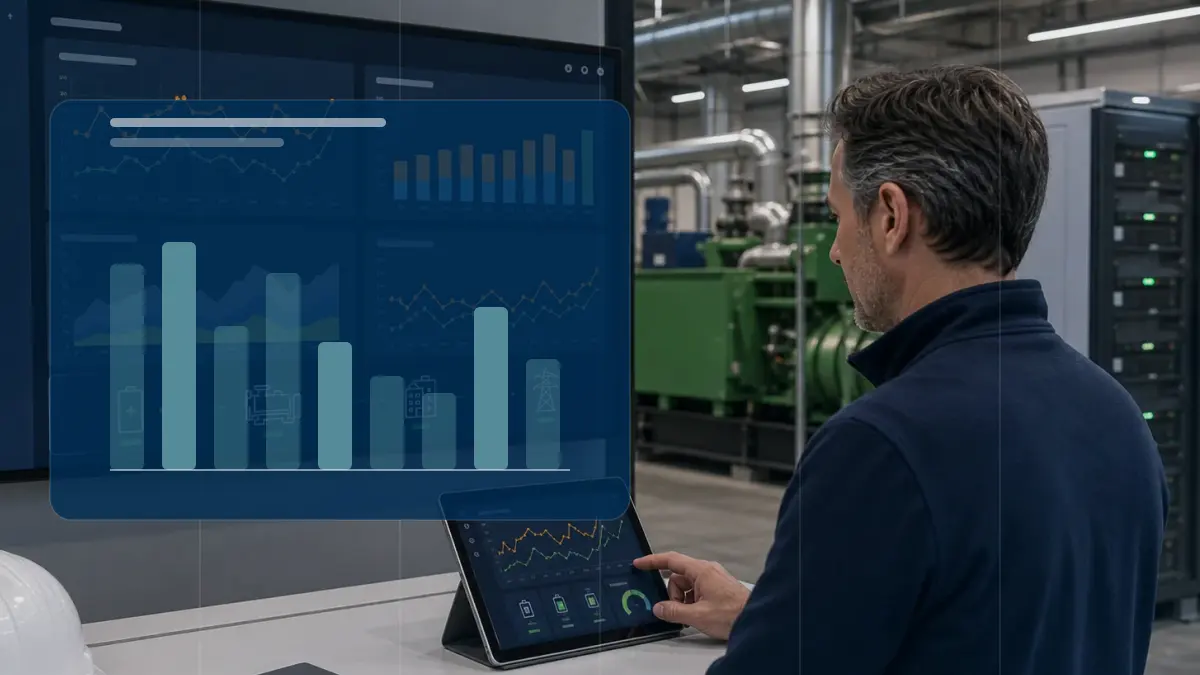
Heat pumps as a flex source: scattered information versus Energy Intelligence
The number of heat pumps keeps rising, and together with solar panels and electric cars they often load the grid at the same moments. Yet a heat pump does not consume the same amount every hour: a building's heat demand moves slowly. Think of an office that warms up early in the morning while the price is still high. Anyone who can shift that consumption relieves the grid and uses cheaper or greener power. This matters to building owners with a larger heat pump installation.
- Heat can be shifted in time: a building and a buffer tank hold heat or cold for hours, so you can warm up earlier or later without loss of comfort.
- You use this with smart control that links the heat pump to price, weather and grid load, often together with a dynamic or flexible contract.
- The limit is comfort and the connection: the building must stay within the desired temperature and the power must stay within the connection capacity.
Insight
Traditional approach
Information is scattered across portals, documents, invoices or separate spreadsheets.
Modern approach
Data, context and interpretation are brought together into a clear decision picture.
Decision-making
Traditional approach
Choices are made based on averages, assumptions or occasional analyses.
Modern approach
Scenarios, KPIs and current measurement data make the trade-off more concrete and repeatable.
Follow-up
Traditional approach
Actions often stay non-committal or disappear into separate reports.
Modern approach
Follow-up actions, monitoring and reporting are linked to the same energy data.
Why does a heat pump offer flexibility?
A heat pump provides flexibility because heat can be stored, which decouples the moment of consumption from the moment of demand. A well-insulated building acts as a buffer in itself: the mass of floors and walls holds heat or cold for hours. A heat or cold buffer tank enlarges that storage further. This lets you preheat or precool when electricity is cheap or there is plenty of sun and wind, and throttle the power back during a price peak or grid peak. Meanwhile the indoor climate stays within the set limits. For the grid, what matters most is that the peak shifts; the total heat demand barely changes. Heat becomes a controllable load.
- The building mass and a buffer tank hold heat or cold for hours.
- Preheat or precool when prices are low or there is plenty of sun or wind.
- Throttle the power back during a price peak or grid peak.
- Consumption shifts in time; the total heat demand stays almost the same.
- The indoor climate stays within the set comfort limits.
How does a business use this?
A business uses the flexibility with smart control that links the heat pump to external signals: the electricity price, the weather and the load on the grid. An energy management system gives insight into consumption and switches the installation up or back at the right moments. This often goes together with a dynamic energy contract, in which the price moves per hour, or with a flexible contract with the grid operator. Under such a flexible contract you adjust your consumption on request and receive compensation or a discount in return. Thermal storage, in the building mass or a buffer tank, gives the control room to manoeuvre: the more heat you can buffer ahead, the longer you can bridge a peak.
- Smart control via an energy management system, linked to price, weather and grid.
- Combine with a dynamic energy contract that moves per hour.
- A flexible contract with the grid operator yields compensation or a discount.
- Thermal storage in building mass or a buffer tank widens the room to manoeuvre.
- More buffer room means you can bridge a peak for longer.
Where are the limits and points of attention?
The main limit is comfort: the room temperature and, in buildings with a process, the hot water demand may not move outside the desired margin. That margin determines how much you can shift. A second point is the control technology: the heat pump and the building management system must be able to handle external control, and the measurement data must be correct. Connection capacity is a limit too. Preheating at full power can cause a new peak that your connection cannot handle, so the control must cap the requested power. Finally, the gain depends on your profile: a building that retains little heat, or an installation without a buffer, offers less room to shift.
- Comfort is the upper limit: keep temperature and hot water demand within the margin.
- The control technology must handle external control and reliable measurement data.
- Preheating at full power must not exceed the connection capacity.
- A poorly insulated building or an installation without a buffer offers less room.
- The return depends on your heat profile and the available storage.
Curious what this looks like with your own data?
In a no-obligation call, a specialist looks at your meters, sites and energy questions with you. Response within one business day.
Search the knowledge base
Find the answer to your question.
Search using your own words. Abbreviations and spelling variants are recognised, so EMS also finds the articles on energy management systems.
Topic