
Virtual power plant (VPP): a guide for businesses
Direct answer
A virtual power plant is a software-linked collection of distributed energy resources, such as batteries, combined heat and power units, rooftop solar and flexible load, that act together as one controllable whole on the energy markets. A central control system bundles and optimises these resources, so together they can deliver flexibility and balancing services that a single installation is too small to provide.
- Clear definition
- Data-driven assessment
- Risks and opportunities visible
- Practical next steps
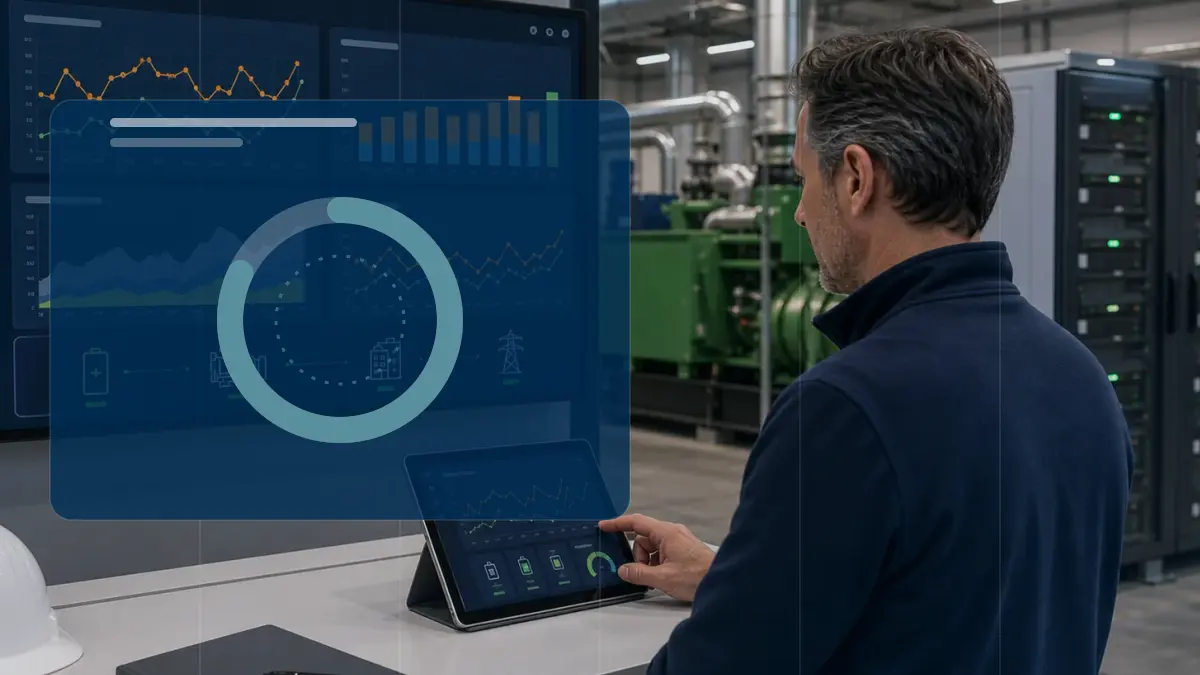
Virtual power plant (VPP): scattered information versus Energy Intelligence
The Dutch electricity grid is filling up and generation is becoming more variable. This raises the demand for flexibility: resources that can switch on or off at the right moment. Individual installations are often too small or too erratic for that. Think of a business with a battery, a roof full of solar panels and a cooling installation that can pause briefly. On their own they amount to little. A virtual power plant links such resources together, so that jointly they do form serious, controllable capacity.
- A virtual power plant bundles separate resources, such as batteries, CHP units, rooftop solar and flexible consumption, into one controllable whole through central software.
- The linked whole behaves towards the market and the grid operator as a single power plant and can offer flexibility and balancing services.
- A virtual power plant is the technical bundling and control; an aggregator is the market party that trades that bundled flexibility.
Insight
Traditional approach
Information is scattered across portals, documents, invoices or separate spreadsheets.
Modern approach
Data, context and interpretation are brought together into a clear decision picture.
Decision-making
Traditional approach
Choices are made based on averages, assumptions or occasional analyses.
Modern approach
Scenarios, KPIs and current measurement data make the trade-off more concrete and repeatable.
Follow-up
Traditional approach
Actions often stay non-committal or disappear into separate reports.
Modern approach
Follow-up actions, monitoring and reporting are linked to the same energy data.
How does a virtual power plant work?
A virtual power plant links distributed resources through software to a central control system. That system continuously measures what each resource does and controls them remotely. It optimises the whole: it lets a battery discharge, a combined heat and power unit ramp up, or a flexible load ease off, depending on the price and the needs on the grid. Towards the market and the grid operator, the bundle behaves as one controllable power plant that can modulate faster than a large conventional installation. This way the whole delivers services that the separate parts cannot. The resources remain owned by their owners; only the control and optimisation are centralised.
- Central software measures each connected resource and controls it remotely.
- The system optimises on price and grid needs: charge, discharge, switch on or off.
- The bundle behaves towards market and grid operator as one controllable power plant.
- The separate resources stay with their owners; only the control is shared.
Why does a business take part?
Many businesses have controllable capacity that sits unused: a backup generator, a battery, a CHP unit or a process that can wait a while. On its own that capacity is too small to enter the markets for balancing and flexibility. A virtual power plant bundles your resource with those of others into a package that is large and reliable enough. This way your unused flexibility can take part in services that help keep the grid in balance. For businesses in an area with grid congestion this is attractive, because smart switching can lower the load on the connection and relieve the grid at busy moments.
- Small, unused controllable capacity becomes marketable through bundling.
- You do not have to arrange complex market access and control yourself.
- Smart switching can lower the peak load on your connection.
- In areas with grid congestion, bundled flexibility helps relieve the grid.
What is the difference with an aggregator, and where are the limits?
A virtual power plant and an aggregator are often used interchangeably, but they denote different things. The virtual power plant is the technical bundling and control: the platform and software that link, measure and optimise the resources. The aggregator is the market role: the party that contracts the bundled flexibility and trades it on the markets for balancing and flexibility. Often one company fulfils both, but the distinction remains useful. The approach has limits. Everything depends on reliable ICT: connections, measurement data and control must be correct, because a missed or wrong control command undermines reliability. Each resource must also do what was promised, otherwise the bundle does not deliver what was sold.
- Virtual power plant = the technical bundling and control of the resources.
- Aggregator = the market party that trades the bundled flexibility.
- Often one company does both, but the terms are not the same.
- Reliable ICT and connections are crucial; an outage undermines the service.
- Each resource must deliver what was promised, or the whole does not add up.
Curious what this looks like with your own data?
In a no-obligation call, a specialist looks at your meters, sites and energy questions with you. Response within one business day.
Search the knowledge base
Find the answer to your question.
Search using your own words. Abbreviations and spelling variants are recognised, so EMS also finds the articles on energy management systems.
Topic