
Real estate
Article 5 of 16 · Buildings and real estateMaking an office more sustainable: a roadmap: a guide for businesses
Direct answer
Making an office building more sustainable works best in five steps: first insight into your energy use and legal obligations, then quick wins, then the building envelope, then the installations, and finally on-site generation with monitoring. This order prevents investing in a heavy heat pump while the building still leaks heat. In the Netherlands, many offices also face legal duties such as the energy label C requirement and the energy saving obligation.
- Clear definition
- Data-driven assessment
- Risks and opportunities visible
- Practical next steps
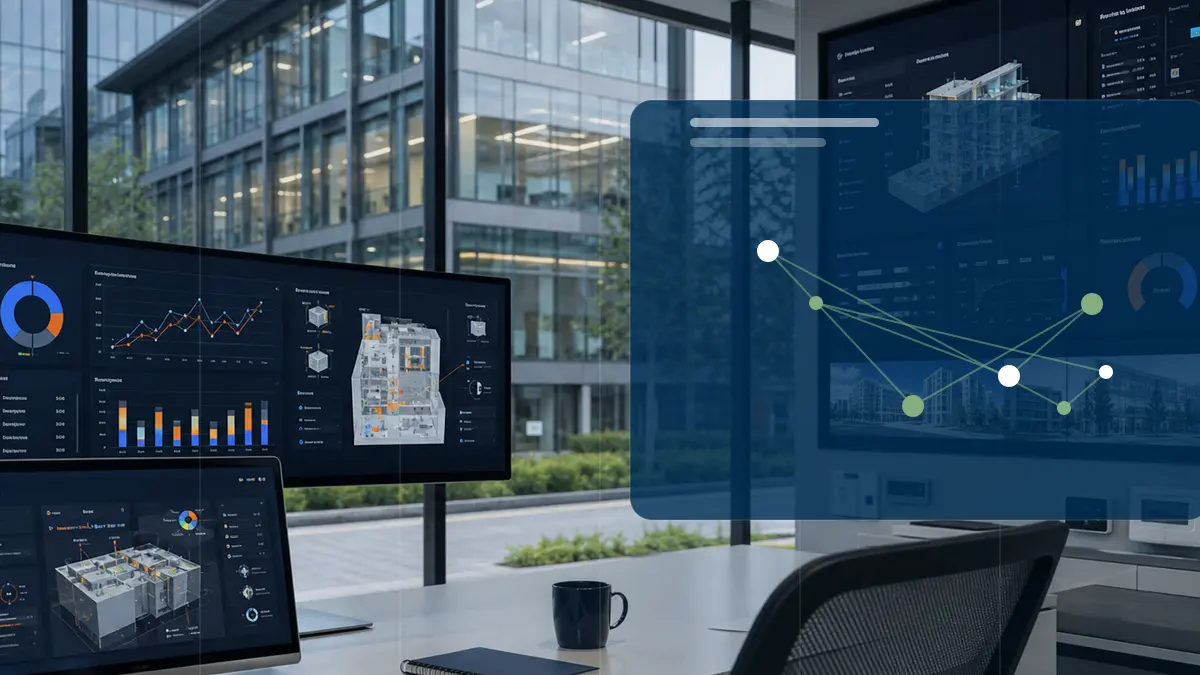
Making an office more sustainable: a roadmap: scattered information versus Energy Intelligence
Many offices use more energy than necessary: the heating runs at weekends, lights burn in empty rooms and the climate installation was never properly tuned. At the same time, the Dutch government keeps raising the requirements for office buildings. Owners and tenants want to act, but often do not know where to start. A fixed sequence of steps helps: you first do what is quick and simple, and plan major work for moments when rebuilding or replacement is happening anyway.
- Start with measuring and with your obligations: Dutch office buildings of 100 square metres or more must have at least energy label C to be used as an office.
- Follow the order insight, quick wins, building envelope, installations and generation: insulating and fine-tuning first reduces the heat demand, so a lighter heating system is enough.
- Link larger measures to natural moments, such as a renovation, the end of a maintenance contract or the replacement of a worn-out boiler.
Insight
Traditional approach
Information is scattered across portals, documents, invoices or separate spreadsheets.
Modern approach
Data, context and interpretation are brought together into a clear decision picture.
Decision-making
Traditional approach
Choices are made based on averages, assumptions or occasional analyses.
Modern approach
Scenarios, KPIs and current measurement data make the trade-off more concrete and repeatable.
Follow-up
Traditional approach
Actions often stay non-committal or disappear into separate reports.
Modern approach
Follow-up actions, monitoring and reporting are linked to the same energy data.
Where do you start: insight and obligations
Start by measuring: how much electricity and gas does your office use per year, and at what times? Hourly data from the smart meter shows what the building consumes at night and at weekends, when nobody is there. Then check your energy label in the Dutch EP-online register and your legal duties. Office buildings of 100 square metres or more must have at least energy label C to be used as an office; the municipality or the regional environmental agency can enforce this. If your site uses 50,000 kilowatt hours of electricity or 25,000 cubic metres of natural gas per year or more, the Dutch energy saving obligation applies: you must take all energy saving measures that pay for themselves within five years. The government's Recognised Measures List gives a concrete overview.
- Request hourly data from your energy supplier or metering company and look for idle consumption outside office hours.
- Check your energy label and its validity in the EP-online register.
- Verify whether the label C requirement and the energy saving obligation apply to your building.
- If the energy saving obligation applies, report your measures to RVO once every four years under the information duty.
Which measures do you take, and in what order?
First take the measures that require little intervention: have the climate installation properly tuned, replace lighting with LED and sensors, switch off equipment outside office hours and set heating curves and timer settings more precisely. Behaviour counts too, such as closing doors and not heating unused rooms. Next comes the building envelope: insulation of roof, facade and floor, insulating glazing and external sun shading against summer overheating. Only once the heat demand is down are the installations up. A well insulated office can run on a heat pump or hybrid system with low temperature heat delivery, for example underfloor heating or adapted convectors. Also optimise ventilation with heat recovery and demand control. This order prevents an oversized installation that never runs efficiently.
- Quick wins: tune installations, LED lighting, tackle standby consumption and set precise timer settings.
- Building envelope: insulate roof, facade and floor and install insulating glazing and sun shading.
- Installations: heat pump or hybrid system with low temperature heat delivery.
- Ventilation: heat recovery and demand control based on CO2 or occupancy.
How do you finish: generation, monitoring and natural moments
On-site generation completes the picture. An office roof is often suitable for solar panels; have the load-bearing capacity of the roof structure and the available room on your grid connection checked in advance, especially in Dutch areas with grid congestion. Just as important is safeguarding the results. An energy registration and monitoring system tracks consumption structurally and flags anomalies, such as heating that switches on at the weekend. Appoint someone to follow the figures and adjust, otherwise results slip back over time. Finally, plan larger interventions for natural moments: a renovation, a refurbishment, the end of a lease or maintenance contract, or the moment the boiler needs replacing anyway. That way you combine works and limit disruption for the building's users.
- Have the roof structure and grid connection assessed before installing solar panels.
- Register energy consumption structurally and investigate anomalies immediately.
- Assign follow-up to one responsible person, for example the facility manager.
- Link major measures to renovation, contract renewal or the end of life of installations.
Curious what this looks like with your own data?
In a no-obligation call, a specialist looks at your meters, sites and energy questions with you. Response within one business day.
Search the knowledge base
Find the answer to your question.
Search using your own words. Abbreviations and spelling variants are recognised, so EMS also finds the articles on energy management systems.
Topic