
Real estate
Article 1 of 16 · Buildings and real estateEnergy labels for commercial buildings: a guide for businesses
Direct answer
An energy label shows how energy efficient a commercial building or other non-residential building in the Netherlands is, with a letter from A+++++ down to G. The class is based on primary fossil energy use in kilowatt-hours per square metre per year, calculated with the Dutch NTA 8800 method. The label is mandatory on sale, rental and completion and is registered in the national database EP-online.
- Clear definition
- Data-driven assessment
- Risks and opportunities visible
- Practical next steps
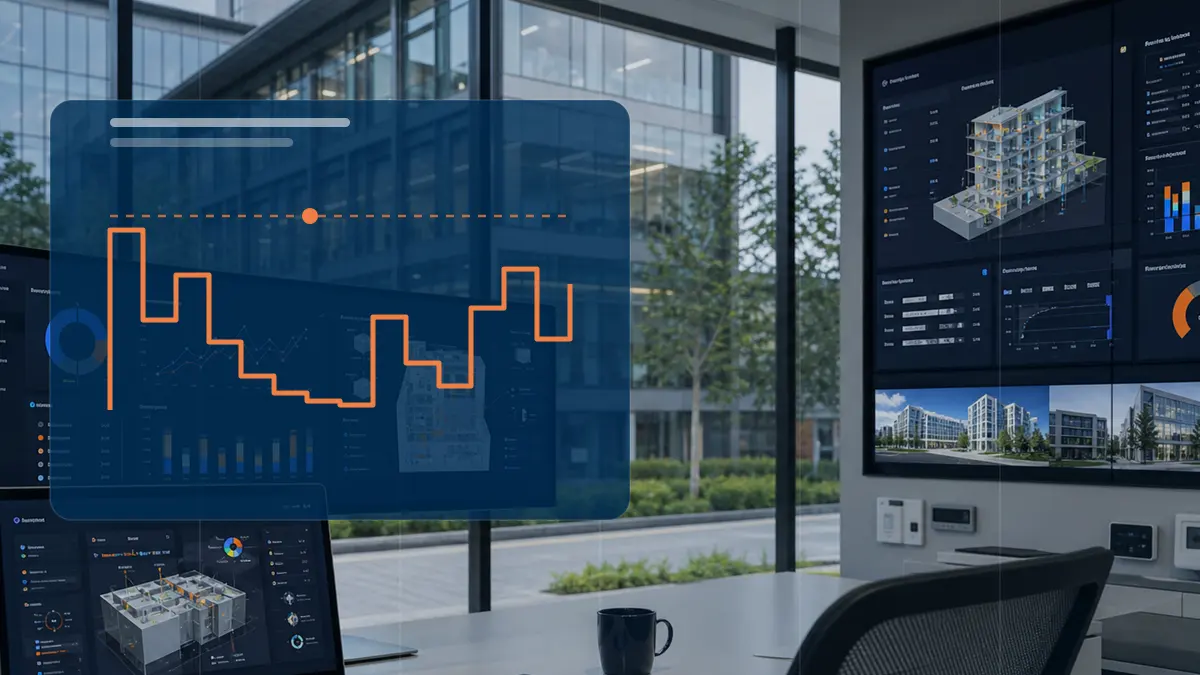
Energy labels for commercial buildings: scattered information versus Energy Intelligence
Non-residential buildings cover all commercial and public real estate not intended for housing: offices, shops, schools, sports halls, care buildings and hotels. In the Netherlands, a legal label obligation applies at transaction moments. Suppose you extend the lease of your business premises or put your building up for sale. At that moment a valid, registered energy label must be available. If it is missing, the owner risks a fine from the Human Environment and Transport Inspectorate (ILT). The label is also a practical starting point for sustainability measures, because it lists concrete improvement options.
- A registered energy label is mandatory on sale, at the start, extension or renewal of a lease, and on completion of a new building; office buildings larger than 100 m2 must also have at least label C.
- Only an energy advisor working for an organisation with a BRL 9500-U certificate may issue the label for non-residential buildings and register it in EP-online.
- The label is valid for a maximum of 10 years and shows, alongside the letter, concrete improvement options for insulation and installations.
Insight
Traditional approach
Information is scattered across portals, documents, invoices or separate spreadsheets.
Modern approach
Data, context and interpretation are brought together into a clear decision picture.
Decision-making
Traditional approach
Choices are made based on averages, assumptions or occasional analyses.
Modern approach
Scenarios, KPIs and current measurement data make the trade-off more concrete and repeatable.
Follow-up
Traditional approach
Actions often stay non-committal or disappear into separate reports.
Modern approach
Follow-up actions, monitoring and reporting are linked to the same energy data.
How is the energy label of a commercial building determined?
The label class follows from the building's primary fossil energy use: the amount of energy from coal, oil and gas, expressed in kilowatt-hours per square metre of usable floor area per year. The less fossil energy the building needs, the better the letter. An energy advisor calculates this value with the Dutch calculation method NTA 8800, which is based on European standards. The advisor assesses the building's characteristics, such as insulation, heating and cooling installations, ventilation and solar panels. The result is registered in EP-online, the Dutch national database for energy labels. The label registered there is leading. Alongside the letter, the label contains an overview of insulation and installations, plus improvement options with points of attention.
- The scale runs from A+++++ (very energy efficient) down to G (inefficient).
- The basis is primary fossil energy use in kWh per m2 per year.
- NTA 8800 has been the calculation method for all Dutch buildings since 2021.
- Registered labels can be looked up in EP-online by postcode and house number.
When is an energy label mandatory?
A valid energy label is mandatory at three transaction moments: on sale, at the start, extension or renewal of a lease, and on completion of a new building or after a major renovation. The obligation applies to buildings with, among others, an office, education, assembly, healthcare, lodging, sports or retail function. Government buildings and office buildings must always have a valid label, even without a transaction. For offices there is an additional requirement: an office building larger than 100 m2 must have at least energy label C. There are exemptions, for example for buildings with an industrial function, buildings used for worship, temporary structures and spaces that are not heated or cooled for people. If you offer a building for sale or rent, you state the label letter and the energy performance indicator in the advertisement.
- Mandatory on sale, rental (including extension or renewal) and completion.
- Office buildings larger than 100 m2 must have at least energy label C.
- Exemptions include industrial functions, places of worship and temporary structures.
- Sale and rental advertisements must state the label letter and energy performance indicator.
- The Human Environment and Transport Inspectorate (ILT) enforces this and can impose a fine.
How do you obtain an energy label and what is it good for?
You engage an energy advisor yourself. For non-residential buildings, only an advisor affiliated with a certifying body and working for an organisation with a BRL 9500-U certificate may issue the label, in practice often called an EPA-U advisor. The advisor surveys the building, for existing buildings via the basic survey and for very energy efficient new buildings via the detailed survey. The advisor then calculates the energy performance and registers the label in EP-online. You receive a digital copy. The label is valid for a maximum of 10 years, so keep an eye on the expiry date. Beyond the legal obligation it offers more: the label makes the energy performance of buildings comparable, and the improvement options provide a substantiated starting point for sustainability plans.
- Find a certified energy advisor, for example via the Dutch Central Register of Technology (Centraal Register Techniek).
- The advisor performs a building survey and registers the label in EP-online.
- Business owners download the copy in EP-online using eHerkenning.
- The energy label is valid for a maximum of 10 years.
Curious what this looks like with your own data?
In a no-obligation call, a specialist looks at your meters, sites and energy questions with you. Response within one business day.
Search the knowledge base
Find the answer to your question.
Search using your own words. Abbreviations and spelling variants are recognised, so EMS also finds the articles on energy management systems.
Topic