
Real estate
Article 9 of 16 · Buildings and real estateHVAC optimisation: a guide for businesses
Direct answer
HVAC optimisation means better tuning and controlling a building's heating, ventilation and air conditioning (HVAC) so that comfort stays the same while energy consumption drops. In most cases nothing is replaced: you adjust the settings, controls and maintenance of existing installations. Think of time schedules, demand-controlled ventilation and hydronic balancing, followed by monitoring to keep the result in place.
- Clear definition
- Data-driven assessment
- Risks and opportunities visible
- Practical next steps
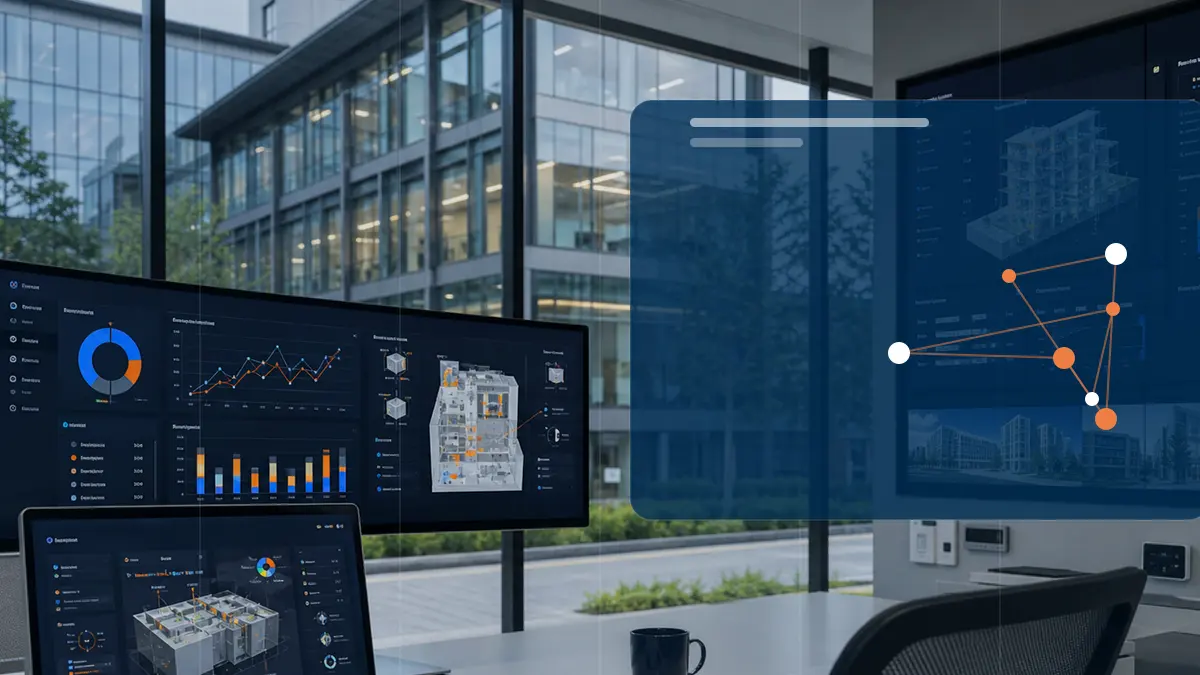
HVAC optimisation: scattered information versus Energy Intelligence
An office that is already comfortably warm on a Sunday morning, while nobody is working: it happens more often than you might think. In many buildings the climate installation runs on settings chosen at handover and never reviewed since. For facility managers, building owners and businesses with their own premises, the installation is therefore one of the easiest places to save energy: often without investing in new equipment, with adjustments you can make step by step.
- Many building installations still run on the generous settings chosen at handover, keep running outside occupancy hours or heat and cool at the same time.
- Concrete steps include time schedules and night setback, temperature and CO2 controlled ventilation, a proper heating curve, hydronic balancing and regular maintenance.
- Many of these measures appear on the Dutch Recognised Measures List (EML) under the energy saving obligation; non-residential buildings with a heating or air conditioning system of more than 290 kilowatts must also have a building automation and control system.
Insight
Traditional approach
Information is scattered across portals, documents, invoices or separate spreadsheets.
Modern approach
Data, context and interpretation are brought together into a clear decision picture.
Decision-making
Traditional approach
Choices are made based on averages, assumptions or occasional analyses.
Modern approach
Scenarios, KPIs and current measurement data make the trade-off more concrete and repeatable.
Follow-up
Traditional approach
Actions often stay non-committal or disappear into separate reports.
Modern approach
Follow-up actions, monitoring and reporting are linked to the same energy data.
Why is there often so much to gain?
Climate installations are usually configured generously and safely at handover: better slightly too warm and slightly too much ventilation than complaints. After that, hardly anyone looks at them again. Meanwhile the use of the building changes: different opening hours, more working from home, refurbished spaces. The settings do not move along. This creates classic sources of waste: heating that keeps running through the weekend, ventilation at full power in empty rooms, and controls that heat and cool at the same time because zones work against each other. Dirty filters and worn valves also let consumption creep up. The building simply feels normal, so nobody notices. That is exactly why re-tuning often delivers a lot without replacing anything.
- Installations often still run on the generous settings from handover.
- The use of the building changes, the settings do not change with it.
- Common sources of waste: running outside occupancy hours, heating and cooling simultaneously, ventilating empty rooms at full power.
- Overdue maintenance, such as dirty filters, lets consumption creep up.
What do you do in practice?
Start with the schedules: set time programmes so the installation only runs around actual occupancy hours, with night setback outside those hours. Then look at the controls. A proper heating curve lets the supply temperature of the heating system follow the outdoor temperature. Hydronic balancing distributes the heating water correctly through the building, so all rooms warm up evenly. Have the ventilation controlled by temperature and CO2, so the building is ventilated according to actual occupancy. Also plan regular maintenance, such as replacing filters and checking valves and sensors. Finish with monitoring: through a building management system (BMS) or an energy registration and monitoring system you spot deviations quickly and adjust.
- Time schedules and night setback: the installation follows actual occupancy hours.
- Heating curve and hydronic balancing: the right temperature in the right place.
- Temperature and CO2 controlled ventilation: ventilate to occupancy instead of at full power.
- Maintenance: clean filters and properly working valves and sensors.
- Monitor and adjust through a BMS or energy monitoring system.
What does Dutch law say and where are the limits?
HVAC optimisation is directly linked to the Dutch energy saving obligation. Companies and institutions using 50,000 kilowatt-hours of electricity or 25,000 cubic metres of natural gas (equivalent) or more per year must take all energy saving measures that pay for themselves within five years. The Recognised Measures List (EML) translates that obligation into concrete measures, including properly tuning climate installations and monitoring energy consumption. Through the reporting obligation you report to the government which measures you have taken. Non-residential buildings with a heating or air conditioning system of more than 290 kilowatts must, since 1 January 2026, also have a building automation and control system. Optimisation has limits too: an outdated installation or a poorly insulated building eventually requires more than adjustment alone.
- The energy saving obligation applies from 50,000 kilowatt-hours of electricity or 25,000 cubic metres of natural gas (equivalent) per year.
- The EML contains recognised measures with a payback time of five years or less, including for climate installations.
- Non-residential buildings with a heating or air conditioning system of more than 290 kilowatts must have a building automation and control system.
- Limit: adjustment does not replace an outdated installation and does not compensate for poor insulation.
Curious what this looks like with your own data?
In a no-obligation call, a specialist looks at your meters, sites and energy questions with you. Response within one business day.
Search the knowledge base
Find the answer to your question.
Search using your own words. Abbreviations and spelling variants are recognised, so EMS also finds the articles on energy management systems.
Topic