
Real estate
Article 8 of 16 · Buildings and real estateBuilding management system (BMS): a guide for businesses
Direct answer
A building management system (BMS), in Dutch called a gebouwbeheersysteem or GBS, is the central software and hardware that controls, monitors and logs a building's installations: heating, cooling, ventilation and often lighting and solar shading. The system regulates based on schedules, temperatures and occupancy, reports faults and records measurement data. For larger non-residential buildings, Dutch law now sets requirements for such building automation.
- Clear definition
- Data-driven assessment
- Risks and opportunities visible
- Practical next steps
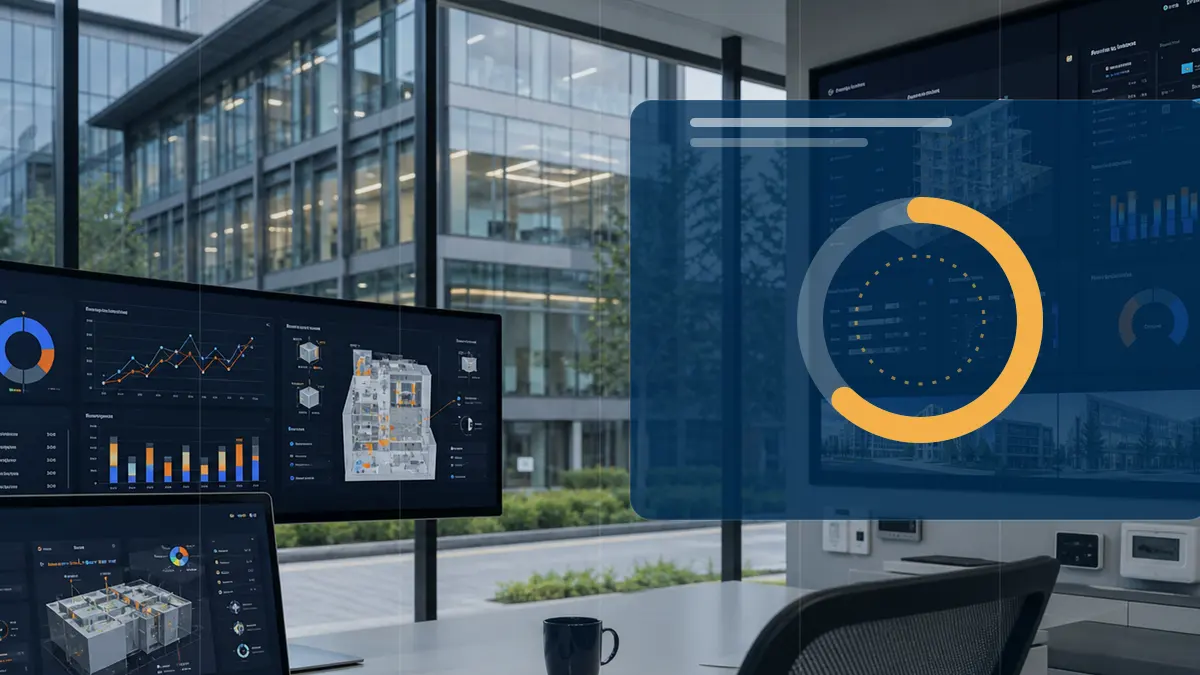
Building management system (BMS): scattered information versus Energy Intelligence
In a building of any size, dozens of installations run at the same time: boilers, heat pumps, air handling units, chillers and lighting. Nobody can adjust all of them by hand. That is why the building management system exists: one place where all those installations come together. It matters to facility managers, building owners and technical managers. A familiar picture: an office where the ventilation keeps running at full power during the weekend while nobody is there. A well configured BMS prevents exactly that kind of waste.
- A BMS controls installations per room or zone via time schedules and setpoints, and shows faults and deviations centrally on one screen.
- Non-residential buildings in the Netherlands with a heating or air conditioning system with a nominal output of more than 290 kilowatts must currently have a building automation and control system (BACS).
- An existing BMS does not automatically meet those legal BACS requirements: the system must also be able to monitor and analyse energy use and detect performance degradation.
Insight
Traditional approach
Information is scattered across portals, documents, invoices or separate spreadsheets.
Modern approach
Data, context and interpretation are brought together into a clear decision picture.
Decision-making
Traditional approach
Choices are made based on averages, assumptions or occasional analyses.
Modern approach
Scenarios, KPIs and current measurement data make the trade-off more concrete and repeatable.
Follow-up
Traditional approach
Actions often stay non-committal or disappear into separate reports.
Modern approach
Follow-up actions, monitoring and reporting are linked to the same energy data.
What does a building management system do in practice?
A BMS consists of controllers at the installations themselves and central software that brings everything together. With time schedules you determine when heating, cooling and ventilation switch on and when they scale back, for example outside office hours. Per room or zone you set target values, such as temperature or air refreshment. The system monitors the installations continuously: if a pump fails or a temperature deviates, a notification appears. In addition, a BMS logs measurement values over longer periods. Those trends help explain comfort complaints and show where energy is leaking away. Many systems can be accessed remotely, so a manager can adjust settings without travelling to the building.
- Time schedules switch installations on and off automatically based on hours of use.
- Per zone you control temperature, ventilation and often lighting as well.
- Faults and deviations arrive as notifications in one central place.
- Logged measurement values make trends in consumption and comfort visible.
- Remote management saves travel time for adjustments and checks.
When is building automation legally required?
The European Energy Performance of Buildings Directive (EPBD) mandates building automation for larger non-residential buildings. In the Netherlands this requirement is laid down in the Besluit bouwwerken leefomgeving, the Dutch building regulations. The obligation currently applies to non-residential buildings with a heating system or an air conditioning system, whether or not combined with ventilation, with a nominal output of more than 290 kilowatts. Heating and air conditioning are assessed separately; their capacities are not added together. Buildings with a residential function are exempt. Such buildings must have a building automation and control system (BACS). That goes further than a classic BMS: a BACS must monitor and analyse energy use, detect degradation of performance and be able to communicate with the connected installations. Under current regulation the capacity threshold will be lowered in 2030, bringing many more buildings under the requirement.
- The requirement stems from the European EPBD directive and is laid down in the Dutch building regulations.
- Threshold: a heating or air conditioning system with a nominal output of more than 290 kilowatts.
- Heating and air conditioning are assessed separately, not added together.
- A BACS must monitor and analyse energy use and detect performance degradation.
- Under current regulation the capacity threshold drops sharply in 2030.
What should you watch out for with your BMS?
A BMS is only as good as its settings. In practice, installations sometimes heat and cool at the same time, or keep running outside hours of use, because nobody adjusted the controls after a renovation. Periodic commissioning and checking of time schedules therefore pays off. Also consider the age of the system: outdated BMS installations often use closed protocols, log little data and are hard to connect to other systems. According to the Dutch agency RVO, a classic BMS, even combined with a simple energy management system, is unlikely to meet the BACS requirements, because the analysis function is missing. Finally, know the limit: a BMS controls and monitors, but does not judge by itself whether the building runs efficiently. That requires someone to connect the logged data to energy monitoring and draw conclusions from it.
- Check settings and time schedules periodically, especially after renovations or changed use.
- Outdated systems log little data and communicate poorly with other systems.
- According to RVO, a classic BMS is unlikely to meet the BACS requirements automatically.
- Connecting the BMS to energy monitoring is what makes the logged data truly useful.
Curious what this looks like with your own data?
In a no-obligation call, a specialist looks at your meters, sites and energy questions with you. Response within one business day.
Search the knowledge base
Find the answer to your question.
Search using your own words. Abbreviations and spelling variants are recognised, so EMS also finds the articles on energy management systems.
Topic