
Vehicle-to-grid (V2G): a guide for businesses
Direct answer
Vehicle-to-grid, or V2G, is a system in which an electric car uses a suitable charging point not only to charge, but also to feed electricity back to a building or to the electricity grid. The battery becomes a flexible buffer. The car takes in power when supply is high and gives it back when you or the grid can make good use of that energy.
- Clear definition
- Data-driven assessment
- Risks and opportunities visible
- Practical next steps
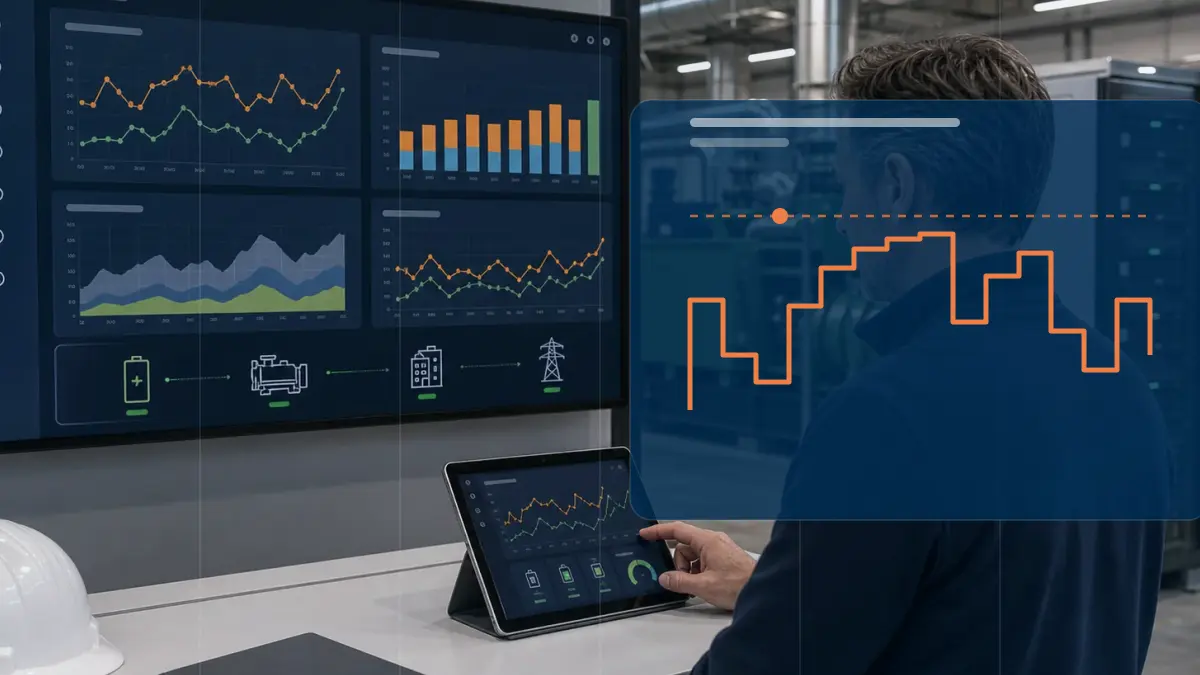
Vehicle-to-grid (V2G): scattered information versus Energy Intelligence
Electric cars stand still for most of the day, with a sizeable battery that does nothing. At the same time the grid fills up at peak moments, while power is sometimes abundant and cheap. Vehicle-to-grid exists to put those idle batteries to work as storage. It matters to businesses with a vehicle fleet, offices with solar panels and facility managers who want to shave peaks without immediately upgrading their connection.
- V2G needs a bidirectional charging point and a car that supports feeding back; an ordinary charger cannot do this.
- Smart charging only shifts the charging moment; V2G, V2H and V2B also let the battery return power to the grid, home or building.
- In the Netherlands the technology is still rolled out on a limited scale: the number of suitable cars and chargers is still small.
Insight
Traditional approach
Information is scattered across portals, documents, invoices or separate spreadsheets.
Modern approach
Data, context and interpretation are brought together into a clear decision picture.
Decision-making
Traditional approach
Choices are made based on averages, assumptions or occasional analyses.
Modern approach
Scenarios, KPIs and current measurement data make the trade-off more concrete and repeatable.
Follow-up
Traditional approach
Actions often stay non-committal or disappear into separate reports.
Modern approach
Follow-up actions, monitoring and reporting are linked to the same energy data.
How does vehicle-to-grid work?
With vehicle-to-grid the power flows both ways. An ordinary charger converts alternating current into direct current for the battery. A bidirectional charger can also do the reverse: the direct current from the battery becomes alternating current for your installation or the grid. Software decides when charging or feeding back makes sense, for example based on your solar generation, your consumption or the pressure on the grid. During the day the car stores local solar energy, and at a suitable moment the surplus goes back out. In this way the battery behaves as a temporary battery that you share with your building or with the grid.
- The charger must be bidirectional and the car must support feeding back.
- Power flows both ways: charging and discharging through the same connection.
- Smart software chooses the charge and feedback moment based on generation, consumption and grid pressure.
- Converting power always involves some energy loss.
Vehicle-to-grid, V2H and V2B: what is the difference?
These terms are closely related but differ in destination. With vehicle-to-grid (V2G) the car feeds back to the public electricity grid. With vehicle-to-home (V2H) and vehicle-to-building (V2B) the power stays within your own home or building, for example to use self-generated solar energy in the evening or to supply power during an outage. Do not confuse this with smart charging: there the car returns nothing, and only the charging moment is shifted to a favourable time. V2G, V2H and V2B go a step further, because the battery also releases energy.
- V2G: feeding back to the public electricity grid.
- V2H and V2B: using power within your own home or building.
- Smart charging only shifts the charging moment and returns nothing.
- V2G, V2H and V2B together fall under the broader term vehicle-to-everything (V2X).
What do you use V2G for, and what should you watch out for?
V2G is attractive for lowering peak consumption, using more of your own solar energy and putting a vehicle fleet to work as a buffer. In time you can also offer the flexibility as a flex service, where the battery helps keep the grid in balance. Pay close attention to the conditions. You need a bidirectional charger and a suitable car, and the charging and feedback standards must match. Ask the car manufacturer whether feeding back affects the battery warranty, because extra charge and discharge cycles can put a load on the battery. Also take the tax and regulatory rules on feeding back into account, such as energy tax and the terms of your energy contract, which differ per situation.
- Use: shaving peaks, raising self-consumption, using a fleet as a buffer, and later flex services.
- Needed: a bidirectional charger and a car that supports feeding back.
- Check whether feeding back has consequences for the battery warranty.
- Feedback touches on energy tax and the terms of your energy contract; have your situation calculated.
Curious what this looks like with your own data?
In a no-obligation call, a specialist looks at your meters, sites and energy questions with you. Response within one business day.
Search the knowledge base
Find the answer to your question.
Search using your own words. Abbreviations and spelling variants are recognised, so EMS also finds the articles on energy management systems.
Topic