
Real estate
Article 7 of 16 · Buildings and real estateSmart building explained for businesses
Direct answer
A smart building is a building in which sensors, installations and software work together to continuously measure and automatically control comfort, energy use and the use of spaces. The building management system forms the foundation; a data layer on top analyses the measurements and adjusts operation. This way the building adapts lighting, heating and ventilation to who is actually present.
- Clear definition
- Data-driven assessment
- Risks and opportunities visible
- Practical next steps
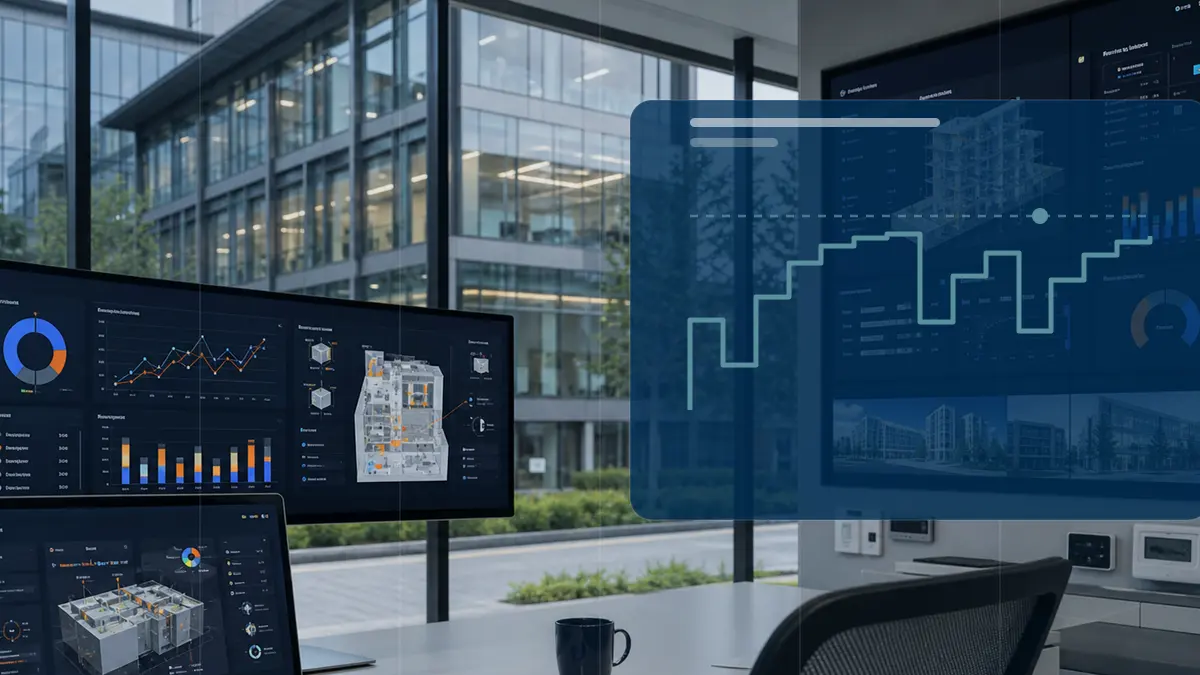
Smart building explained: scattered information versus Energy Intelligence
Offices, schools and healthcare buildings often sit largely empty while lighting and climate systems run at full capacity. Meanwhile, energy costs are rising and Dutch legal requirements on building energy use are getting stricter. More and more building owners and facility managers are therefore looking at smart building technology. Think of a meeting room that switches itself off once everyone has left, or an installation reporting a fault before users notice. This article explains what such a building can do, its building blocks and what to watch out for.
- A smart building controls lighting and climate based on actual presence and occupancy, instead of fixed time schedules.
- The foundation is a building management system (BMS); sensors and a data layer with analytics are what make the building truly smart.
- In the Netherlands, non-residential buildings with a heating or air conditioning system above 290 kilowatts of rated output must have a building automation and control system (BACS) since 1 January 2026.
Insight
Traditional approach
Information is scattered across portals, documents, invoices or separate spreadsheets.
Modern approach
Data, context and interpretation are brought together into a clear decision picture.
Decision-making
Traditional approach
Choices are made based on averages, assumptions or occasional analyses.
Modern approach
Scenarios, KPIs and current measurement data make the trade-off more concrete and repeatable.
Follow-up
Traditional approach
Actions often stay non-committal or disappear into separate reports.
Modern approach
Follow-up actions, monitoring and reporting are linked to the same energy data.
What can a smart building do?
A smart building uses measurements to continuously adapt the building to actual use. Lighting and climate follow presence: if a room is empty, the lights go out and ventilation scales down. Occupancy sensors show which spaces are used a lot and which hardly at all, valuable input for accommodation decisions. Energy monitoring makes visible where electricity and heat are going and flags anomalies, such as an installation that keeps running unnecessarily at night. With predictive maintenance, installations report wear or deviating behaviour before a breakdown occurs. Some buildings also respond to the electricity grid: they shift flexible consumption, for example car charging, to moments with low electricity prices or plenty of on-site solar generation.
- Presence-based lighting and climate control instead of fixed time schedules.
- Insight into occupancy as a basis for accommodation and workplace decisions.
- Energy monitoring that reveals idle consumption and anomalies.
- Predictive maintenance: seeing faults coming instead of fixing them afterwards.
- Responding flexibly to electricity prices and on-site generation.
What are the building blocks of a smart building?
The bottom layer consists of sensors and meters: temperature, CO2, presence and energy consumption. The second layer is the building management system, or BMS. It controls installations such as heating, cooling and ventilation, and has done so for years. What makes a building smart is the layer above: software that brings together the data from all systems, analyses it and translates it into automatic adjustments and reports. Regulation is pushing in the same direction. In the Netherlands, non-residential buildings with a heating or air conditioning system with a rated output above 290 kilowatts must have a building automation and control system (BACS) since 1 January 2026; the building owner is the first to be held accountable. The European Energy Performance of Buildings Directive also includes the Smart Readiness Indicator, a score expressing how well a building supports smart functions.
- Sensors and meters form the bottom layer: temperature, CO2, presence and consumption.
- The building management system (BMS) controls the installations and is the foundation.
- A data layer with analytics and automatic adjustment is what makes the building truly smart.
- Above 290 kilowatts of heating or air conditioning capacity, a BACS is legally required in Dutch non-residential buildings.
What should you watch out for?
Technology is a means, not a goal. So start with the question of what you want to achieve, for example lower energy use, better comfort or better utilised floor space, and choose the technology to match. Also pay attention to cybersecurity: a building full of connected systems is digitally reachable too and deserves the same protection as your office IT. Occupancy sensors and cameras also touch on privacy; choose anonymous measurements where possible and be transparent towards the building's users. When purchasing, ask about open standards and interoperability, so that systems from different suppliers work together and you are not locked into a single party. And do not count your savings in advance: data only delivers value if someone looks at it and the settings are actually adjusted.
- Define the goal first and only then choose the technology.
- Secure connected building systems as seriously as the rest of your IT.
- Measure occupancy anonymously where possible and inform users.
- Demand open standards to avoid dependence on a single supplier.
- Data only saves anything if it is followed up on.
Curious what this looks like with your own data?
In a no-obligation call, a specialist looks at your meters, sites and energy questions with you. Response within one business day.
Search the knowledge base
Find the answer to your question.
Search using your own words. Abbreviations and spelling variants are recognised, so EMS also finds the articles on energy management systems.
Topic