
Technology
Article 5 of 13 · Technology and AIPredictive maintenance and energy: a guide for businesses
Direct answer
Predictive maintenance is maintenance based on measured condition data and predictive models, rather than fixed intervals or waiting for a breakdown. Sensors track signals such as vibration, temperature and power consumption of machines. Software detects deviations that point to early wear. This matters for energy because wear and fouling often push up a machine's energy consumption long before anything actually fails.
- Clear definition
- Data-driven assessment
- Risks and opportunities visible
- Practical next steps
Predictive maintenance and energy: scattered information versus Energy Intelligence
Many businesses maintain machines at fixed moments, or only after something breaks. Both approaches cost money: maintaining too early is wasteful, maintaining too late means downtime. Picture a compressor that gradually draws more power because of a worn bearing. Nobody notices until the machine fails and production stops. Predictive maintenance addresses exactly this and is relevant for anyone responsible for both the installations and the energy bill: from facility managers to production managers.
- Wear and fouling increase energy consumption: think of fouled heat exchangers, worn bearings and leaking compressed air lines.
- The relationship works both ways: rising energy consumption at constant output is often an early sign of a technical problem.
- You do not need to start big: periodic measurements on a few critical machines are a workable first step for many SMEs.
Insight
Traditional approach
Information is scattered across portals, documents, invoices or separate spreadsheets.
Modern approach
Data, context and interpretation are brought together into a clear decision picture.
Decision-making
Traditional approach
Choices are made based on averages, assumptions or occasional analyses.
Modern approach
Scenarios, KPIs and current measurement data make the trade-off more concrete and repeatable.
Follow-up
Traditional approach
Actions often stay non-committal or disappear into separate reports.
Modern approach
Follow-up actions, monitoring and reporting are linked to the same energy data.
How does predictive maintenance work?
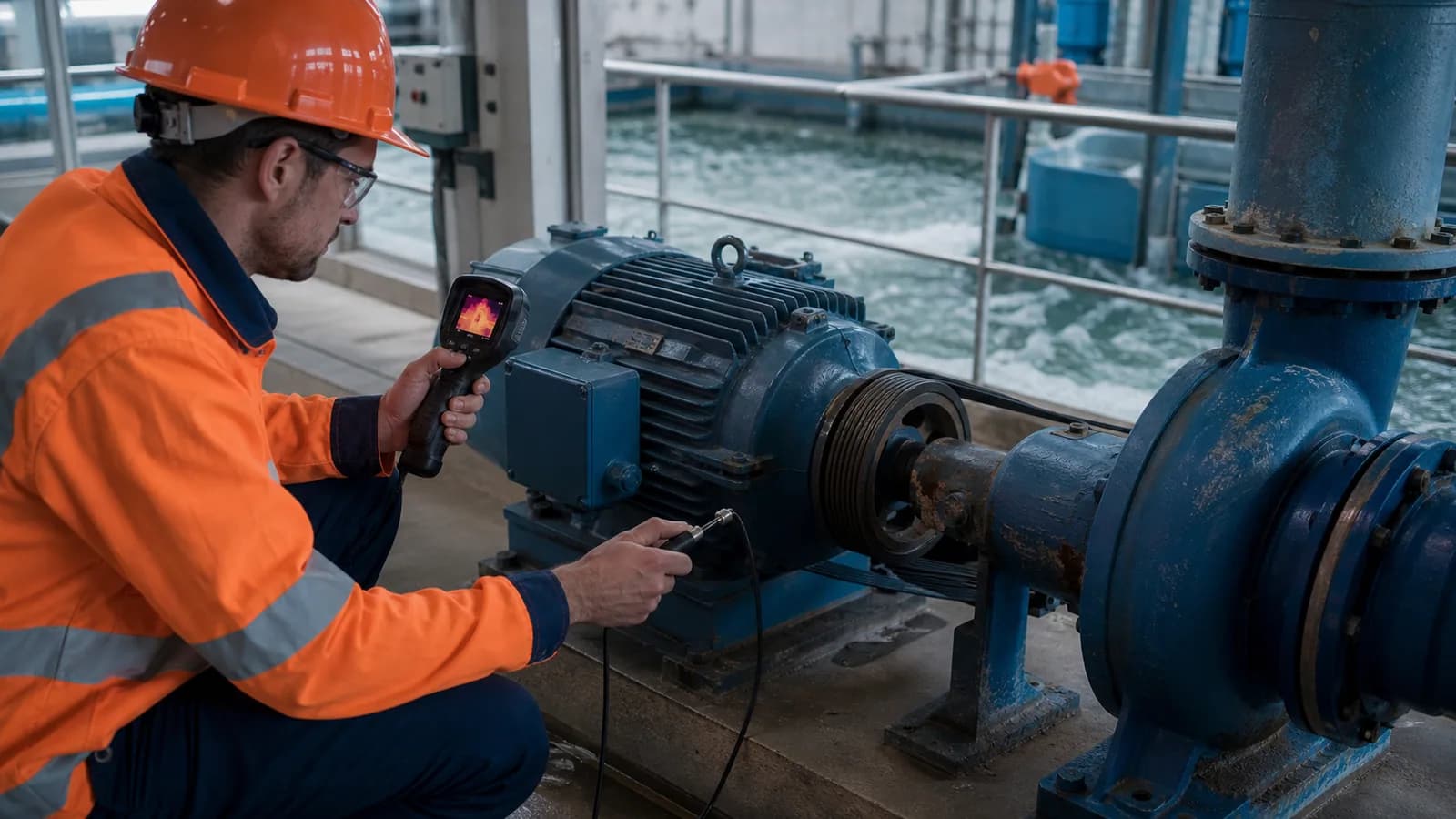
Predictive maintenance revolves around measuring the condition of machines, continuously or periodically. Sensors register signals that change as a component deteriorates. Vibration analysis, for example, detects bearing damage and imbalance in rotating machinery. Thermography uses a thermal camera to reveal abnormal temperatures, such as an overheating electrical connection or a fouled heat exchanger. Current signature analysis reads problems from the electricity consumption of a motor. Ultrasonic detection finds leaks in compressed air systems that you cannot hear or see. The measurements themselves are not new. What is new is that software, often using machine learning, recognises patterns in this data and warns you before a failure occurs. You then schedule maintenance at the moment the condition requires it, no earlier and no later.
- Vibration analysis detects bearing wear and imbalance in rotating machinery
- Thermography reveals overheating and fouling through thermal images
- Current signature analysis reads a motor's condition from its electricity consumption
- Ultrasonic detection finds compressed air leaks you cannot hear or see
- Machine learning recognises abnormal patterns in the collected sensor data
What does maintenance have to do with energy?
A machine in poor condition often uses more energy for the same work. A fouled heat exchanger transfers heat less effectively, so a boiler or chiller has to run longer and harder. A worn bearing increases friction and with it the motor's power consumption. Leaks in a compressed air network force the compressor to produce unnecessarily. The Netherlands Enterprise Agency (RVO) notes that compressed air leakage cannot be fully prevented, so leaks should be traced and repaired regularly. The relationship also works the other way round. If an installation's energy consumption rises while output stays the same, that is often an early sign of a technical problem. Energy data per machine or per department thus acts as a simple condition measurement, even before you install dedicated sensors.
- Fouled heat exchangers transfer heat poorly and extend running times
- Bearing wear increases friction and with it the power consumption of motors
- Compressed air leaks force compressors to produce unnecessarily
- Unexplained rising consumption at constant output is an early failure signal
What is realistic for SMEs and industry?
Large industrial companies often monitor critical installations continuously, with fixed sensors and models trained on their own machines. That approach requires data, expertise and budget, and pays off mainly where downtime causes immediate major damage. For SMEs a lighter route is more realistic. Start by asking which machines are truly critical for production or energy consumption. Periodic measurement rounds, such as an annual thermographic inspection or a compressed air leak survey, already provide plenty of insight without fixed sensors. Tracking energy consumption per installation is often possible with existing meters or simple submeters. If an anomaly stands out, you then bring in a specialist for targeted measurements. This way you grow towards predictive maintenance step by step, at a pace that suits your organisation.
- Industry: continuous monitoring of critical installations with fixed sensors and trained models
- SMEs: periodic inspections and leak surveys as an accessible starting point
- First select the machines that are critical for production or energy consumption
- Use existing energy meters as a first condition indicator
Curious what this looks like with your own data?
In a no-obligation call, a specialist looks at your meters, sites and energy questions with you. Response within one business day.
Search the knowledge base
Find the answer to your question.
Search using your own words. Abbreviations and spelling variants are recognised, so EMS also finds the articles on energy management systems.
Topic