
Technology
Article 1 of 13 · Technology and AIAI in energy management: a guide for businesses
Direct answer
AI in energy management is the use of self-learning software that analyses metering data to forecast energy consumption, flag anomalies and control installations more intelligently. The software recognises patterns that no one would spot in individual meter readings. Energy data thus becomes a steering tool for daily decisions on installations, procurement and maintenance.
- Clear definition
- Data-driven assessment
- Risks and opportunities visible
- Practical next steps
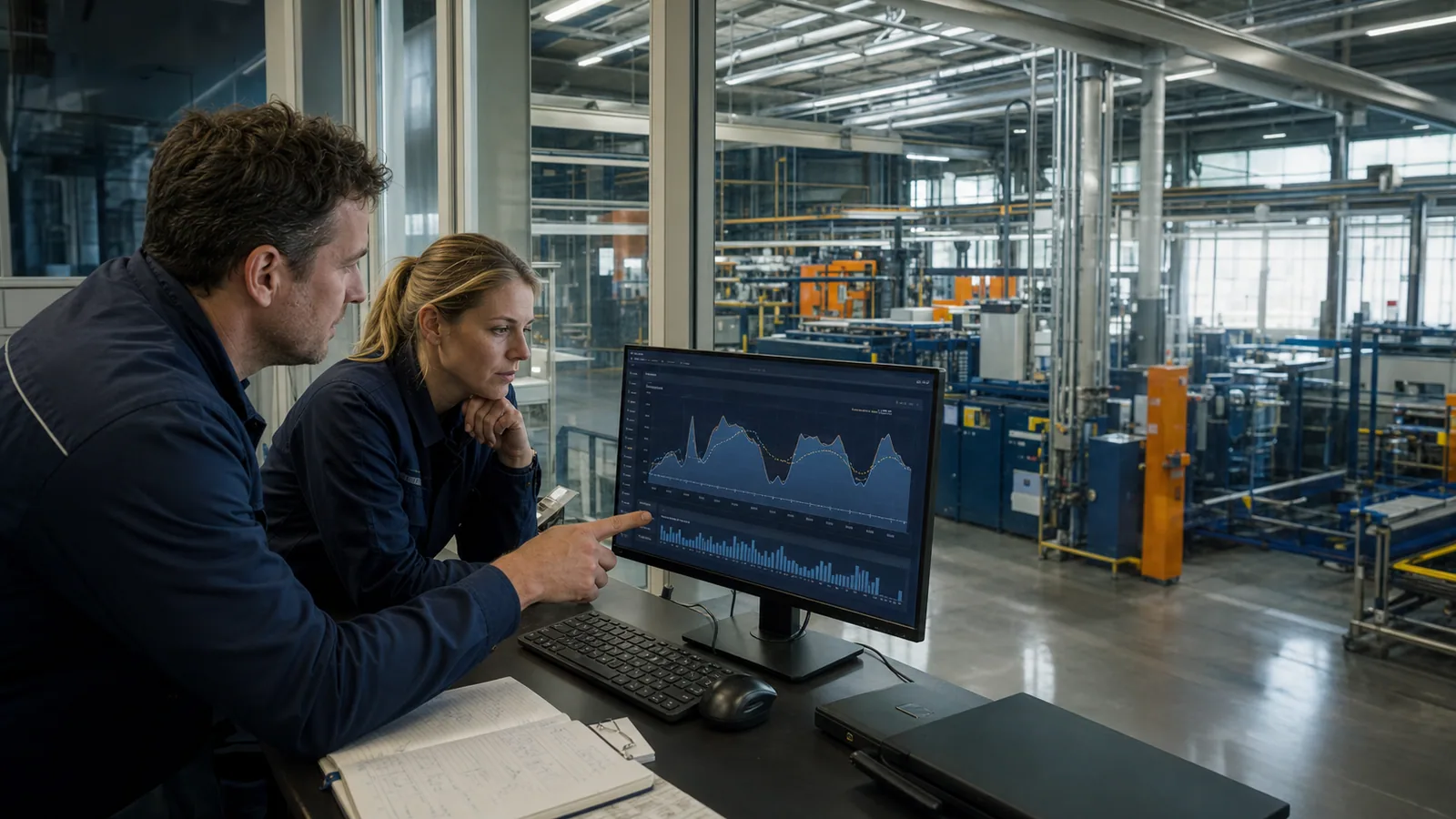
AI in energy management: scattered information versus Energy Intelligence
Energy data now pours in from every direction: smart meters, submeters, building management systems and solar panels deliver fresh figures every quarter of an hour. No human can search all those series by hand. Picture a facility manager who only discovers at the annual statement that the air handling unit ran every weekend for months. Self-learning software scans such data streams continuously and reveals what would otherwise stay hidden. That is why artificial intelligence appears ever more often in energy software for businesses, from SMEs to large property portfolios.
- AI forecasts consumption and generation based on historical metering data, weather forecasts and business activity.
- Anomaly detection flags deviating consumption immediately, such as an installation left running over the weekend.
- AI only performs well on reliable metering data: submetering and integrations with installations are preconditions.
Insight
Traditional approach
Information is scattered across portals, documents, invoices or separate spreadsheets.
Modern approach
Data, context and interpretation are brought together into a clear decision picture.
Decision-making
Traditional approach
Choices are made based on averages, assumptions or occasional analyses.
Modern approach
Scenarios, KPIs and current measurement data make the trade-off more concrete and repeatable.
Follow-up
Traditional approach
Actions often stay non-committal or disappear into separate reports.
Modern approach
Follow-up actions, monitoring and reporting are linked to the same energy data.
What does AI actually do in energy management?
AI supports four tasks. First, the software forecasts expected consumption and generation, based on historical metering data, weather forecasts and business activity. Second, it detects anomalies: consumption that does not fit the normal pattern, such as a cooling installation still running at night. Third, AI helps optimise installations and flexibility. Think of intelligently scheduling climate installations, charging points or a battery within the available grid connection capacity. Fourth, AI automates reporting: the software turns raw metering data into overviews for management, sustainability reporting and audits. International analyses, including work by the International Energy Agency, see particular potential for these applications in heating, cooling and flexible electricity use.
- Consumption forecasting based on metering data, weather and the business calendar
- Anomaly detection: flagging deviating consumption immediately instead of at the annual statement
- Optimisation of installations, charging points and batteries within the grid connection capacity
- Automated reporting for management and sustainability disclosure
Which techniques sit behind it?
Under the bonnet it is usually machine learning: software that learns patterns from historical data instead of following fixed rules. Consumption forecasts often rely on regression models. These link consumption to factors such as outdoor temperature, day of the week and production intensity. For more complex patterns, developers use neural networks, models that can learn layered relationships. Anomaly detection often works the other way round: the model first learns what normal consumption looks like and raises an alarm on deviations from it. Scientific review studies describe dozens of variants of these techniques for buildings. For you as a user, the exact technique matters less than whether the model is explainable and its forecasts can be checked.
- Machine learning: learning patterns from historical data instead of fixed calculation rules
- Regression models link consumption to temperature, weekday and business intensity
- Neural networks recognise more complex, layered patterns
- Anomaly detection first learns the normal pattern and flags deviations from it
What are the preconditions and limitations?
AI is only as good as the data that goes in. Reliable metering data is the first precondition: a single smart meter per connection is often too coarse, and submetering per installation or department is what makes analyses truly useful. Integrations matter too: the software must be able to retrieve data from meters, building management systems and, where relevant, production systems. AI also has limitations. Some models are a black box: they produce an outcome without explanation, which makes verification difficult. Models trained on old data can miss the mark when the situation changes, for instance after a renovation or the arrival of new machinery. Human oversight therefore remains necessary. AI flags and advises, but a member of staff judges whether an alert is valid and which action is appropriate.
- Submetering and data quality determine the value of every AI analysis
- Integrations with meters and building management systems are a practical precondition
- Black-box models produce outcomes without explanation: ask about explainability
- After renovations or new equipment, a model has to learn afresh
- Human judgement remains the final step before any intervention
Curious what this looks like with your own data?
In a no-obligation call, a specialist looks at your meters, sites and energy questions with you. Response within one business day.
Search the knowledge base
Find the answer to your question.
Search using your own words. Abbreviations and spelling variants are recognised, so EMS also finds the articles on energy management systems.
Topic