
Technology
Article 10 of 13 · Technology and AIEdge computing in energy: a guide for businesses
Direct answer
Edge computing in energy means that metering data and control logic are processed locally, on a gateway or controller close to your installations, instead of sending everything to the cloud. This lets your energy system respond to peaks almost instantly and keeps control running when the internet connection drops. The cloud remains in place for analysis and reporting.
- Clear definition
- Data-driven assessment
- Risks and opportunities visible
- Practical next steps
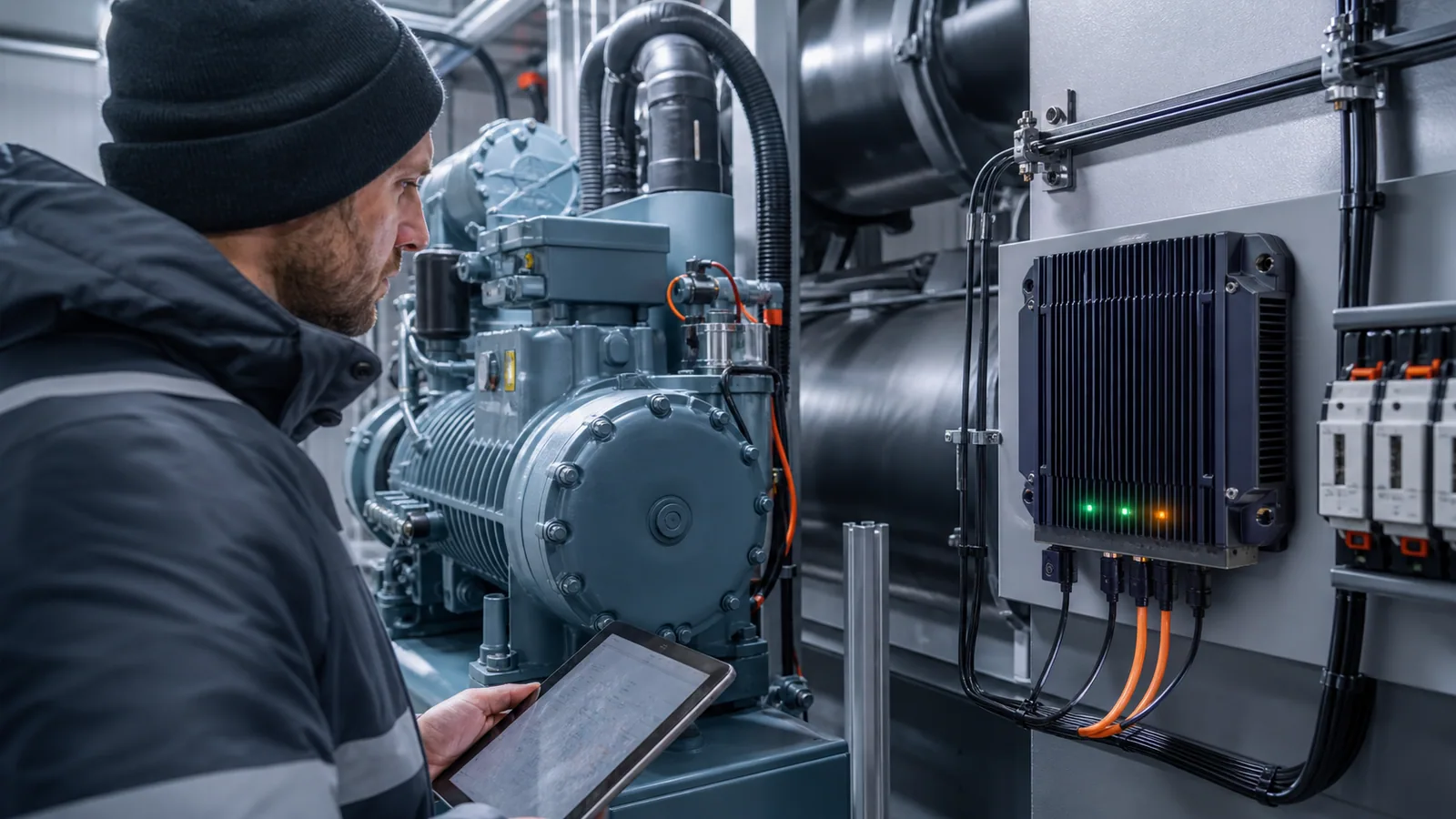
Edge computing in energy: scattered information versus Energy Intelligence
More and more businesses actively manage their energy use: a battery that shaves peaks, charging points that share capacity, installations that respond to the grid. That kind of control demands decisions within seconds or faster. Suppose your charging plaza must reduce power because the connection is at its limit: a round trip to a data centre offers no certainty then, and during an internet outage nothing happens at all. That is why part of the computing power is moving to the site itself.
- Local control responds almost instantly to batteries, charging points and demand response, without a round trip to a data centre.
- During an internet outage, local control simply continues; only reporting and analysis wait until the connection returns.
- Only summarised data goes to the cloud: this limits data traffic and keeps detailed metering data within your own network.
Insight
Traditional approach
Information is scattered across portals, documents, invoices or separate spreadsheets.
Modern approach
Data, context and interpretation are brought together into a clear decision picture.
Decision-making
Traditional approach
Choices are made based on averages, assumptions or occasional analyses.
Modern approach
Scenarios, KPIs and current measurement data make the trade-off more concrete and repeatable.
Follow-up
Traditional approach
Actions often stay non-committal or disappear into separate reports.
Modern approach
Follow-up actions, monitoring and reporting are linked to the same energy data.
How does edge computing work in an energy system?
With edge computing you place computing power in or next to the installation, usually a gateway or local controller in the meter cupboard or plant room. That device reads meters, inverters, batteries and charging points directly via industrial protocols. The control logic runs on site: the device compares actual consumption with the limit of your connection and adjusts almost instantly. Only a summary goes to the cloud, for example quarter-hour values and alerts. The cloud then does what works better centrally: analysis over longer periods, reporting and adjusting the settings the edge device uses. Edge and cloud thus form one system with two speeds.
- A gateway or local controller provides the computing power on site
- Meters, inverters and charging points are read directly on location
- Control logic runs locally and responds almost instantly
- Only summarised data and alerts are sent to the cloud
- The cloud handles analysis, reporting and adjusting settings
When is local computing useful?
Edge computing pays off mainly when speed and reliability matter. A battery that must absorb peak load has to respond within seconds or faster; a detour via a data centre offers no guarantees there and depends on the internet connection. The same applies to a charging plaza that distributes available capacity across vehicles, and to demand response where installations are briefly turned down. If the internet connection fails, local control keeps running; you temporarily lose the dashboard, but control does not stop. In addition, local processing limits data traffic, because not every measurement has to be sent separately. Detailed metering data also stays within your own network, which helps with privacy and confidentiality.
- Battery control and peak monitoring need response times that cannot be guaranteed via the cloud
- Charging plazas distribute available capacity best on site
- Local control keeps functioning during an internet outage
- Less data traffic, because only summaries are transmitted
- Sensitive metering data stays within your own network
What should you pay attention to?
Edge computing means distributed devices at one or more sites, and these must be managed as seriously as a server. Arrange from the start how you roll out software updates and security patches remotely; a forgotten gateway otherwise becomes a weak spot in your network. Separate the devices from the rest of the company network and encrypt the connection to the cloud. Also pay attention to standardisation: choose equipment that works with open protocols, so you are not tied to a single supplier and can connect new installations later. Finally, agree who monitors the devices, because without monitoring you only notice a stalled edge device at a late stage.
- Be able to roll out updates and security patches remotely
- Separate edge devices from the rest of the company network
- Choose open protocols to limit supplier dependence
- Set up monitoring of the edge devices themselves
Curious what this looks like with your own data?
In a no-obligation call, a specialist looks at your meters, sites and energy questions with you. Response within one business day.
Search the knowledge base
Find the answer to your question.
Search using your own words. Abbreviations and spelling variants are recognised, so EMS also finds the articles on energy management systems.
Topic