
Technology
Article 8 of 13 · Technology and AIBACnet vs. Modbus: a guide for businesses
Direct answer
BACnet vs. Modbus is the comparison between two of the most widely used communication protocols in building automation and energy monitoring. Modbus is a simple register protocol from 1979 that exchanges measurements as plain numbers; BACnet is an object based protocol from ASHRAE that lets devices describe themselves. In practice, building managers often combine both protocols within a single energy monitoring system.
- Clear definition
- Data-driven assessment
- Risks and opportunities visible
- Practical next steps
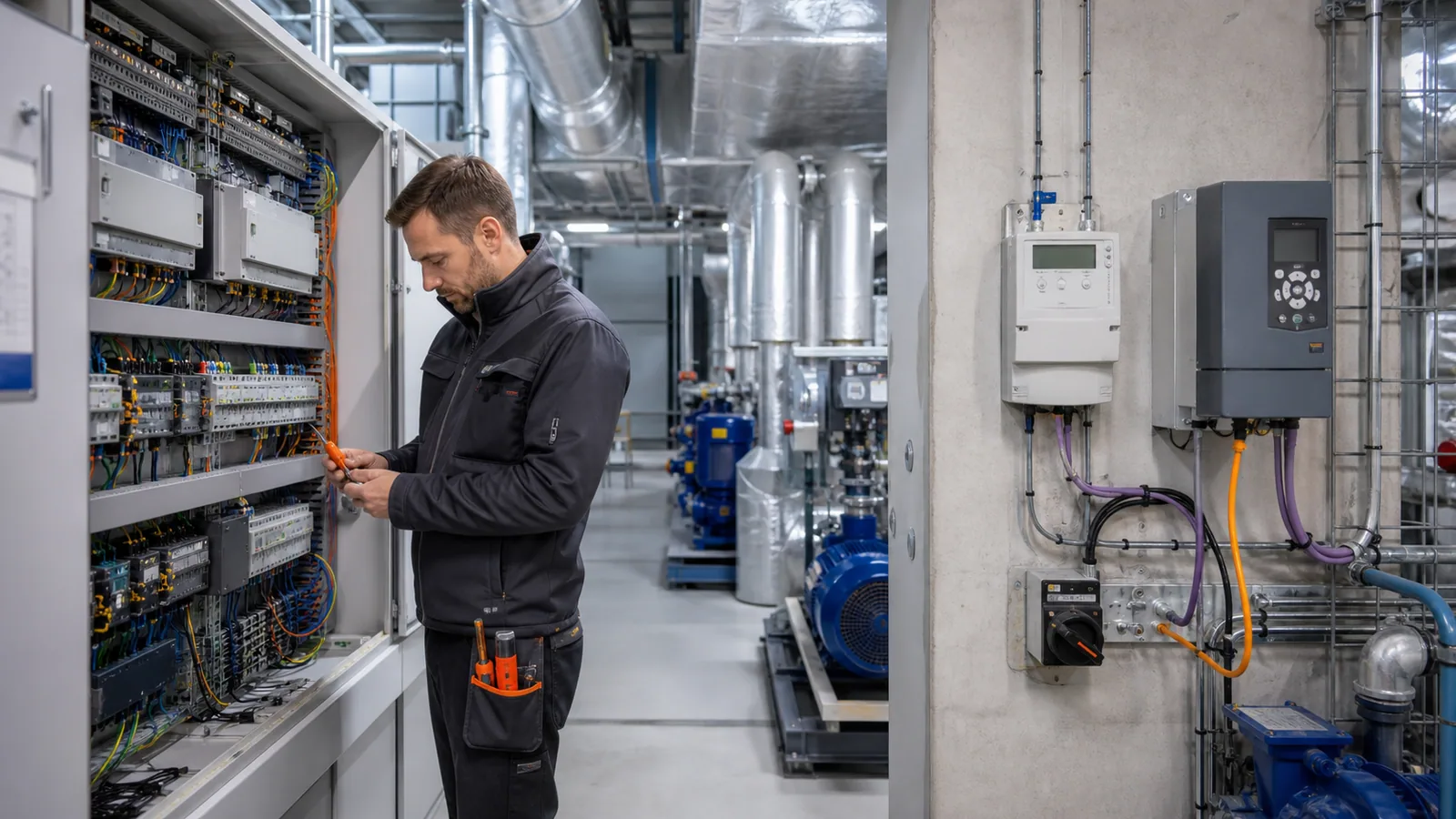
BACnet vs. Modbus: scattered information versus Energy Intelligence
Anyone who wants to measure energy consumption in a building quickly runs into protocol choices. The climate installation communicates through the building management system, while the energy meters in the utility cupboard speak their own language. A facility manager who wants all measurement data on one dashboard has to connect those worlds. Knowledge of both protocols helps you select meters, data loggers and software, and prevents you from buying equipment that cannot communicate with your existing installation.
- Modbus exchanges raw register values; what each number means must be looked up in the register table of every device.
- BACnet uses self-describing objects and automatic device discovery, so systems from different manufacturers understand each other.
- Energy meters usually speak Modbus, building management systems usually BACnet; a data logger or gateway connects both worlds.
Insight
Traditional approach
Information is scattered across portals, documents, invoices or separate spreadsheets.
Modern approach
Data, context and interpretation are brought together into a clear decision picture.
Decision-making
Traditional approach
Choices are made based on averages, assumptions or occasional analyses.
Modern approach
Scenarios, KPIs and current measurement data make the trade-off more concrete and repeatable.
Follow-up
Traditional approach
Actions often stay non-committal or disappear into separate reports.
Modern approach
Follow-up actions, monitoring and reporting are linked to the same energy data.
How do Modbus and BACnet work?
Modbus dates from 1979 and was developed for industrial control systems. It follows a simple request and response model: a client requests a register, a server replies with a number; until 2020 these roles were officially called master and slave. The serial variant Modbus RTU usually runs over an RS-485 cable, the newer Modbus TCP variant uses a standard computer network. The protocol does not define what a register value means; that is documented in the manual of each device. BACnet was developed by ASHRAE, published in 1995 as Standard 135 and later also laid down as international standard ISO 16484-5. It describes devices as objects with properties, such as a temperature value with a name, unit and status. BACnet also standardises services, including automatic device discovery, alarms and trend logs. Devices can therefore exchange information without manual register tables.
- Modbus RTU: serial communication, usually over an RS-485 cable, often in a chain of meters
- Modbus TCP: the same registers, but over a standard Ethernet network
- BACnet objects: self-describing data points with a name, unit and status
- BACnet services: device discovery, alarms and trend logging are standardised
What are the strengths and weaknesses?
Modbus owes its popularity to simplicity. Almost every energy meter, inverter or variable speed drive supports it, and it is light enough for small devices. The downside: there is no standard data model, so every integration requires manual work with register tables. Classic Modbus also lacks built-in authentication and encryption. BACnet offers a richer data model and interoperability between manufacturers, supported by independent certification of devices. In return, BACnet is more complex to configure and demands more knowledge from installers and administrators. For security, BACnet Secure Connect (BACnet/SC) was developed, an addition to the standard that encrypts traffic using accepted IT practices. This variant is gradually being adopted in new building management systems.
- Modbus: available everywhere and simple, but without a standard data model or built-in security
- BACnet: interoperable and self-describing, but more complex to design and manage
- BACnet/SC adds encrypted communication based on accepted IT practices
- Network segmentation remains a sensible baseline measure for both protocols
Which protocol should you choose for energy monitoring?
Usually the question is not which protocol wins, but how to combine both intelligently. At meter level, Modbus is the practical standard: kWh meters, submeters and inverters almost always deliver their values via Modbus RTU or TCP. At building level, BACnet is dominant, because building management systems use it to control climate installations. An energy monitoring platform therefore often reads Modbus meters directly and retrieves additional data, such as room temperatures or running hours, via BACnet from the building management system. Gateways and data loggers translate between the two protocols. When purchasing meters, check for a documented register table, and for BACnet equipment, check for certification. Also record who manages the protocol configuration, so later extensions run smoothly.
- Meter level: Modbus RTU or TCP for kWh meters, submeters and inverters
- Building level: BACnet for climate installations and the building management system
- Gateway or data logger: translates between the two protocols and bundles the data
- Documentation: always ask for register tables and clear object names
Curious what this looks like with your own data?
In a no-obligation call, a specialist looks at your meters, sites and energy questions with you. Response within one business day.
Search the knowledge base
Find the answer to your question.
Search using your own words. Abbreviations and spelling variants are recognised, so EMS also finds the articles on energy management systems.
Topic