
Technology
Article 12 of 13 · Technology and AICloud vs. on-premise EMS: a guide for businesses
Direct answer
Cloud versus on-premise EMS is the choice of where your energy management system runs: on a supplier's servers in the cloud or on your own servers on site. A cloud EMS starts quickly and is accessible anywhere, but makes you dependent on the internet and the supplier. An on-premise EMS keeps data and control in house, but requires your own management and security.
- Clear definition
- Data-driven assessment
- Risks and opportunities visible
- Practical next steps
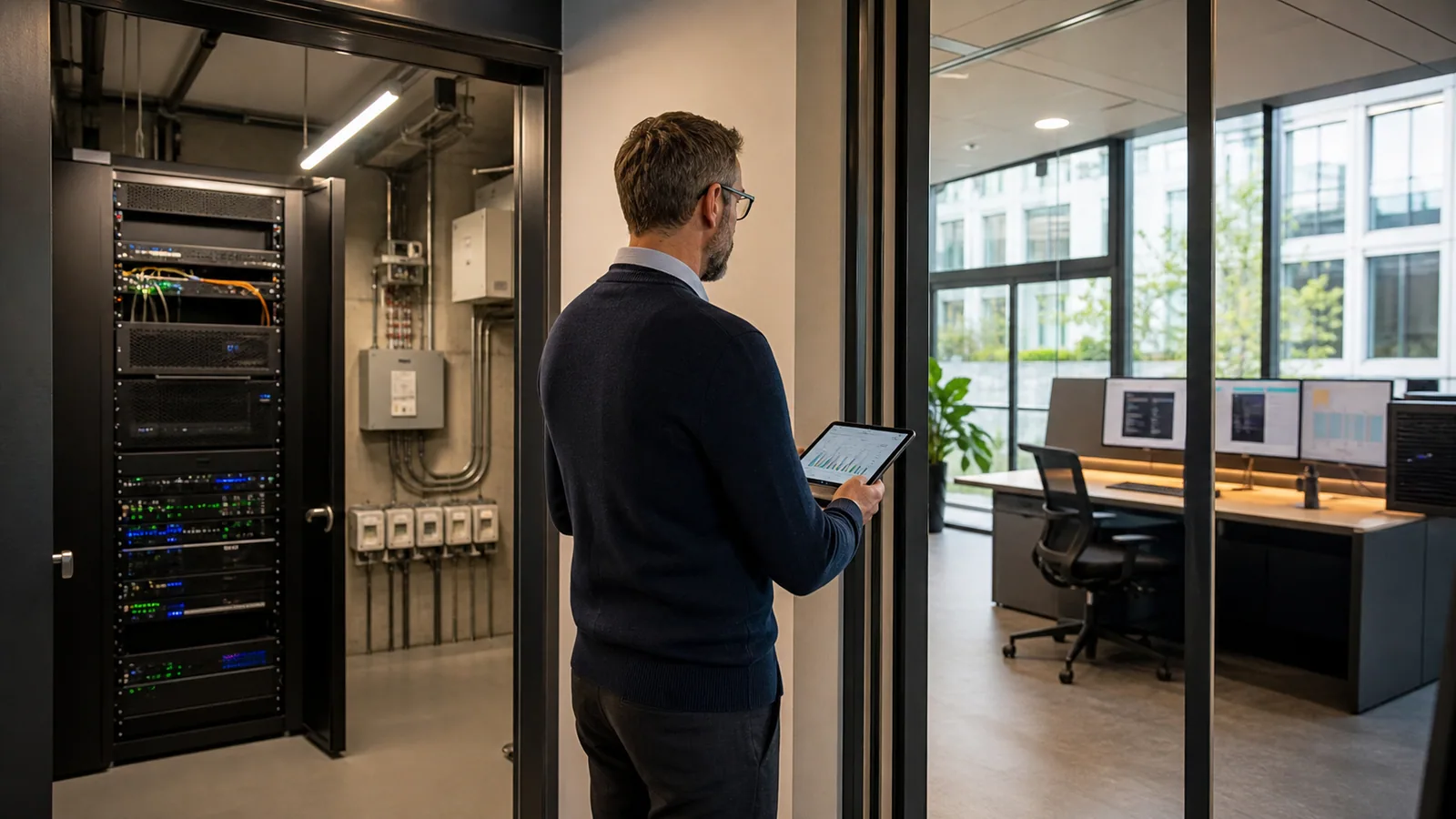
Cloud vs. on-premise EMS: scattered information versus Energy Intelligence
Anyone buying an energy management system faces the question early on of where it should run. The IT department often wants to follow the existing cloud policy. The technical team is wary of connecting production installations to the internet. Picture a manufacturing site where the EMS also controls a battery and solar panels: if the connection drops, control must not stop. That tension between convenience, control and availability makes this more than an IT detail.
- Cloud: quick to start, automatic updates and access from any location, but dependent on a working internet connection and on the supplier.
- On-premise: data and control stay within your own network and keep working without internet, but you manage hardware, updates and security yourself.
- Hybrid is common: a local gateway collects data and controls on site, while the cloud handles analysis and reporting.
Insight
Traditional approach
Information is scattered across portals, documents, invoices or separate spreadsheets.
Modern approach
Data, context and interpretation are brought together into a clear decision picture.
Decision-making
Traditional approach
Choices are made based on averages, assumptions or occasional analyses.
Modern approach
Scenarios, KPIs and current measurement data make the trade-off more concrete and repeatable.
Follow-up
Traditional approach
Actions often stay non-committal or disappear into separate reports.
Modern approach
Follow-up actions, monitoring and reporting are linked to the same energy data.
What are the pros and cons of a cloud EMS?
With a cloud EMS, the software runs in the supplier's data centre. You log in through a browser and need no servers of your own. That means a quick start, easy scaling to extra sites or meters, and automatic updates. Your energy data does live outside your walls. You depend on a working internet connection and on the supplier's continuity. Pay attention to data location: is the data stored within the European Economic Area, and what is arranged for personal data under the GDPR? The Dutch National Cyber Security Centre warns that without clear agreements with the supplier, you lose grip on your data, processes and responsibilities.
- Quick start: no servers of your own, installation is often limited to meters and a gateway.
- Automatic updates and new features without your own maintenance.
- Access anywhere: dashboards and reports available at every location.
- Points of attention: internet dependency, supplier dependency, data location and GDPR.
When is an on-premise EMS a better fit?
An on-premise EMS runs on servers in your own building or your own data centre. Metering data and control commands stay within your network. That matters greatly when the EMS controls machines, a battery or a building management system. The link with that operational technology (OT) can be fully shielded from the internet, for example in a separate network segment. The system also keeps working when the internet connection fails. In return, you are responsible for hardware, backups, security updates and availability yourself. That requires IT knowledge and capacity that not every organisation has in house. In practice, an unpatched server of your own poses a bigger security risk than a well-managed cloud service.
- Data and control stay within your own network.
- Keeps working without an internet connection.
- OT links can be tightly shielded from the outside world.
- You are responsible for hardware, updates, backups and security yourself.
How do you choose, and what is a hybrid setup?
Many installations combine both worlds. A local gateway or edge computer collects the metering data and executes control on site, even during a connection failure. The cloud handles the heavy analysis, reporting and comparison between sites. Base your choice on four questions. What does your IT policy prescribe: cloud first or everything under your own management? How sensitive is the data, for example production data that reveals something about your process? What availability do you require: may control ever stop? And which legal requirements apply? If your organisation falls under the Dutch Cyberbeveiligingswet, the national implementation of the European NIS2 directive, the security of your suppliers must demonstrably be in order as well.
- Hybrid: local collection and control, analysis and reporting in the cloud.
- Test the choice against your existing IT policy.
- Weigh the sensitivity of metering and process data.
- Define availability requirements: what must keep running during a failure?
- Check legal requirements such as the Dutch Cyberbeveiligingswet (NIS2).
Curious what this looks like with your own data?
In a no-obligation call, a specialist looks at your meters, sites and energy questions with you. Response within one business day.
Search the knowledge base
Find the answer to your question.
Search using your own words. Abbreviations and spelling variants are recognised, so EMS also finds the articles on energy management systems.
Topic