
More efficient pumps and fans: a guide for businesses
Direct answer
Making pumps and fans more efficient means reducing the electricity consumption of the machines that move liquids and air through your business, without harming the process. Because pumps and fans often run for thousands of hours per year, every improvement counts heavily. The main steps are correct sizing, controlling the speed instead of throttling with valves, choosing efficient motors and only running them when needed.
- Clear definition
- Data-driven assessment
- Risks and opportunities visible
- Practical next steps
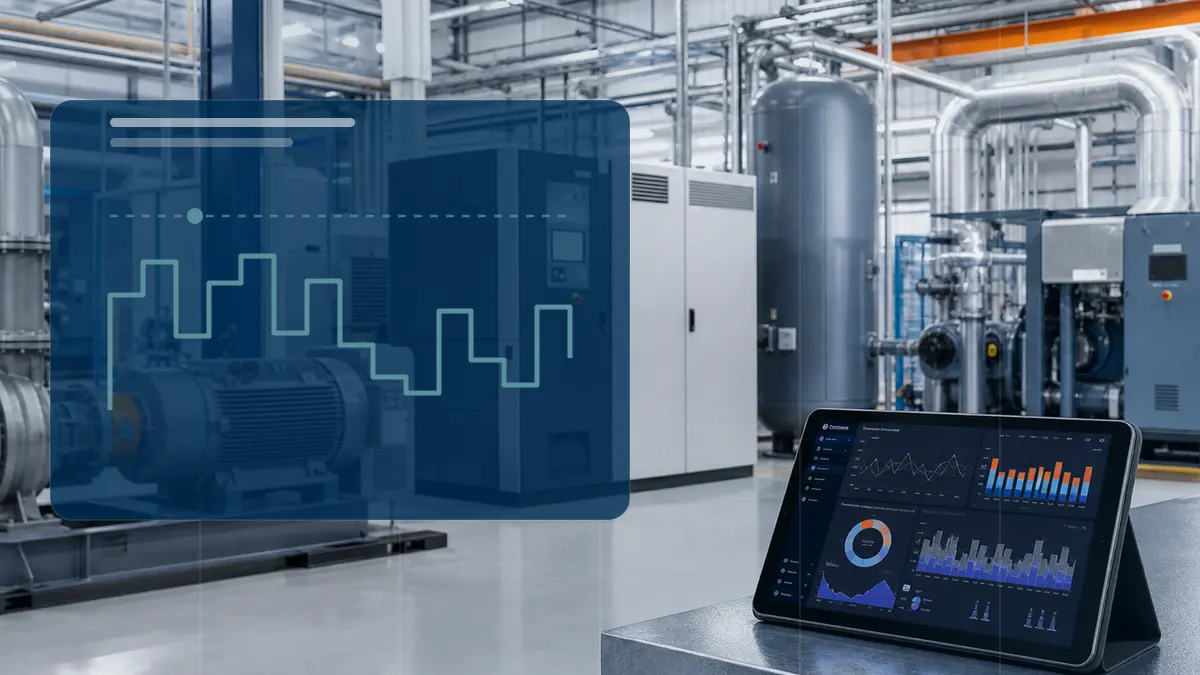
More efficient pumps and fans: scattered information versus Energy Intelligence
Pumps and fans run in almost every commercial building and factory: for heating, cooling, ventilation, process water or extraction. They rarely attract attention, precisely because they are so reliable. A heating pump in the basement running day and night while a control valve sits half closed is a familiar picture. Electric motors account for a large share of business electricity consumption, and a substantial part of that drives exactly these machines. That is why they rank high in almost every energy scan.
- The power drawn by a pump or fan varies roughly with the cube of its speed: running slightly slower saves a disproportionate amount of electricity.
- Throttling with a valve or damper wastes energy as pressure loss; speed control, usually with a variable frequency drive, matches output to actual demand.
- Many measures for pumps and fans are on the Dutch Recognised Measures List (EML) and therefore fall under the legal energy saving obligation for many businesses.
Insight
Traditional approach
Information is scattered across portals, documents, invoices or separate spreadsheets.
Modern approach
Data, context and interpretation are brought together into a clear decision picture.
Decision-making
Traditional approach
Choices are made based on averages, assumptions or occasional analyses.
Modern approach
Scenarios, KPIs and current measurement data make the trade-off more concrete and repeatable.
Follow-up
Traditional approach
Actions often stay non-committal or disappear into separate reports.
Modern approach
Follow-up actions, monitoring and reporting are linked to the same energy data.
Why do pumps and fans consume so much electricity?
Three causes keep coming back. First, running hours: many pumps and fans run for thousands of hours per year, sometimes continuously. Even a modest motor then becomes a major item on the energy bill. Second, oversizing: designers build in safety margins, so the installation is larger than the process usually requires. The machine then structurally delivers more pressure or flow than needed. Third, the control method: in many installations the motor simply runs at full speed while a valve or damper chokes the flow. That is comparable to accelerating and braking at the same time. The motor keeps drawing nearly full power and the difference disappears as pressure loss and heat in the valve.
- Long running hours turn even a small machine into a large consumer.
- Oversized installations structurally deliver more pressure or flow than the process demands.
- Throttle control with valves destroys energy instead of reducing consumption.
- The problem usually sits in the system as a whole, not in a single component.
How do you make pumps and fans more efficient?
Start with the demand of the process: how much flow and pressure are actually needed, and when. Size the installation for the real demand, or correct an oversized pump, for example with a smaller impeller. Replace throttle control with speed control: a variable frequency drive lets the motor run as fast as needed. The core is the cubic relationship between speed and power: running roughly twenty percent slower cuts the power drawn roughly in half. When replacing a motor, choose a high efficiency class; the international IE classes run from IE1 to IE5 and a European regulation currently sets a legal minimum class for many new motors. Maintenance matters too: fouled impellers, worn bearings and clogged filters cost extra energy. And the simplest measure: switch off what does not need to run, with time switches or a process link.
- Size for the actual demand of the process, not for the design safety margin.
- Replace throttle control with speed control: running slower saves a disproportionate amount of power.
- Choose a motor in a high IE efficiency class when replacing one.
- Keep impellers, bearings and filters clean and in good condition.
- Only run pumps and fans when the process requires it.
What does Dutch law say and where do you start?
The Netherlands has an energy saving obligation. Business locations consuming from 50,000 kilowatt hours of electricity or 25,000 cubic metres of natural gas equivalent per year must take all energy saving measures that pay for themselves within five years. The Recognised Measures List (EML) of the Dutch agency RVO makes this concrete and includes measures for pumps, fans and electric motors, such as speed control and efficient motors. Every four years you report your status to RVO under the information duty. Start by measuring: map running hours, load profile and consumption per major machine, for example with submeters. Also know the limits. If a machine runs at nearly constant full load, speed control adds little and the drive itself causes a small loss. Some processes require constant pressure or a fixed flow; change then starts with a proper system analysis.
- The energy saving obligation applies from 50,000 kilowatt hours of electricity or 25,000 cubic metres of natural gas equivalent per year.
- Measures with a payback time of five years or less are then mandatory; the EML makes them concrete.
- Measure running hours and load profile first, before investing.
- With near constant full load, speed control adds little.
- Processes with a fixed pressure or flow requirement need a system analysis first.
Curious what this looks like with your own data?
In a no-obligation call, a specialist looks at your meters, sites and energy questions with you. Response within one business day.
Search the knowledge base
Find the answer to your question.
Search using your own words. Abbreviations and spelling variants are recognised, so EMS also finds the articles on energy management systems.
Topic