
Reducing peak load for businesses: a guide for businesses
Direct answer
Reducing peak load means lowering the highest power in kilowatts that your business draws from the grid at any single moment. You do this by spreading consumption, not running large loads at the same time, and covering peaks with storage or your own generation. This keeps you within your contracted transport capacity and avoids a costly upgrade of your Dutch grid connection.
- Clear definition
- Data-driven assessment
- Risks and opportunities visible
- Practical next steps
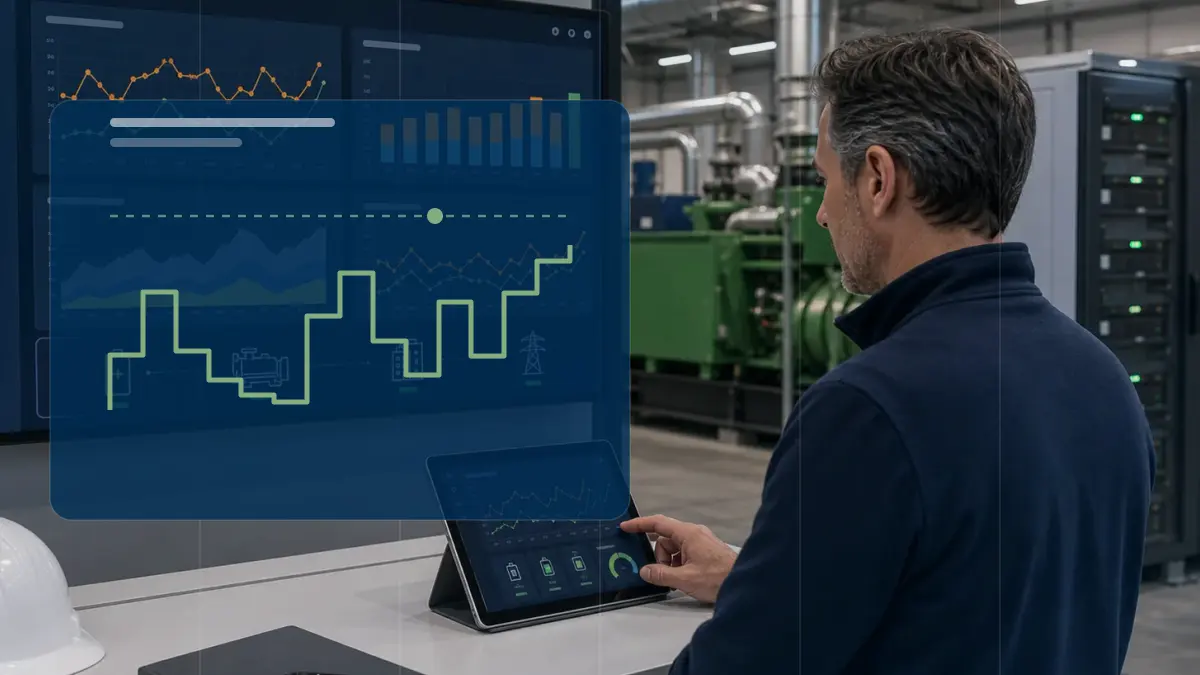
Reducing peak load for businesses: scattered information versus Energy Intelligence
Every business has moments when many devices draw power at once: the morning start, a production peak, charging points charging together. That highest moment determines how much transport capacity you need and whether your connection is large enough. In areas with grid congestion, more capacity is often not readily available. It then pays to lower the peak yourself instead of waiting for a heavier connection. This matters for production sites, cold stores, logistics locations and anyone with growing electricity use.
- The peak is the highest moment: move heavy loads to quiet hours and do not let them switch on simultaneously.
- First measure where your peaks occur with an energy monitoring or energy management system; without insight you are steering blind.
- A battery or your own generation can flatten the peak, so you draw less power from the grid at the busiest moment.
Insight
Traditional approach
Information is scattered across portals, documents, invoices or separate spreadsheets.
Modern approach
Data, context and interpretation are brought together into a clear decision picture.
Decision-making
Traditional approach
Choices are made based on averages, assumptions or occasional analyses.
Modern approach
Scenarios, KPIs and current measurement data make the trade-off more concrete and repeatable.
Follow-up
Traditional approach
Actions often stay non-committal or disappear into separate reports.
Modern approach
Follow-up actions, monitoring and reporting are linked to the same energy data.
How do you reduce peak load in practice?
Start by measuring. An energy monitoring system shows when your consumption peaks; an energy management system can then control devices automatically. Next, find the large loads that run at the same time and pull them apart. You can shift consumption to quiet hours or to moments with plenty of your own solar power, change the order of processes, and run charging points, cooling installations and heat pumps in a spread out way instead of simultaneously. A battery or your own generation covers the remaining peak, so you draw less from the grid at the busiest moment. This lowers your highest power without total production having to shrink.
- Measure your peaks with an energy monitoring or energy management system.
- Avoid simultaneity: do not let heavy loads switch on together.
- Shift consumption to off-peak hours or moments with plenty of own generation.
- Control charging points, cooling and heat pumps in a spread out way.
- Flatten the remaining peak with a battery or your own generation.
Why does lowering your peak pay off?
Your contracted transport capacity is the maximum power in kilowatts you are entitled to at any moment, recorded in the connection and transport agreement with the grid operator. That capacity is set by your highest peak, not by your average consumption. If you lower the peak, you need less transport capacity and can often manage with your current connection. That is important in areas with grid congestion, where a new or heavier connection may sit on a waiting list. It also leaves room to grow within the capacity you already have. The costs for using the grid are part of that same agreement.
- Contracted transport capacity follows your highest peak, not your average.
- A lower peak means less transport capacity is needed.
- You avoid an upgrade that can take a long time in a congestion area.
- You keep room to grow within your existing connection.
What steps and pitfalls are there?
First map your energy profile: when do you peak and which devices cause it. Then look at which processes and installations you can technically shift or control. Discuss the options in your region with your grid operator; if you can adjust your consumption flexibly, there are arrangements such as a capacity steering contract, where you temporarily take less at busy moments in return for a fee. Then install an energy management system and keep monitoring, so you check the effect. The biggest pitfall is steering without measuring: if you shift consumption without insight, you sometimes only move the peak to another moment. So test and measure afterwards.
- First map your energy profile and peak moments.
- Determine which processes and devices you can shift or control.
- Discuss flexible arrangements in your region with the grid operator.
- Keep measuring after each measure: steering without insight moves the peak.
- Consider sharing a connection with a neighbouring business with a complementary profile.
Curious what this looks like with your own data?
In a no-obligation call, a specialist looks at your meters, sites and energy questions with you. Response within one business day.
Search the knowledge base
Find the answer to your question.
Search using your own words. Abbreviations and spelling variants are recognised, so EMS also finds the articles on energy management systems.
Topic