
Optimising a compressed air system: a guide for businesses
Direct answer
Optimising a compressed air system means reducing the energy use of your compressor installation by fixing leaks, lowering the working pressure, improving the control strategy and recovering compressor heat. Compressed air is an expensive form of energy: the compressor converts electricity into pressurised air, and most of that energy leaves the machine as heat. That is why every cubic metre of air you do not have to produce pays off.
- Clear definition
- Data-driven assessment
- Risks and opportunities visible
- Practical next steps
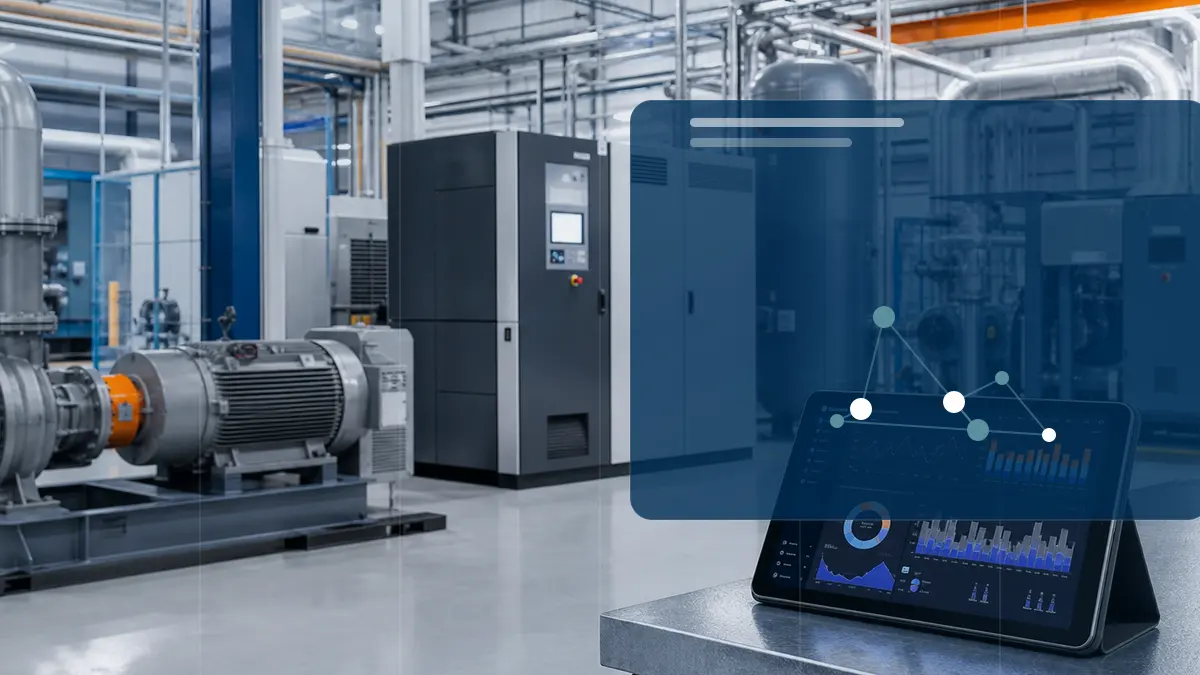
Optimising a compressed air system: scattered information versus Energy Intelligence
Almost every production site uses compressed air: for cylinders, tools, packaging lines or blow cleaning. The compressor usually runs out of sight, in a separate room, drawing electricity year after year. Companies that have never audited the system typically pay for air that leaks away or for pressure nobody needs. This topic matters to every business owner or facility manager with a compressor installation, from a small workshop to a factory with a full compressed air network.
- Leakage is often the largest loss in practice: leaks run day and night, even when nobody is working, and can be found with a night measurement or an ultrasonic detector.
- Every bar of reduced working pressure saves compressor energy; many systems are set higher than the equipment actually requires.
- Several compressed air measures appear on the Recognised Measures List (EML) of the Dutch agency RVO and thus fall under the Dutch energy saving obligation for larger consumers.
Insight
Traditional approach
Information is scattered across portals, documents, invoices or separate spreadsheets.
Modern approach
Data, context and interpretation are brought together into a clear decision picture.
Decision-making
Traditional approach
Choices are made based on averages, assumptions or occasional analyses.
Modern approach
Scenarios, KPIs and current measurement data make the trade-off more concrete and repeatable.
Follow-up
Traditional approach
Actions often stay non-committal or disappear into separate reports.
Modern approach
Follow-up actions, monitoring and reporting are linked to the same energy data.
Why is compressed air such an expensive form of energy?
Compressed air is produced by compressing air with an electrically driven compressor. Compression releases a lot of heat: most of the electricity taken in leaves the compressor as heat, and only a small part reaches your machines as useful pressure. That makes compressed air one of the most expensive forms of energy per unit of delivered work in a company. The losses do not stop at the compressor. Leaks in couplings, hoses and fittings blow air away continuously, including at weekends. A compressor idling without delivering air, known as running unloaded, also consumes electricity without any output in return. Unnecessary pressure and pressure drop across dirty filters increase consumption further.
- Most of the electricity taken in becomes heat, not useful pressure.
- Leaks consume energy as long as the network is pressurised, so also outside working hours.
- Unloaded running hours cost electricity without delivering any compressed air.
- Dirty filters and a higher working pressure than needed drive consumption up further.
Which measures deliver the most?
Start with leakage: locate leaks with an ultrasonic detector or a measurement outside production hours, then repair them and repeat periodically, because leaks return. Next, lower the working pressure step by step to the lowest level at which all equipment still functions properly; many systems are set too high out of habit. Then look at the control strategy: a variable speed compressor matches its output to demand and limits unloaded running, and good sequencing of multiple compressors prevents machines from idling unnecessarily. Recover compressor heat for space heating or process water. Finally, avoid improper use: blow cleaning with compressed air guns can often be done with a blower or in a different way altogether. Replace dirty filters on time and shut the network down outside operating hours with a valve or timer.
- Find and repair leaks and schedule this as a recurring maintenance round.
- Lower the working pressure step by step to the minimum the equipment needs.
- Variable speed drives and smart sequencing limit unloaded and unnecessary running hours.
- Heat recovery puts compressor heat to use for heating or process water.
- Use compressed air only where truly needed; blowing can often be done with a blower.
How do you measure waste and what does Dutch law say?
Measuring starts simply: check outside production hours how often the compressor loads while nobody is using air. What it delivers then is almost entirely leakage loss. Running hour counters also show how many hours the installation spends unloaded. For a deeper view, commission an air flow measurement or system audit. There is also a legal side. Companies using more than 50,000 kilowatt hours of electricity or 25,000 cubic metres of natural gas equivalent per year fall under the Dutch energy saving obligation. They must implement all measures with a payback period of five years or less. The Recognised Measures List of the Dutch agency RVO includes compressed air measures such as limiting leakage and recovering compressor heat. Keep the limits in mind: some processes require a fixed minimum pressure or specific air quality, so not every measure fits every installation.
- A measurement outside production hours makes the leakage loss directly visible.
- Read unloaded hours from the compressor controller or a running hour counter.
- The Dutch energy saving obligation currently applies from 50,000 kilowatt hours or 25,000 cubic metres of natural gas equivalent per year.
- Compressed air measures on the EML with a payback period of five years or less are then mandatory.
- Process requirements for pressure and air quality set the lower limit of what is possible.
Curious what this looks like with your own data?
In a no-obligation call, a specialist looks at your meters, sites and energy questions with you. Response within one business day.
Search the knowledge base
Find the answer to your question.
Search using your own words. Abbreviations and spelling variants are recognised, so EMS also finds the articles on energy management systems.
Topic