
Peak shaving: a guide for businesses
Direct answer
Peak shaving is flattening the peaks in your electricity demand, measured in kilowatts. On the busiest moments you briefly lower demand, or you top up from a battery or your own generation. This keeps you within your contracted transport capacity without having to upgrade your grid connection. It cuts grid costs that are set by the peak and frees room on a congested network.
- Clear definition
- Data-driven assessment
- Risks and opportunities visible
- Practical next steps
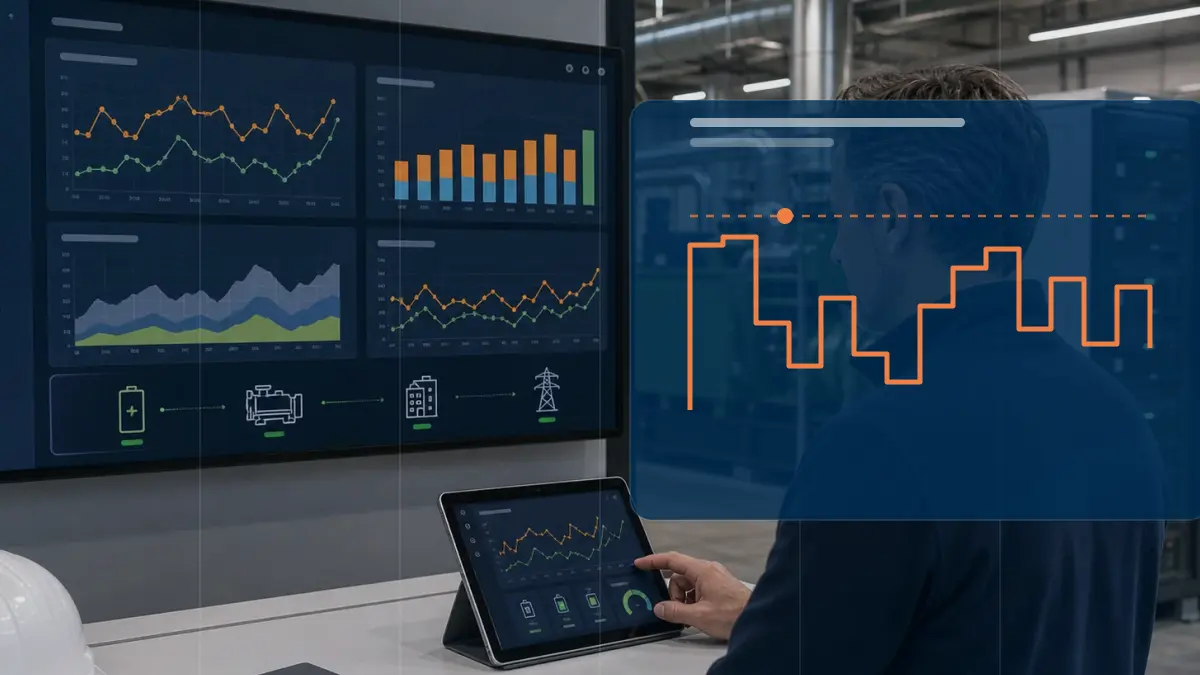
Peak shaving: scattered information versus Energy Intelligence
On a business park, machines, cooling and charging points sometimes draw power at the same time. In that single moment the demanded power shoots up, while it stays low for the rest of the day. That short peak determines how heavy your connection must be and drives your grid costs. In areas with grid congestion there is often no room to upgrade either. Peak shaving matters to any business that wants to tame the peak without shutting down operations.
- Peak shaving targets power in kilowatts at peak moments, not the total consumption in kilowatt-hours over a day.
- In the Netherlands your grid costs and your contracted transport capacity depend on your highest peak; a lower peak often means a cheaper contract and less need to upgrade.
- You flatten the peak with a battery, by spreading out processes, by steering charging, or by adding your own generation or a combined heat and power unit.
Insight
Traditional approach
Information is scattered across portals, documents, invoices or separate spreadsheets.
Modern approach
Data, context and interpretation are brought together into a clear decision picture.
Decision-making
Traditional approach
Choices are made based on averages, assumptions or occasional analyses.
Modern approach
Scenarios, KPIs and current measurement data make the trade-off more concrete and repeatable.
Follow-up
Traditional approach
Actions often stay non-committal or disappear into separate reports.
Modern approach
Follow-up actions, monitoring and reporting are linked to the same energy data.
How does peak shaving work?
Peak shaving focuses on power, expressed in kilowatts, at the moment your demand is highest. Your total consumption over the day can stay the same; what matters is the height of the peak. You can lower that peak in two ways. You temporarily reduce demand, for example by not running appliances at the same time. Or you top up the peak from another source, such as a battery that charged earlier, solar panels or a combined heat and power unit. The grid operator then sees a flatter line. Your connection can be lighter and you stay within the capacity you agreed with the grid operator.
- The measure is power in kilowatts at the busiest moment, not the total in kilowatt-hours.
- Reducing demand: not letting appliances and processes peak at the same time.
- Topping up the peak: drawing from a battery, own generation or a combined heat and power unit.
- The goal is a flatter demand line, not necessarily less total consumption.
When will you encounter it?
Peak shaving becomes relevant as soon as your peak drives your costs or your growth. Your contracted transport capacity is the amount of power you agreed with the grid operator, and part of your grid costs is tied to it. A high, short peak forces a heavy contract, even if you rarely reach that peak. If you want to expand, electrify or install charging points, in a congestion area you often hit the limit of your connection. Upgrading there can take years or be impossible. By flattening the peak you use your existing connection better and keep room for new equipment, without joining a waiting list.
- Your grid costs are partly tied to your highest peak and your contracted transport capacity.
- A lower peak allows a lighter, often cheaper contract.
- In a congestion area, upgrading can take a long time or be impossible.
- Flattening creates room to expand or electrify within the existing connection.
What can you do yourself?
Start with insight: measure when your peaks occur and what causes them. A peak often arises because installations happen to coincide. By spreading out processes, part of the peak disappears without any investment. Think of not starting cooling and machines at the same time, or planning and steering vehicle charging outside the busiest hours. If a hard peak remains, a battery can absorb it by charging outside the peak and discharging during it. Own generation or a combined heat and power unit can top up at peak moments. Weigh the costs and permit requirements, and have an energy adviser calculate the effect on your consumption and connection before you invest.
- First measure when and why your peaks occur.
- Spread out processes: do not start installations simultaneously.
- Steer vehicle charging towards quieter moments.
- Absorb the remaining peak with a battery or own generation and calculate the effect beforehand.
Curious what this looks like with your own data?
In a no-obligation call, a specialist looks at your meters, sites and energy questions with you. Response within one business day.
Search the knowledge base
Find the answer to your question.
Search using your own words. Abbreviations and spelling variants are recognised, so EMS also finds the articles on energy management systems.
Topic