
Technology
Article 9 of 13 · Technology and AIOT-IT integration: a guide for businesses
Direct answer
OT-IT integration is the controlled linking of operational technology, such as PLCs, SCADA systems, building management systems and meters, to IT systems such as ERP, cloud platforms and analytics tools. Organisations do this to combine production and energy data for real-time insight and automation. Such a link requires careful security, because a connection to office IT can also open a route to critical processes.
- Clear definition
- Data-driven assessment
- Risks and opportunities visible
- Practical next steps
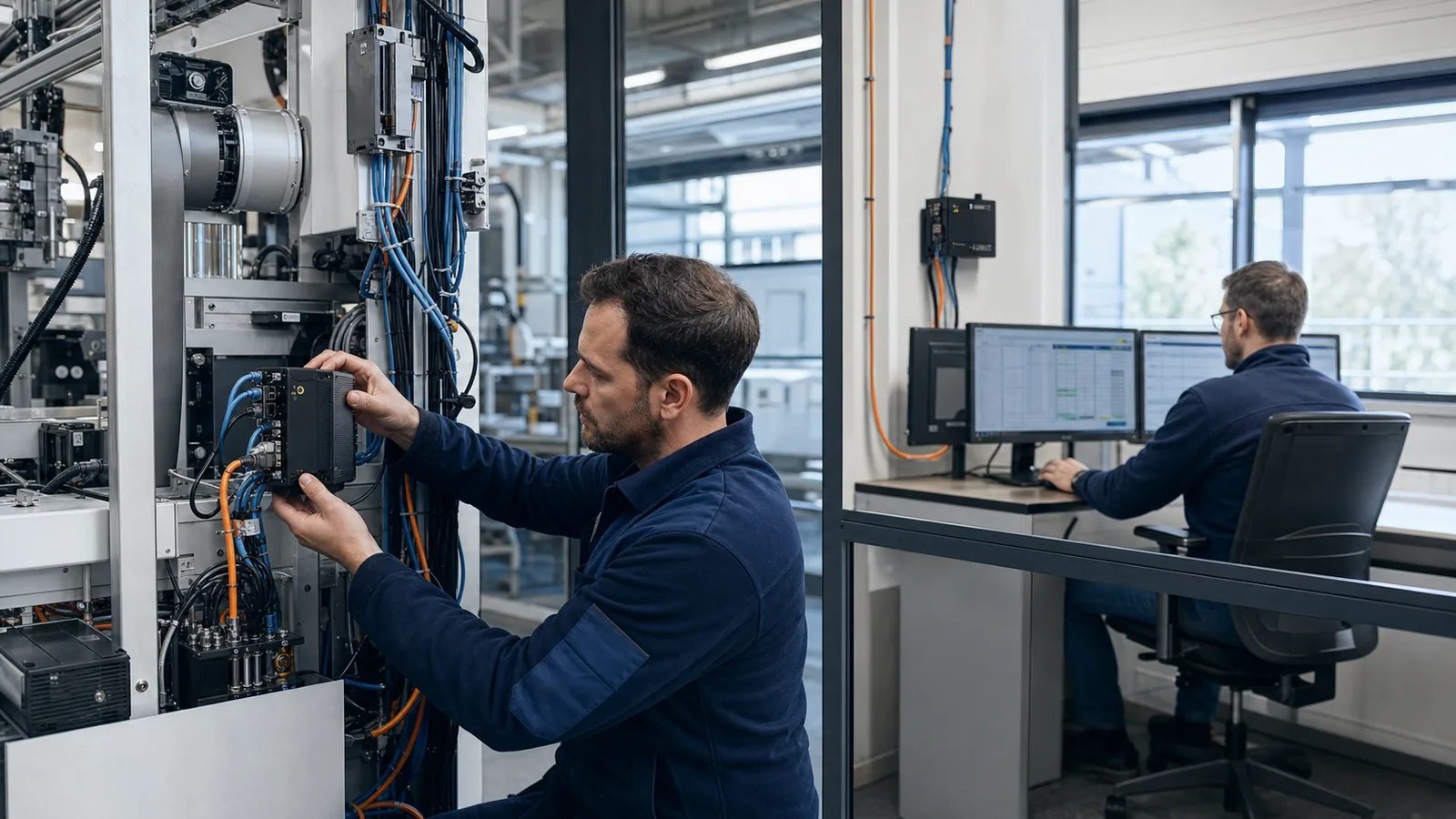
OT-IT integration: scattered information versus Energy Intelligence
Many organisations run two separate worlds: the factory floor or plant room with control systems, and the office with administration and cloud applications. Picture a manufacturer that wants to see energy consumption per machine next to the production schedule. That information sits in separate systems that historically never talked to each other. As energy costs, grid congestion and reporting obligations gain weight, the need to connect these worlds grows. Connecting them is not a matter of pulling a cable, but a project involving technology, security and cooperation between teams.
- OT controls physical processes, IT processes information: a link makes operational data usable for analysis, reporting and energy management.
- Segmentation with a separate buffer zone (DMZ) keeps office IT and process control apart and limits the impact of an incident.
- Appoint an owner for every link in advance: unclear ownership between OT and IT teams is a common cause of problems.
Insight
Traditional approach
Information is scattered across portals, documents, invoices or separate spreadsheets.
Modern approach
Data, context and interpretation are brought together into a clear decision picture.
Decision-making
Traditional approach
Choices are made based on averages, assumptions or occasional analyses.
Modern approach
Scenarios, KPIs and current measurement data make the trade-off more concrete and repeatable.
Follow-up
Traditional approach
Actions often stay non-committal or disappear into separate reports.
Modern approach
Follow-up actions, monitoring and reporting are linked to the same energy data.
Why do organisations connect OT to IT?
The value lies in combining data that currently lives apart. Meters and control systems know exactly what installations are doing, but that knowledge often stays inside the technical environment. IT systems hold schedules, costs and reports, but lack the live picture from the shop floor. By connecting both, you see in real time what processes consume and how they perform. That enables automation: processes can respond to demand peaks, contract limits or the production schedule. Reporting on energy and emissions also becomes easier, because the source data arrives automatically. For many organisations it starts small: first read metering data into a dashboard, and only then move on to control.
- Real-time insight: consumption and performance per installation next to schedules and costs.
- Automation: letting processes respond to demand peaks or contract limits.
- Reporting: energy and emissions figures straight from the source instead of collected by hand.
- Maintenance: unusual consumption can be an early sign of wear or a fault.
What risks come with such a link?
OT and IT were traditionally kept strictly separate. The Purdue model describes that separation as layers: field devices and control at the bottom, business systems at the top, with clear transitions in between. Every new link partially breaks that separation and therefore deserves attention. The Dutch National Cyber Security Centre (NCSC) warns that attackers can use a link between IT and OT to reach systems that control physical processes. OT also behaves differently from office IT: an update or network scan that is harmless in the office can disrupt a control system. Much equipment stays in service for decades and cannot always be patched. Finally, the teams differ: IT prioritises data confidentiality, OT prioritises availability and process safety.
- Attack path: an IT link can give access to process control.
- Disruption: scans and updates from the IT world can make OT systems falter.
- Legacy: old equipment often cannot be patched and runs outdated software.
- Culture: OT teams and IT teams work with different priorities and methods.
How do you approach OT-IT integration safely?
Start with an inventory: which systems, devices and links already exist. Then segment the network into zones, so that office IT and process control never touch each other directly. Place a separate buffer zone between them, a DMZ, where data servers handle the exchange. If you only need metering data, choose one-way traffic: data may leave the OT environment, but nothing comes in. A data diode enforces this technically. Also arrange ownership: appoint one responsible person per link and have OT and IT assess changes together. International guidelines such as NIST SP 800-82 describe this approach in detail. Make agreements with suppliers about remote access as well.
- First inventory all equipment, systems and existing links.
- Segment the network and place a DMZ between OT and IT.
- Choose one-way traffic or a data diode if you only need to read data.
- Appoint one owner per link and assess changes jointly.
- Make agreements on remote access by suppliers.
Curious what this looks like with your own data?
In a no-obligation call, a specialist looks at your meters, sites and energy questions with you. Response within one business day.
Search the knowledge base
Find the answer to your question.
Search using your own words. Abbreviations and spelling variants are recognised, so EMS also finds the articles on energy management systems.
Topic