
Real estate
Article 14 of 16 · Buildings and real estateMulti-tenant real estate and energy costs: a guide for businesses
Direct answer
In multi-tenant real estate, several tenants share one building and usually one main grid connection: the owner or property manager buys the energy and passes the costs on through the service charges. The costs are divided based on square metres, submeters or another allocation key. Without individual metering, the settlement remains an estimate and tenants have no incentive to save energy.
- Clear definition
- Data-driven assessment
- Risks and opportunities visible
- Practical next steps
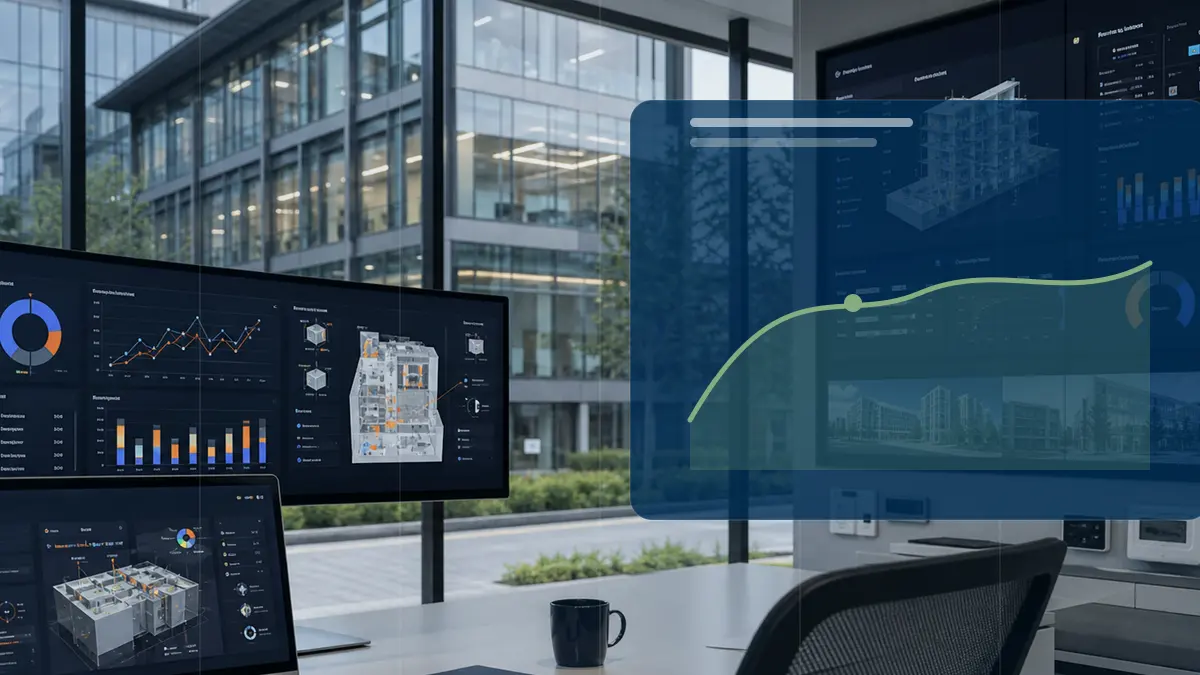
Multi-tenant real estate and energy costs: scattered information versus Energy Intelligence
A multi-let office building, a business centre or a shopping centre: wherever several companies share one roof, the energy bill arrives through the landlord. The facility manager or property manager then gets the questions: why am I paying this amount, and why the same as the neighbour with a server room? This topic matters to Dutch owners and managers who want to settle costs fairly, and to tenants who want a grip on a cost item they never contracted themselves.
- The owner or property manager holds the energy contract on the main connection and passes the costs on through the service charges; tenants often have no contract with a supplier themselves.
- Dividing costs per square metre is simple, but ignores actual consumption; submeters make each tenant's consumption visible and billable.
- The consumption of shared installations, such as lifts, climate systems and lighting in common areas, always remains a joint cost item divided through an allocation key.
Insight
Traditional approach
Information is scattered across portals, documents, invoices or separate spreadsheets.
Modern approach
Data, context and interpretation are brought together into a clear decision picture.
Decision-making
Traditional approach
Choices are made based on averages, assumptions or occasional analyses.
Modern approach
Scenarios, KPIs and current measurement data make the trade-off more concrete and repeatable.
Follow-up
Traditional approach
Actions often stay non-committal or disappear into separate reports.
Modern approach
Follow-up actions, monitoring and reporting are linked to the same energy data.
How are energy costs divided in a multi-tenant building?
Most multi-tenant buildings have one main connection for electricity and often also for gas or heat. The owner or property manager signs the energy contract and pays the supplier. Those costs are passed on to the tenants through the service charges, usually as a monthly advance with an annual settlement. The division follows an allocation key. The simplest key is the number of square metres rented. On top of that comes the consumption of shared installations, such as the climate system, lifts and lighting in common areas. If submeters are installed, the manager can bill each tenant's measured consumption and only divide the shared part through the key.
- One main connection, one energy contract: it is in the name of the owner or property manager.
- Costs are passed on through the service charges, with an advance and an annual settlement.
- The most common allocation key is the number of square metres rented.
- Shared installations form a separate joint cost item.
- With submeters, individual consumption can be settled on actual meter readings.
Why does this lead to disputes?
Without an individual meter, every tenant pays a share of the total bill, regardless of their own behaviour. A tenant with a server room and long opening hours pays the same per square metre as the neighbour who uses energy sparingly. That feels unfair and it removes the incentive to save: consuming less does not show up in the settlement. Transparency is another recurring issue. Tenants want to know how the allocation key is built up and which part of the shared installations they carry. With sustainability upgrades, a further question arises: who benefits from an investment made by the owner? That division of costs and benefits is known as the split incentive and is a topic in its own right.
- Division per square metre ignores large differences in actual consumption between tenants.
- Without individual metering, saving energy earns a tenant almost nothing in the settlement.
- Unclear allocation keys feed distrust at the annual settlement.
- Sustainability investments cause friction when the owner invests and the tenants receive the benefits: the split incentive.
What does submetering solve and where are the limits?
Submetering means installing additional meters behind the main meter, per tenant, per floor or per installation. The grid operator's main meter remains the basis for the energy bill; the submeters divide that total. This lets the manager settle on actual consumption, and every tenant sees what their own behaviour costs. That insight also helps with Dutch legal obligations, such as the energy saving obligation and making offices more sustainable. There are limits. The consumption of shared installations remains a joint item that you divide through a key. Submeters have to be managed, read out and processed in the settlement. And the arrangements belong in the lease or the service charge overview, otherwise the dispute merely shifts from the amount to the method.
- Submeters make consumption per tenant, floor or installation visible and billable.
- Settling on actual consumption restores the incentive to save energy.
- Shared consumption remains a joint item with an allocation key.
- Record the metering setup and settlement method in the lease or service charge overview.
- If you resell energy to tenants, check the current rules of the Dutch regulator ACM on supply and resale.
Curious what this looks like with your own data?
In a no-obligation call, a specialist looks at your meters, sites and energy questions with you. Response within one business day.
Search the knowledge base
Find the answer to your question.
Search using your own words. Abbreviations and spelling variants are recognised, so EMS also finds the articles on energy management systems.
Topic