
Technology
Article 11 of 13 · Technology and AILoRaWAN for submetering: a guide for businesses
Direct answer
LoRaWAN for submetering means reading additional meters, such as electricity sub-meters and water, gas and heat meters, over a wireless network with long range and very low energy use. Battery-powered meters send small messages to a gateway, which forwards them to a network server. This lets you collect meter data in places without cabling or a power supply, including basements and meter cupboards.
- Clear definition
- Data-driven assessment
- Risks and opportunities visible
- Practical next steps
LoRaWAN for submetering: scattered information versus Energy Intelligence
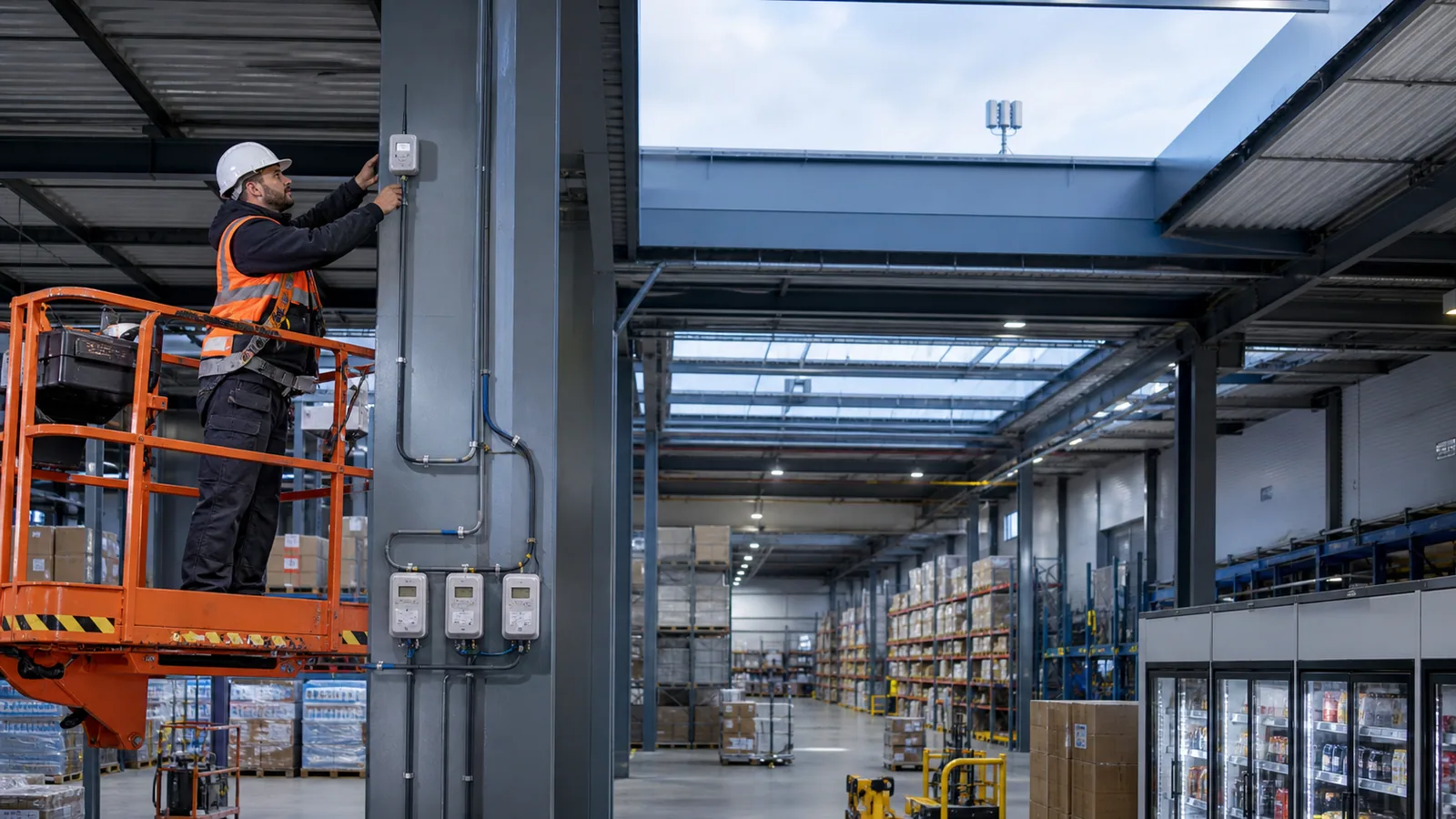
Anyone who wants to know energy use per department, machine or tenant soon runs into extra meters in awkward places: a water meter in a basement, a heat meter in a plant room, a sub-meter in a distribution board. Pulling cables to all those points is expensive and sometimes impossible. That is why many building managers and business owners choose wireless readout. LoRaWAN is a widely used technique for this, precisely because it needs little power and reaches far.
- In Europe, LoRaWAN uses the licence-free band around 868 MHz: you need no SIM card or spectrum licence and can run your own private network.
- Battery-powered LoRaWAN meters often run for years on a single battery, and the signal penetrates buildings and basements relatively well.
- LoRaWAN sends small messages at intervals: suitable for meter readings and interval data, not for real-time control of installations.
Insight
Traditional approach
Information is scattered across portals, documents, invoices or separate spreadsheets.
Modern approach
Data, context and interpretation are brought together into a clear decision picture.
Decision-making
Traditional approach
Choices are made based on averages, assumptions or occasional analyses.
Modern approach
Scenarios, KPIs and current measurement data make the trade-off more concrete and repeatable.
Follow-up
Traditional approach
Actions often stay non-committal or disappear into separate reports.
Modern approach
Follow-up actions, monitoring and reporting are linked to the same energy data.
How does LoRaWAN work?
LoRaWAN combines two layers. LoRa is the radio technique: a signal that covers long distances with very little transmit power. LoRaWAN is the network protocol on top. Meters send their messages to one or more nearby gateways. Those gateways convert the radio signal into internet traffic and forward it to a network server, which deduplicates the messages and delivers them to your software. In Europe, LoRaWAN uses the licence-free band around 868 MHz; no spectrum licence is required. The protocol defines three device classes. Class A is the most energy-efficient and the most common for meters: the device transmits briefly and only listens immediately afterwards. Class B additionally listens at fixed moments, while Class C listens almost continuously and therefore usually needs mains power.
- LoRa is the radio layer, LoRaWAN the network protocol that handles messages and security
- Gateways forward messages to a network server over the internet
- The band around 868 MHz is licence-free in Europe
- Class A devices are the most energy-efficient and the most common for sub-meters
Why is LoRaWAN a good fit for submetering?
Sub-meters often sit in places without a power supply or network cable: basements, crawl spaces, shafts and distribution boards. LoRaWAN was designed for exactly this. A battery-powered meter that sends a reading a few times per hour typically runs for years on a single battery. The signal reaches hundreds of metres to kilometres and, thanks to its low frequency, penetrates buildings relatively well. One gateway can serve many meters at once, so a single installation point per building is often enough. You can choose between connecting to a public or commercial network and running your own private network with your own gateway. With a private network, the meter data stays within your own environment and you do not depend on third-party coverage. LoRaWAN meters exist for electricity, water, gas, heat and temperature, plus pulse counters for existing meters.
- Battery power: no power supply or cabling needed at the meter
- Relatively good penetration into basements and plant rooms
- One gateway serves many meters at once
- Private network possible: meter data stays within your own environment
- Meters available for electricity, water, gas, heat and temperature
What are the limitations and points of attention?
LoRaWAN is built for small messages at intervals, not for continuous data streams. A message typically holds a few dozen bytes, enough for a meter reading with a timestamp. European rules for the band around 868 MHz also limit the transmission time per device: the so-called duty cycle, at most 1 percent of the time on the most-used channels. Real-time control of installations is therefore not possible with LoRaWAN; other techniques exist for that. Pay attention to three further points. First test coverage at the actual meter locations, because thick concrete basements or metal cabinets can still block the signal. Check that every meter is registered with unique keys; LoRaWAN encrypts messages with AES by default, but this only works well with careful key management. Finally, choose meters that support the European frequency band and are certified for LoRaWAN.
- Small messages: meter readings and interval values, no continuous data stream
- Duty cycle rules limit how often a device may transmit
- Not suitable for real-time control of installations
- Test coverage at the actual meter locations beforehand
- Key management and certification determine reliability
Curious what this looks like with your own data?
In a no-obligation call, a specialist looks at your meters, sites and energy questions with you. Response within one business day.
Search the knowledge base
Find the answer to your question.
Search using your own words. Abbreviations and spelling variants are recognised, so EMS also finds the articles on energy management systems.
Topic