
Load shifting: a guide for businesses
Direct answer
Load shifting means moving your electricity use in time to moments with a lower price, more solar or wind, or less strain on the grid. The total amount of energy stays the same; only the timing changes. For example, you move cooling, charging or a production step to a more favourable hour.
- Clear definition
- Data-driven assessment
- Risks and opportunities visible
- Practical next steps
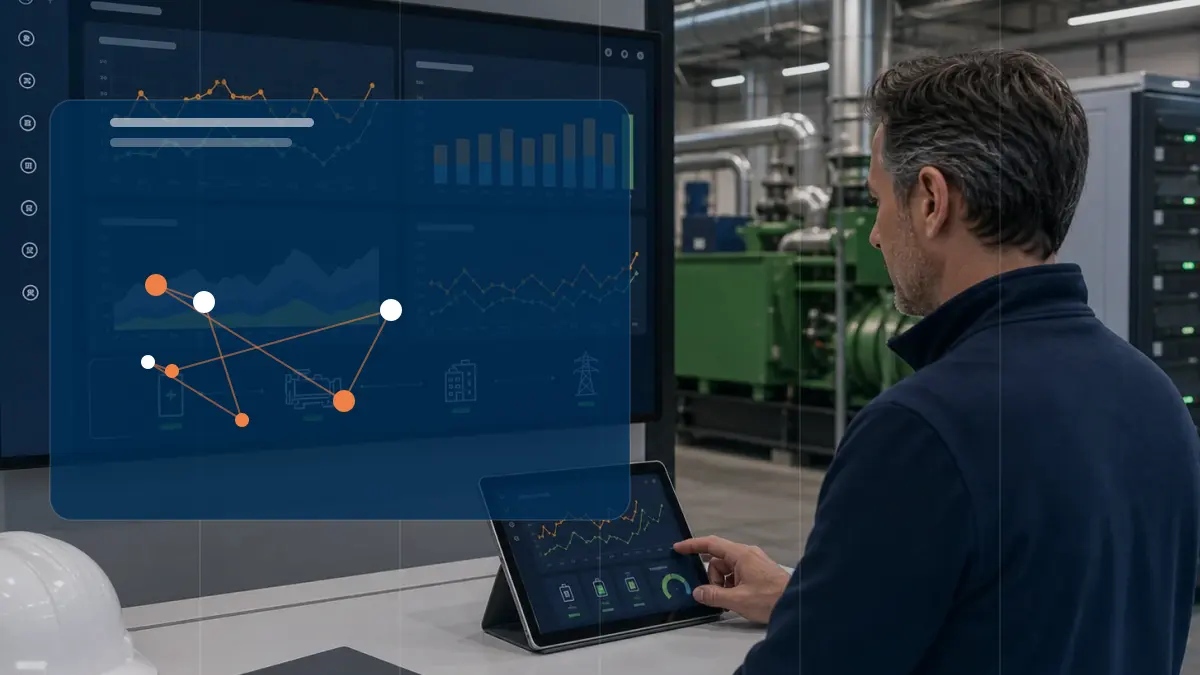
Load shifting: scattered information versus Energy Intelligence
Large parts of the Dutch electricity grid are full, and the power price varies by the hour. A business that runs its whole process during the day often pays at the most expensive and busiest moments. Yet not everything can move at will. Load shifting is about the processes you can shift: a cold store that pre-cools, a fleet that charges at night. It matters to any business with a flexible share in its consumption.
- With load shifting you move consumption to another moment; you do not use less, but at a smarter time.
- It differs from peak shaving: peak shaving cuts off the peak, while load shifting moves that peak to a quieter hour.
- It only works for processes you can postpone or bring forward, such as cooling, charging or batch production.
Insight
Traditional approach
Information is scattered across portals, documents, invoices or separate spreadsheets.
Modern approach
Data, context and interpretation are brought together into a clear decision picture.
Decision-making
Traditional approach
Choices are made based on averages, assumptions or occasional analyses.
Modern approach
Scenarios, KPIs and current measurement data make the trade-off more concrete and repeatable.
Follow-up
Traditional approach
Actions often stay non-committal or disappear into separate reports.
Modern approach
Follow-up actions, monitoring and reporting are linked to the same energy data.
How does load shifting work?
With load shifting you look at when you use electricity, not how much. You move consumption to moments with plenty of supply, such as high solar or wind output, or to moments with low demand and a lower price. On the EPEX day-ahead market the power price is set per trading period; anyone with a dynamic contract sees those prices and can steer on them. With an energy management system you steer devices automatically towards the favourable moments. The total energy over the day stays the same. Only the distribution across the day changes, so you opt for cheaper and greener power and your peak on the grid no longer coincides with the most expensive moments.
- You judge the timing of consumption, not the total amount of energy.
- Favourable moments are periods with lots of solar or wind, or with low demand.
- The EPEX day-ahead price rises and falls per trading period and guides your choice.
- An energy management system switches devices automatically at the right moment.
- Total consumption stays the same; only the distribution over the day changes.
Load shifting or peak shaving?
These two are often confused, but they do different things. Peak shaving cuts off the highest peak in your consumption, so you stay below a limit. At that moment you use less power, for example by briefly switching off a device or deploying a battery. Load shifting leaves the amount of work untouched and moves it to another hour. You do not cut anything away, you shift it. In practice, businesses combine both. A cold store that pre-cools while the sun shines shifts consumption (load shifting) and at the same time lowers demand during the evening peak hour (peak shaving). Which approach fits depends on your goal: costs, grid strain or making better use of your own generation.
- Peak shaving lowers the power drawn at the peak moment itself.
- Load shifting keeps the amount the same and moves it to another hour.
- Peak shaving cuts off; load shifting shifts along.
- In practice the two often complement each other.
- Your goal decides the choice: costs, grid strain or your own solar output.
What does a business use load shifting for?
There are three common reasons. First, costs: with a dynamic contract you move consumption to the cheaper hours on the EPEX market. Second, grid congestion: in areas where the grid is full, shifting helps you stay within your contracted transport capacity and move along with the grid operator. Third, CO2 and your own generation: by running when there is plenty of solar or wind, you use greener power and make better use of your own solar panels. The limit lies in process dependency. A cold store or charging hub is flexible, but a process that must run continuously or is tied to a fixed delivery time cannot simply be moved. So start with the question of which part of your consumption is genuinely deferrable.
- Costs: move consumption to the cheaper hours of a dynamic contract.
- Grid congestion: stay within the contracted transport capacity and move along with the grid operator.
- CO2 and own generation: run during high solar or wind and use solar panels better.
- Suitable processes: cooling, charging, heat pumps, batch production.
- The limit is process dependency: what must run continuously or on a fixed time does not shift.
Curious what this looks like with your own data?
In a no-obligation call, a specialist looks at your meters, sites and energy questions with you. Response within one business day.
Search the knowledge base
Find the answer to your question.
Search using your own words. Abbreviations and spelling variants are recognised, so EMS also finds the articles on energy management systems.
Topic