
Technology
Article 4 of 13 · Technology and AIIoT sensors for energy: a guide for businesses
Direct answer
IoT sensors for energy are small measuring devices that continuously monitor energy use and conditions in a building or process and automatically send their data to a monitoring platform. Typical examples are kWh meters, current clamps, gas and heat meters, and sensors for temperature, CO2 and occupancy. Together they show where, when and why energy is being used.
- Clear definition
- Data-driven assessment
- Risks and opportunities visible
- Practical next steps
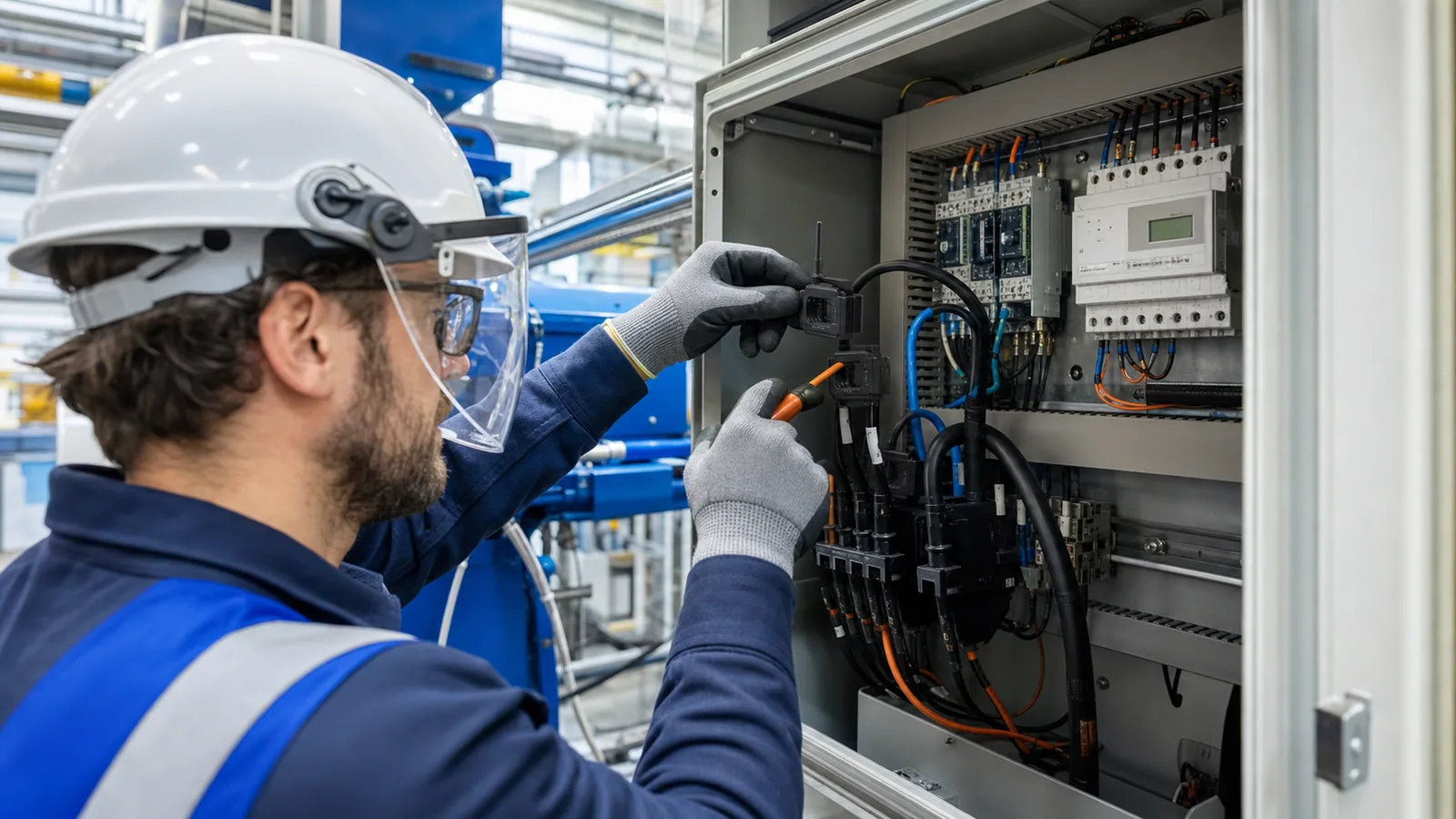
IoT sensors for energy: scattered information versus Energy Intelligence
A single main meter tells you what an entire building uses per month, but not which installation drives that use. A facility manager who wants to know why weekend consumption stays high needs readings per floor, machine or installation. IoT sensors fill that gap: they measure at detail level and forward their readings automatically. The result is a continuous data stream that reveals anomalies, exposes hidden base load and supports reporting obligations.
- Electricity is measured with kWh meters or current clamps; gas, heat and water usually via a pulse output or M-Bus.
- Data travels wired through protocols such as Modbus or M-Bus, or wirelessly through networks such as LoRaWAN, NB-IoT and wifi.
- If you bill costs to another party based on a reading, choose a meter with MID certification under EU Directive 2014/32/EU.
Insight
Traditional approach
Information is scattered across portals, documents, invoices or separate spreadsheets.
Modern approach
Data, context and interpretation are brought together into a clear decision picture.
Decision-making
Traditional approach
Choices are made based on averages, assumptions or occasional analyses.
Modern approach
Scenarios, KPIs and current measurement data make the trade-off more concrete and repeatable.
Follow-up
Traditional approach
Actions often stay non-committal or disappear into separate reports.
Modern approach
Follow-up actions, monitoring and reporting are linked to the same energy data.
Which sensors are used?
Four groups of sensors dominate business energy management. Electricity meters record consumption in kilowatt hours. Current clamps clip around an existing cable, so you can measure without interrupting the installation. Gas, heat and water meters cover the other energy flows, often through a pulse output or a readable register. Climate and occupancy sensors measure temperature, CO2 and presence. They show whether heating and ventilation match how a room is actually used. Production environments add pressure and flow meters, for example for compressed air, steam or cooling water. The Dutch recognised measures list under the energy savings obligation also names an energy registration and monitoring system that records gas and heat per hour and electricity per quarter hour.
- kWh meters and current clamps: electricity per main connection, distribution board or machine
- Gas, heat and water meters: other energy flows, often via pulse output or M-Bus
- Temperature, CO2 and occupancy sensors: context for the measured consumption
- Pressure and flow meters: process media such as compressed air, steam and cooling water
How do sensors transmit their data?
Wired sensors usually communicate through industrial protocols. Modbus is common for electricity meters and building installations, M-Bus for gas, heat and water meters. Cabling is reliable, but retrofitting an existing building takes installation work and lead time. Wireless sensors use networks such as LoRaWAN, NB-IoT or wifi. LoRaWAN is designed for battery-powered devices: it sends small messages over long distances with low energy use, in licence-free frequency bands. NB-IoT runs on the mobile networks of telecom operators and suits locations without a network of your own. Wifi offers plenty of bandwidth but draws more power and needs solid coverage across the site. A gateway or data logger bundles the readings and forwards them to the monitoring platform, usually in the cloud.
- Modbus: wired standard for electricity meters and building installations
- M-Bus: wired standard for gas, heat and water meters
- LoRaWAN: wireless, long range and low power for small messages
- NB-IoT: wireless via the mobile network, no network of your own required
- Wifi: high bandwidth, but higher power draw and dependent on coverage
What should you consider when selecting and managing sensors?
Start from the goal and choose the sensor to match. Indicative measurement is often enough for control and analysis; for billing or charging costs to another party, European metrology rules apply and you choose a meter with MID certification under Directive 2014/32/EU. Also check measurement accuracy, battery life, wireless range through concrete and steel, and security: encrypted connections, unique passwords and an update policy, in line with the recommendations of the EU agency ENISA. The biggest pitfalls come after installation. Sensor sprawl arises when departments install sensors independently without a register or naming convention. Data quality degrades silently through empty batteries, dropped connections or wrongly scaled pulse values. Plan for maintenance: a sensor register, automatic outage checks and periodic calibration.
- The goal sets the requirement: indicative measurement for analysis, MID-certified for billing
- Check accuracy class, battery life and range at the actual mounting location
- Secure sensors and gateways: encryption, unique passwords, firmware updates
- Prevent sprawl with a sensor register and consistent naming
- Monitor data quality automatically: outages, gaps and abnormal values
Curious what this looks like with your own data?
In a no-obligation call, a specialist looks at your meters, sites and energy questions with you. Response within one business day.
Search the knowledge base
Find the answer to your question.
Search using your own words. Abbreviations and spelling variants are recognised, so EMS also finds the articles on energy management systems.
Topic