
Market dynamics
Article 12 of 20 · Energy markets and market dynamicsGuarantees of origin (GvO): a guide for businesses
Direct answer
A guarantee of origin (garantie van oorsprong) is a digital certificate proving that 1 megawatt-hour of electricity was generated from a specific renewable source, such as wind or solar. In the Netherlands, VertiCer issues these certificates. A supplier cancels guarantees of origin to demonstrate that the power you use is green. The certificate thereby makes electricity green on paper.
- Clear definition
- Data-driven assessment
- Risks and opportunities visible
- Practical next steps
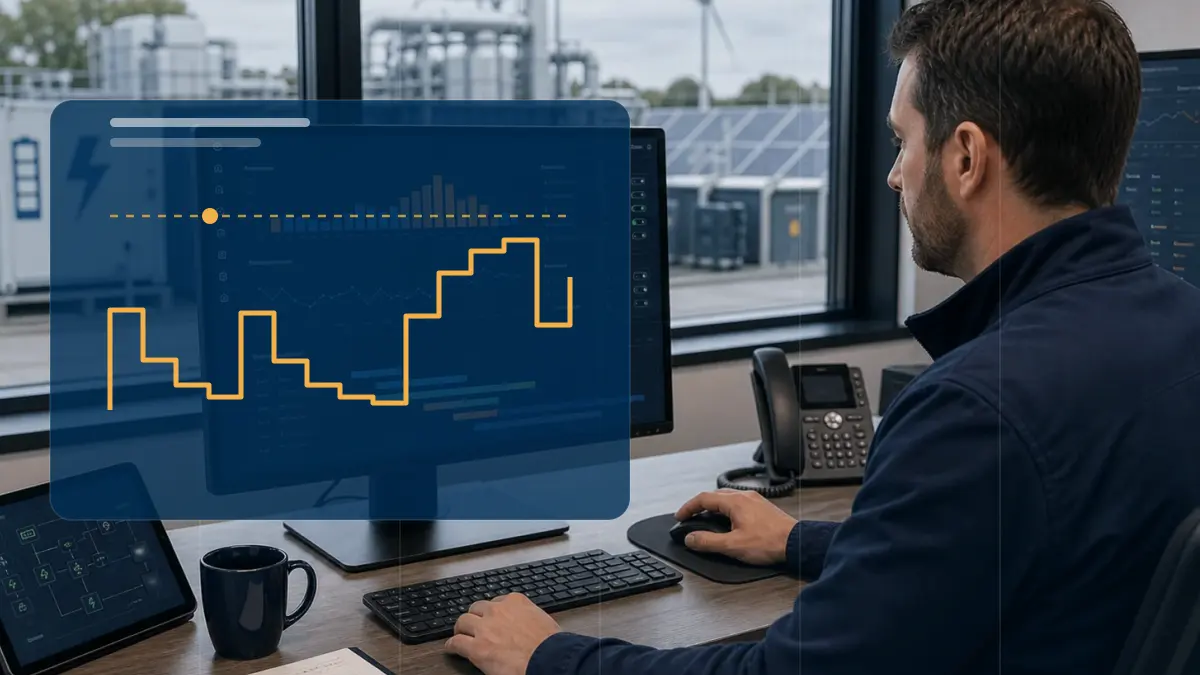
Guarantees of origin (GvO): scattered information versus Energy Intelligence
Almost every supplier offers green power, but physical electricity from wind, solar or gas cannot be distinguished within the grid. So an accounting system is needed to show that green power was generated somewhere for what you use. The guarantee of origin is that proof. It matters to any business that buys green power or wants to report on renewable energy internally or to customers.
- One guarantee of origin represents 1 megawatt-hour of renewably generated electricity and is issued in the Netherlands by VertiCer, formerly CertiQ.
- The certificate is traded separately from the electricity itself and works Europe-wide through the EECS system run by the Association of Issuing Bodies.
- A supplier cancels the certificates to demonstrate green power; the Dutch regulator ACM checks this through electricity labelling.
Insight
Traditional approach
Information is scattered across portals, documents, invoices or separate spreadsheets.
Modern approach
Data, context and interpretation are brought together into a clear decision picture.
Decision-making
Traditional approach
Choices are made based on averages, assumptions or occasional analyses.
Modern approach
Scenarios, KPIs and current measurement data make the trade-off more concrete and repeatable.
Follow-up
Traditional approach
Actions often stay non-committal or disappear into separate reports.
Modern approach
Follow-up actions, monitoring and reporting are linked to the same energy data.
How does a guarantee of origin work?
A producer generating renewable electricity has the metering registered. For every megawatt-hour, VertiCer, the Dutch issuing body, issues one guarantee of origin. The certificate states the energy source, the installation and the production period. The producer can sell the certificate to a supplier, who cancels it at VertiCer to make a customer's electricity green on paper. Importantly, the certificate and the physical electricity are traded separately and often go their own way. The Netherlands is connected to the European EECS system, managed by the Association of Issuing Bodies, which makes certificates from other countries usable here.
- One megawatt-hour of renewable generation yields one guarantee of origin.
- VertiCer is the issuing body in the Netherlands; CertiQ was merged into it.
- The certificate states the source, the installation and the production period.
- Through the European EECS system, foreign certificates are usable in the Netherlands.
Why is the system debated?
The core of the criticism is that a guarantee of origin is traded separately from the electricity. A hydropower plant in Norway, for example, supplies the physical power to its own grid but sells the accompanying certificate to a supplier elsewhere in Europe. At European level the supply of such certificates is ample, so the price is relatively low. A supplier can thus make grey electricity green on paper with a cheap foreign certificate, without any extra renewable capacity being added anywhere. Legally this is correct, but on balance it greens little. For anyone wanting to demonstrate genuine sustainability, merely holding certificates therefore says little about the real contribution.
- Certificate and physical electricity are traded separately and follow their own route.
- Ample supply on the European market keeps certificate prices low.
- Cheap foreign hydropower certificates add no new capacity.
- Holding certificates in itself says little about genuine sustainability.
What should you watch for when buying green?
Look beyond the green label on a contract. Ask which source the guarantees of origin come from and which country. Certificates from nearby, such as Dutch wind or solar, steer more towards local generation than surplus certificates from foreign hydropower. If you want to demonstrably contribute to new capacity, arrangements tied to a specific installation are stronger than loose certificates. The Dutch regulator ACM checks through electricity labelling whether suppliers cancel enough certificates for their green sales. That safeguards the accounting, but says nothing about the environmental gain of a specific choice. So weigh source, origin and the link to generation, not just the presence of certificates.
- Ask about the source and country of origin of the guarantees of origin.
- Certificates from local generation steer more than foreign surpluses.
- A link to a specific installation is stronger than loose certificates.
- The ACM safeguards the accounting, not the environmental gain of your choice.
Curious what this looks like with your own data?
In a no-obligation call, a specialist looks at your meters, sites and energy questions with you. Response within one business day.
Search the knowledge base
Find the answer to your question.
Search using your own words. Abbreviations and spelling variants are recognised, so EMS also finds the articles on energy management systems.
Topic