
Market dynamics
Article 6 of 20 · Energy markets and market dynamicsDynamic energy prices: a guide for businesses
Direct answer
Dynamic energy prices are energy rates that track the wholesale market and change every hour or quarter-hour. Under a dynamic contract in the Netherlands, the electricity price is linked to the day-ahead exchange, so you know a day in advance what each hour costs. On top of that come Dutch energy tax, VAT and a small purchase fee. Fixed and variable contracts instead lock the price in for longer.
- Clear definition
- Data-driven assessment
- Risks and opportunities visible
- Practical next steps
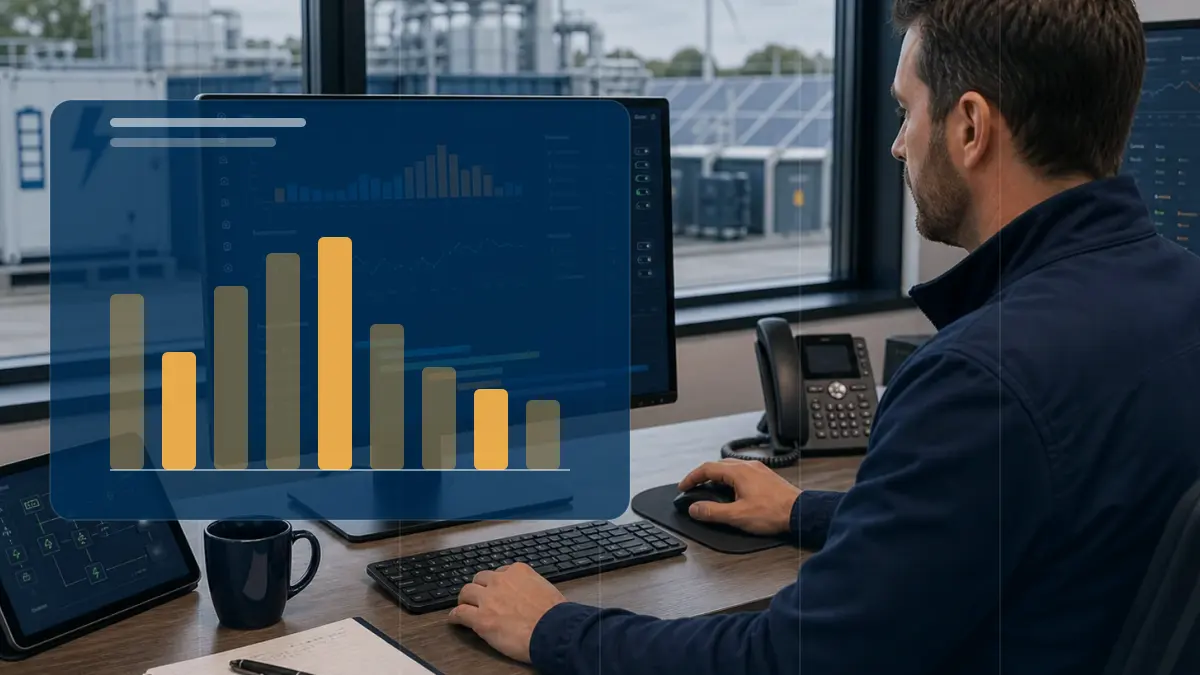
Dynamic energy prices: scattered information versus Energy Intelligence
The price on the energy exchange moves all day. When it is windy and sunny, electricity is cheap; on a windless evening peak it is expensive. With fixed and variable contracts you notice none of this, because your supplier smooths those swings. A dynamic contract passes the swing straight through. This matters to businesses that can steer their consumption, such as charging vehicles, cooling or running production at certain hours, and to anyone who wants to use their own solar or wind generation.
- The hourly prices are known a day ahead and set on the day-ahead market; for gas a daily price usually applies.
- On top of the bare exchange rate you pay Dutch energy tax, VAT and a small purchase fee, typically a few cents.
- Those who can shift consumption to cheap hours benefit most; those who cannot bear the full risk of price peaks.
Insight
Traditional approach
Information is scattered across portals, documents, invoices or separate spreadsheets.
Modern approach
Data, context and interpretation are brought together into a clear decision picture.
Decision-making
Traditional approach
Choices are made based on averages, assumptions or occasional analyses.
Modern approach
Scenarios, KPIs and current measurement data make the trade-off more concrete and repeatable.
Follow-up
Traditional approach
Actions often stay non-committal or disappear into separate reports.
Modern approach
Follow-up actions, monitoring and reporting are linked to the same energy data.
How does a dynamic energy contract work?
With a dynamic energy contract your rate tracks the wholesale market. For electricity that is the day-ahead market: every day around midday the prices for each hour of the next day are set. So you know a day in advance what each hour costs. For gas a daily price usually applies. The amount on your bill is not just that bare exchange rate. On top come Dutch energy tax, VAT and a small purchase fee from the supplier, typically a few cents per unit. With fixed and variable contracts that fee is already built into the price and you do not see it separately. Always compare the total price including taxes, not the bare supply rate.
- Electricity prices come from the day-ahead market and are known per hour or quarter-hour a day in advance.
- For gas a dynamic contract usually applies a daily price.
- On top of the exchange rate come Dutch energy tax, VAT and a purchase fee of a few cents.
- Compare the total price including taxes, not only the bare supply rate.
What can you do with it, and what are the risks?
Because the hourly prices are known in advance, you can shift consumption to the cheap hours. Often that is in the middle of the day, when there is plenty of solar and wind power. If you charge vehicles, cool, or run production that can wait, steering pays off directly. If you have your own solar panels, a dynamic rate aligns with your generation. The downside is the risk. The price can turn out much higher the next day, with sharp peaks on cold, windless evenings. Those who cannot steer consumption pay those peaks in full. A dynamic contract therefore calls for insight and active steering. The Dutch regulator ACM asks suppliers to explain clearly beforehand how it works and what the risks are.
- Shift steerable consumption to cheap hours, often midday with plenty of solar and wind.
- Your own solar or wind generation aligns well with a dynamic rate.
- Price peaks on cold, windless moments are paid in full if you cannot steer.
- The contract requires insight, measurement and active steering of your consumption.
Who is it suitable for?
A dynamic contract suits organisations that can steer their consumption and can handle the risk of fluctuating prices. Think of businesses with flexible processes, charging infrastructure, cooling with a buffer or their own generation. Without that flexibility the gain is limited and the risk weighs heavier. Fixed and variable contracts then remain more attractive. A fixed contract locks the price for one or more years and gives the most certainty. With a variable contract the price changes periodically, for example monthly or quarterly, but not per hour. The choice depends on how much you can steer and how much price certainty you need. Anyone without the time or means to respond to the hourly prices rarely gets the best out of a dynamic rate.
- Suitable for steerable consumption, charging infrastructure, buffer capacity or own generation.
- Without flexibility the risk weighs heavier than the benefit.
- A fixed contract gives price certainty; a variable contract changes periodically, not per hour.
- Base your choice on your steering room and your need for certainty.
Curious what this looks like with your own data?
In a no-obligation call, a specialist looks at your meters, sites and energy questions with you. Response within one business day.
Search the knowledge base
Find the answer to your question.
Search using your own words. Abbreviations and spelling variants are recognised, so EMS also finds the articles on energy management systems.
Topic