
Market dynamics
Article 16 of 20 · Energy markets and market dynamicsCO2 price development: a guide for businesses
Direct answer
The CO2 price is the price of an emission allowance in the European Emissions Trading System, the EU ETS: the right to emit one tonne of CO2. In the Netherlands, a national CO2 levy on industry sits on top of this, acting as a floor under the market price. Together they set the cost of emitting. The price moves with the shrinking emissions cap, the economy and energy prices.
- Clear definition
- Data-driven assessment
- Risks and opportunities visible
- Practical next steps
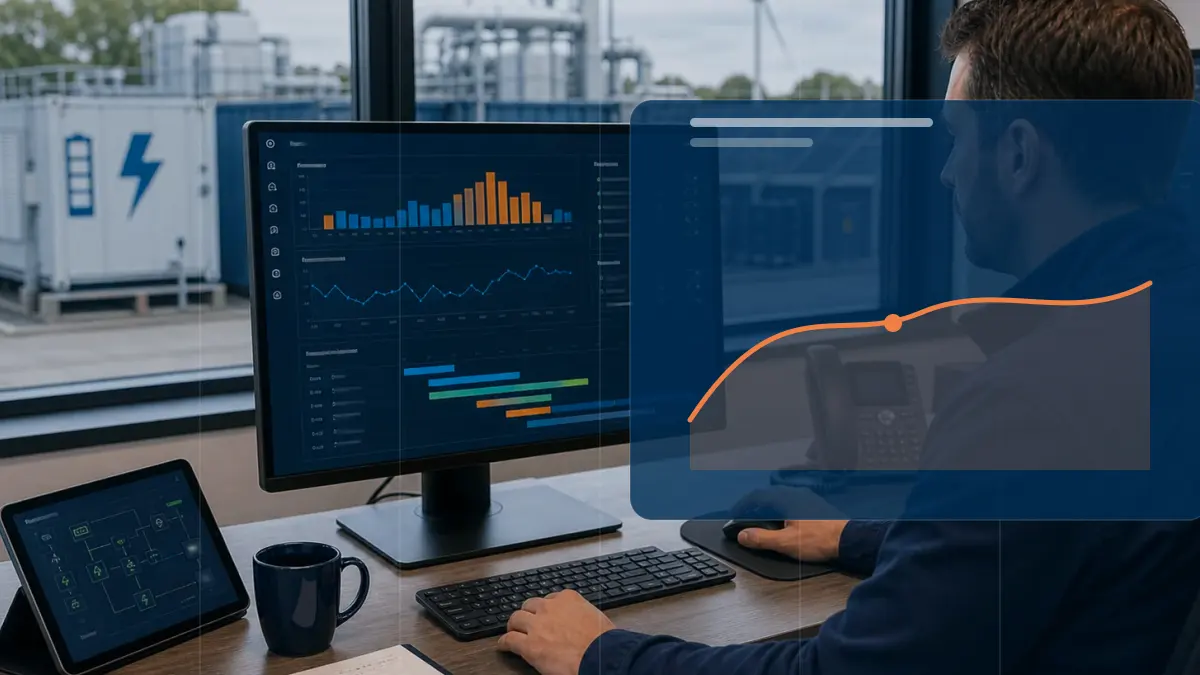
CO2 price development: scattered information versus Energy Intelligence
A factory burning natural gas, or a power plant running on coal, must surrender an emission allowance for every tonne of CO2. Those allowances have a price, and that price changes constantly. For companies with high emissions this is a growing cost that moves with the market and with policy. Anyone planning ahead wants to know which forces move that price and why it is set to rise over time. This topic mainly matters for industry, power generators and large consumers.
- The EU ETS sets a cap on emissions that falls every year; companies buy or trade allowances within that cap, and scarcity sets the price.
- The Dutch CO2 levy on industry puts a floor under the price: if the ETS price is low, the levy tops it up to a rising minimum.
- The price is deliberately intended to rise over time, because the cap and the national floor tighten each year to reward decarbonisation.
Insight
Traditional approach
Information is scattered across portals, documents, invoices or separate spreadsheets.
Modern approach
Data, context and interpretation are brought together into a clear decision picture.
Decision-making
Traditional approach
Choices are made based on averages, assumptions or occasional analyses.
Modern approach
Scenarios, KPIs and current measurement data make the trade-off more concrete and repeatable.
Follow-up
Traditional approach
Actions often stay non-committal or disappear into separate reports.
Modern approach
Follow-up actions, monitoring and reporting are linked to the same energy data.
What exactly is the CO2 price?
The CO2 price is the market price of one emission allowance in the EU ETS, the European Emissions Trading System. One allowance represents one tonne of emitted CO2. Europe sets a cap on the total emissions of the participating sectors and issues a limited number of allowances for it. Companies buy them at auctions or trade them among each other. Because the cap falls every year, allowances become scarcer and the price moves. In the Netherlands a national CO2 levy on industry sits on top of this. It acts as a floor: if the ETS price is low, the levy tops it up to a minimum that rises each year. This keeps the incentive to decarbonise in place even when the market price disappoints.
- One allowance in the EU ETS equals one tonne of CO2.
- The number of allowances is limited by a cap that falls each year.
- Companies buy allowances at auctions or trade them among each other.
- The Dutch CO2 levy on industry places a rising floor under the price.
- The Dutch part is supervised by the Dutch Emissions Authority.
Which forces move the price?
The price is an outcome of the supply of and demand for allowances. On the supply side, the cap falls step by step, making allowances scarcer. Demand moves with the economy: when industry runs at full capacity, there are more emissions and more demand for allowances. Fuel and gas prices also play a role. When gas becomes expensive, power plants sometimes switch to coal, which emits more CO2 and so needs more allowances. Policy adjusts through the Market Stability Reserve, a rule-based buffer that takes allowances out of the market when the surplus grows too large and releases them again when it becomes too small. Expectations about future policy and the expansion of the system also count.
- Supply: the emissions cap falls each year, making allowances scarcer.
- Demand: economic growth and industrial output raise the need for allowances.
- Fuels: high gas prices can make coal more attractive and push up demand.
- The Market Stability Reserve dampens surpluses and shortages by fixed rules.
- Expectations of stricter policy are priced in ahead of time.
What does this mean for your business?
For an emitting business the CO2 price is a real cost that weighs more heavily each year, because the cap and the national floor keep tightening. That is exactly the intention: the system makes polluting more expensive to reward decarbonisation. The price also works through indirectly. Electricity from fossil sources becomes more expensive as generators pass on their CO2 costs, so even those not covered by the ETS notice it on the energy bill. Alongside the existing system a second one is being introduced, called ETS2, which will price emissions from fuels in buildings and road transport. Bear in mind that the price is volatile: it can swing sharply in the short term, even though the direction over the long term is upward.
- The CO2 price is a cost that is expected to rise.
- The system is designed to make polluting more expensive than decarbonising.
- Fossil electricity becomes more expensive as generators pass on their CO2 costs.
- ETS2 will separately price fuels in buildings and road transport.
- The price is volatile; the long-term direction is up, but the path is uneven.
Curious what this looks like with your own data?
In a no-obligation call, a specialist looks at your meters, sites and energy questions with you. Response within one business day.
Search the knowledge base
Find the answer to your question.
Search using your own words. Abbreviations and spelling variants are recognised, so EMS also finds the articles on energy management systems.
Topic