
Variable frequency drives (VFD): a guide for businesses
Direct answer
A frequency converter, better known as a variable frequency drive (VFD), is power electronics that controls the frequency and voltage supplied to an electric motor. This lets the motor speed follow the actual demand steplessly, instead of always running at full speed. For pumps and fans in particular, running slightly slower cuts electricity use considerably.
- Clear definition
- Data-driven assessment
- Risks and opportunities visible
- Practical next steps
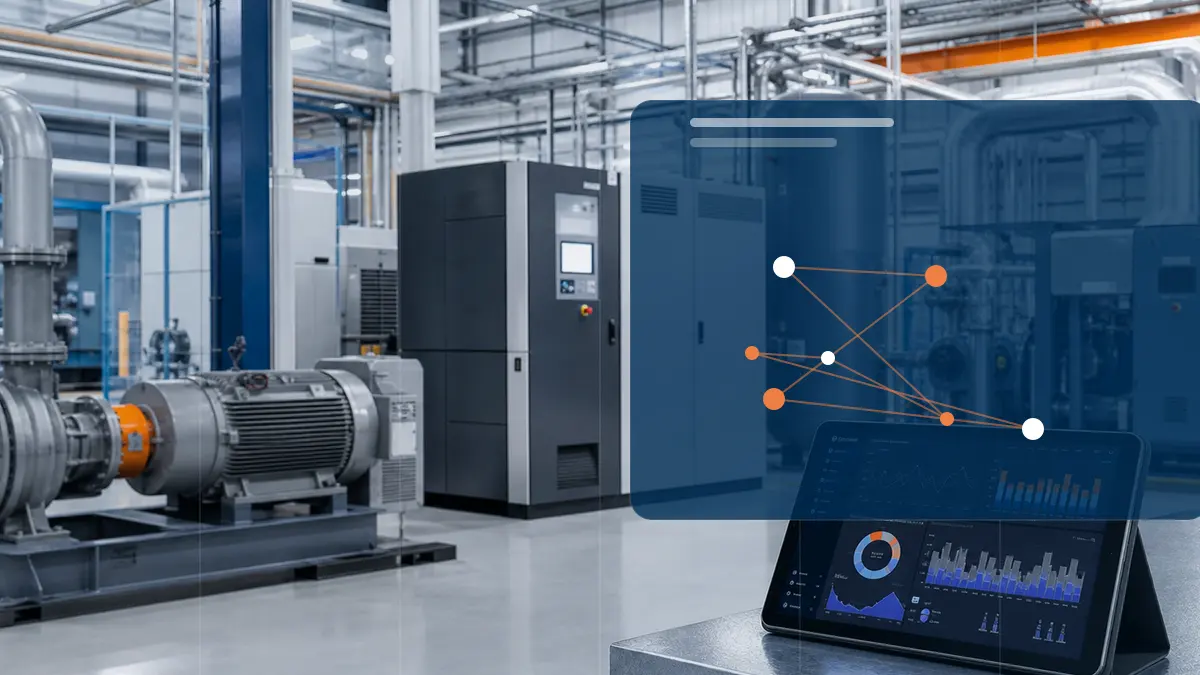
Variable frequency drives (VFD): scattered information versus Energy Intelligence
Almost every commercial building and factory runs electric motors: in pumps, fans, compressors and conveyor belts. Together those motors account for a large share of business electricity use. Yet many of them run at full speed while the process rarely demands it. An air handling unit blowing as hard at night as on a busy afternoon is the classic example. For facility managers and business owners with their own installations, speed control is therefore often one of the first places to look.
- For pumps and fans, the power drawn scales roughly with the cube of the motor speed: running slightly slower means considerably less electricity.
- A VFD starts a motor softly, without the high inrush current and the mechanical shock of a direct-on-line start.
- Speed control on electric motors is listed on the Dutch Recognised Measures List (EML) under the energy saving obligation, and may therefore be mandatory for your business.
Insight
Traditional approach
Information is scattered across portals, documents, invoices or separate spreadsheets.
Modern approach
Data, context and interpretation are brought together into a clear decision picture.
Decision-making
Traditional approach
Choices are made based on averages, assumptions or occasional analyses.
Modern approach
Scenarios, KPIs and current measurement data make the trade-off more concrete and repeatable.
Follow-up
Traditional approach
Actions often stay non-committal or disappear into separate reports.
Modern approach
Follow-up actions, monitoring and reporting are linked to the same energy data.
How does a variable frequency drive work?
A VFD sits between the grid supply and the electric motor. It first converts the fixed grid frequency of 50 hertz into direct current, and then builds a new alternating voltage from it, with exactly the frequency and voltage the desired speed requires. The motor no longer always runs at full speed, but exactly as fast as the process needs. The saving comes from the physics of moving air and liquid: for pumps and fans, the power drawn scales roughly with the cube of the speed. A small reduction in speed therefore gives a much larger drop in electricity use. In addition, the motor starts softly: the speed ramps up gradually, without a high inrush current and without a mechanical shock to couplings and belts.
- Conversion in two steps: from grid voltage to direct current and then to a controllable alternating voltage.
- The speed follows a control signal steplessly, for example from a pressure or temperature sensor.
- For pumps and fans, power scales roughly with the cube of the speed.
- A soft start prevents high inrush currents and wear on the drive train.
Where does a VFD deliver the most?
Speed control pays off wherever demand varies but the motor currently keeps running at full speed. Think of pumps in cooling and heating installations, fans in air handling units, compressors for compressed air, and conveyor belts that are not continuously fully loaded. In many installations the potential is currently thrown away: a damper throttles the air flow or a bypass returns surplus water, while the motor keeps drawing full power. A VFD tackles this at the source by slowing the motor itself down. Coupled to a sensor and a controller, it automatically keeps the pressure, flow or temperature at the desired level, even as demand changes throughout the day.
- Pumps and fans with varying demand are the classic application.
- Compressors and conveyor belts with a variable load also qualify.
- Dampers and bypass controls are signs that speed control could deliver value.
- Combine the drive with a sensor, so the speed automatically follows demand.
Points of attention and limits
A VFD is not automatically the right choice. If a motor runs at full load almost all the time, there is little to control and the electronics only add a small loss of their own. Furthermore, the rectifier in the drive distorts the current it draws from the grid: this harmonic pollution can disturb other equipment and sometimes requires filters or line reactors. Also consider the installation: the drive produces heat and needs a clean, well cooled location, for example a ventilated switchboard cabinet. For older motors, have a specialist check whether the windings and bearings are suitable for being fed from a drive. In the Netherlands, speed control on electric motors is listed on the Recognised Measures List (EML) of the energy saving obligation; for many businesses it is therefore more than optional.
- At near-constant full load a VFD adds little and introduces a small loss of its own.
- Harmonic pollution of the grid sometimes requires filters or line reactors.
- Reserve space and cooling: the drive produces heat in the switchboard cabinet.
- For older motors, have their suitability for drive operation checked.
- Speed control is listed on the Dutch Recognised Measures List (EML) under the energy saving obligation.
Curious what this looks like with your own data?
In a no-obligation call, a specialist looks at your meters, sites and energy questions with you. Response within one business day.
Search the knowledge base
Find the answer to your question.
Search using your own words. Abbreviations and spelling variants are recognised, so EMS also finds the articles on energy management systems.
Topic