
Flexibility and cybersecurity: a guide for businesses
Direct answer
With energy flexibility, external parties and software control devices remotely, such as batteries, charging stations and processes. Cybersecurity is crucial here, because every digital link that enables that control is also a possible way in for misuse. Good security keeps the control reliable and thereby protects the stability of your installation and the Dutch grid.
- Clear definition
- Data-driven assessment
- Risks and opportunities visible
- Practical next steps
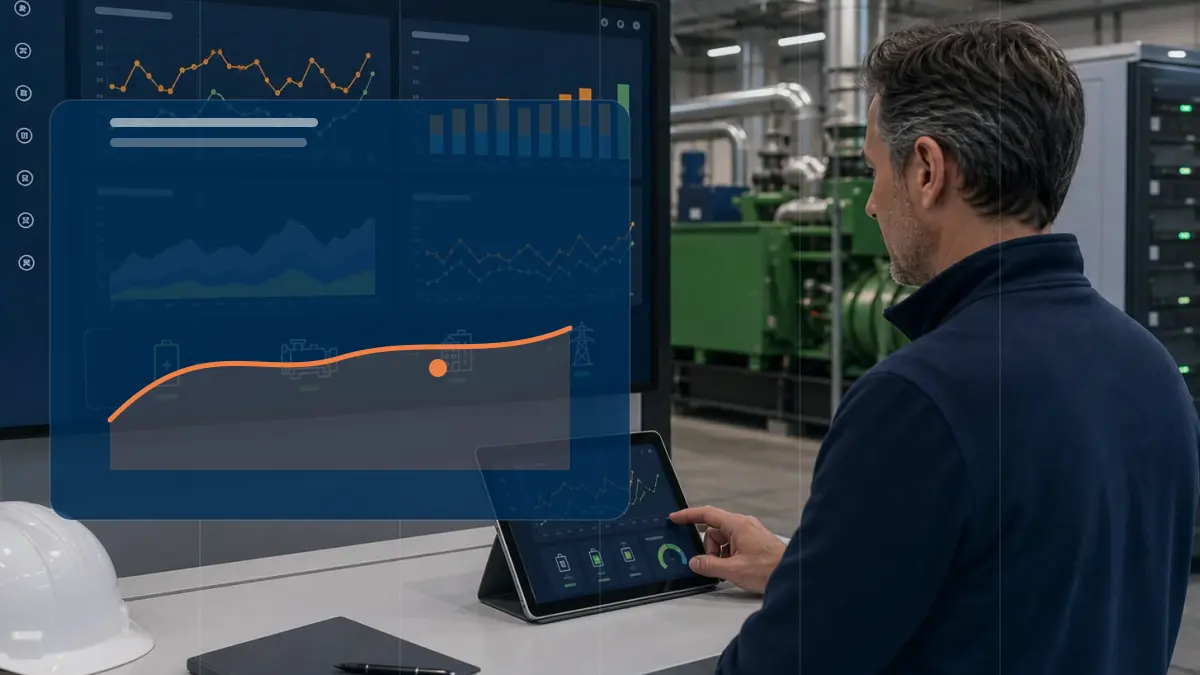
Flexibility and cybersecurity: scattered information versus Energy Intelligence
Flexibility only delivers value when devices can be controlled remotely. An aggregator, supplier or your own energy management system tells a battery, charging hub or cooling unit to charge, discharge or wait. This happens over the internet and through software. For a facility manager or business owner taking part in flexibility, this means the security of those links suddenly matters. A failure or misuse affects not only your data, but also physical equipment and sometimes the grid.
- Flexibility means remote control, which enlarges the digital attack surface, because every outward link is a possible entry point.
- The main risks are unauthorised control of devices, data breaches and disruption that can affect grid stability.
- Since 15 August 2026 the Dutch Cybersecurity Act, the national implementation of the EU NIS2 directive, sets requirements for essential and important entities, including a duty of care and a duty to report incidents.
Insight
Traditional approach
Information is scattered across portals, documents, invoices or separate spreadsheets.
Modern approach
Data, context and interpretation are brought together into a clear decision picture.
Decision-making
Traditional approach
Choices are made based on averages, assumptions or occasional analyses.
Modern approach
Scenarios, KPIs and current measurement data make the trade-off more concrete and repeatable.
Follow-up
Traditional approach
Actions often stay non-committal or disappear into separate reports.
Modern approach
Follow-up actions, monitoring and reporting are linked to the same energy data.
Why does flexibility involve cybersecurity?
Flexibility works because an external party or a piece of software can adjust your devices remotely. That control runs over digital links: an internet connection, an API, a cloud platform or a communication module in the installation. Every link that enables control is also a possible entry point for someone with bad intentions. This is called the attack surface. The more devices take part and the more parties are involved, the larger that surface becomes. What is special about the energy context is that a digital action has a physical consequence: a battery that discharges unwanted, a charging hub that fails, or many devices switching at once and so loading the grid.
- Remote control runs over the internet, APIs, cloud platforms or communication modules.
- Every outward link enlarges the attack surface of your installation.
- More participating devices and more involved parties mean more possible entry points.
- Unlike ordinary IT, a digital action here has a direct physical consequence.
Which risks are involved?
The risks fall roughly into three groups. The first is unauthorised control: someone gains access and makes devices switch at a moment or in a way you do not want. For a single installation the damage is local, but if many devices are controlled through the same platform at once, disruption can carry through to grid level. The second is a data breach: consumption profiles, control data and access credentials can be stolen or misused. The third is disruption of the service itself, so that your flexibility fails or becomes unreliable. The Dutch NCSC and the European agency ENISA have long pointed out that the growing connection of devices in the energy sector increases these risks. These are genuine points of attention, not certainties; good security keeps the likelihood small.
- Unauthorised control: devices switch against your wishes.
- Data breach: consumption profiles, control data and access credentials leak.
- Disruption: the flexibility service fails or becomes unreliable.
- With control through a shared platform, one problem can affect several parties at once.
What can you do and which framework applies?
Start with the links themselves: use encrypted connections, separated networks and up-to-date software, so that control only arrives along a secured route. Next, arrange access management, so that only authorised people and systems can control devices, preferably with multi-factor authentication. Set up monitoring, so that abnormal behaviour stands out and you can intervene. Finally, set requirements for the party that controls your devices, such as the aggregator or supplier, because their security becomes part of yours. The framework for this is the Cybersecurity Act, the Dutch implementation of the European NIS2 directive, in force since 15 August 2026. It places a duty of care and a duty to report on essential and important entities. Whether your organisation is covered depends on sector and size; energy suppliers, for example, count as an essential entity.
- Secure the links: encryption, network separation and timely updates.
- Arrange access management with least privilege and multi-factor authentication.
- Set up monitoring so that abnormal behaviour becomes visible.
- Set requirements for the controlling party; their security becomes yours.
- Check whether the Cybersecurity Act (NIS2) applies to you via the self-assessment.
Curious what this looks like with your own data?
In a no-obligation call, a specialist looks at your meters, sites and energy questions with you. Response within one business day.
Search the knowledge base
Find the answer to your question.
Search using your own words. Abbreviations and spelling variants are recognised, so EMS also finds the articles on energy management systems.
Topic