
Role of the flex aggregator: a guide for businesses
Direct answer
A flexibility aggregator bundles the flexibility of many businesses and devices into a portfolio and offers that combined capacity on the energy markets. This gives a collection of small parties the market access they would not have on their own. The aggregator trades on their behalf on the markets for balancing, congestion and imbalance; the grid operator or TSO calls off the flexibility.
- Clear definition
- Data-driven assessment
- Risks and opportunities visible
- Practical next steps
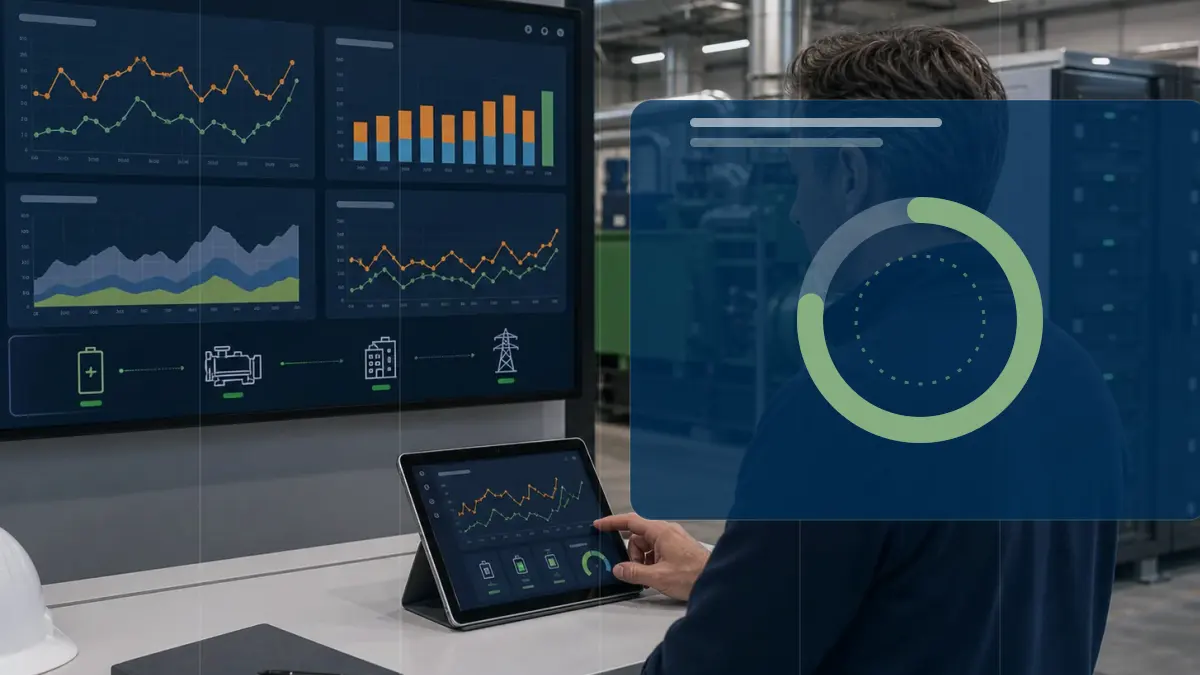
Role of the flex aggregator: scattered information versus Energy Intelligence
The Dutch electricity system increasingly needs flexibility to keep supply and demand in balance and to relieve congested grids. Individual businesses are often too small for this: a single cooling installation, charging hub or buffer battery does not meet the thresholds for direct market access. A flexibility aggregator solves this by bundling many of those small sources. Think of a service provider that links dozens of businesses and offers their controllable capacity as one package on the market.
- A flexibility aggregator combines the controllable demand and generation of many participants into a portfolio large enough for market access.
- The aggregator can act as a balancing service provider (BSP) and must prequalify with TenneT per product for that, such as aFRR or mFRR.
- An independent aggregator is not affiliated with the participant's energy supplier; participation does require clear agreements on settlement.
Insight
Traditional approach
Information is scattered across portals, documents, invoices or separate spreadsheets.
Modern approach
Data, context and interpretation are brought together into a clear decision picture.
Decision-making
Traditional approach
Choices are made based on averages, assumptions or occasional analyses.
Modern approach
Scenarios, KPIs and current measurement data make the trade-off more concrete and repeatable.
Follow-up
Traditional approach
Actions often stay non-committal or disappear into separate reports.
Modern approach
Follow-up actions, monitoring and reporting are linked to the same energy data.
What does a flexibility aggregator do?
A flexibility aggregator collects the flexibility of many participants into one portfolio. Flexibility here means consumption or generation you can shift, increase or reduce, for example a battery, a heat pump or a production process. The aggregator controls those sources and offers the combined capacity on the markets. This happens on the balancing market, where supply and demand must stay equal at every moment, on congestion markets in congested grid areas, and on the imbalance market. The aggregator can do this as a balance responsible party or as a balancing service provider, or prequalify as such a role. The participant supplies the flexibility; the aggregator handles the technology and the trading.
- Bundles controllable consumption and generation of many parties into one portfolio.
- Offers the combined capacity on balancing, congestion and imbalance markets.
- Can act as a balance responsible party (BRP) or balancing service provider (BSP).
- Controls the connected devices and processes based on market signals.
Why would you use an aggregator?
The main reason is scale. The balancing markets set minimum bid sizes and technical requirements that a single business rarely meets alone. By participating in a portfolio, your flexibility still reaches the market. The second reason is outsourcing. Trading on these markets requires prequalification with TenneT, real-time control, metering and administration. An aggregator takes over that technology and trading work, so you do not have to build it yourself. This way, flexibility that would otherwise stay idle can still gain value. For the system this is useful: deferred or avoided grid reinforcement and better balance, because demand moves with supply.
- On your own you are often too small for the bid sizes and requirements of the balancing market.
- The aggregator arranges prequalification, control, metering and administration for you.
- You keep your core process; you outsource the trading work.
- It helps the grid: fewer peaks and deferred grid reinforcement.
Who does what, and where are the limits?
The division of roles is clear. The aggregator trades on the markets and controls the portfolio. The grid operator or national system operator TenneT calls off the flexibility: TenneT procures balancing capacity and activates it to remove imbalance in the grid. You as a participant supply the flexibility according to contract. That cooperation has limits. In the contract you set out how much capacity you make available and when, because the aggregator must be able to count on you: unreliable delivery affects the whole portfolio. Settlement also needs attention. An independent aggregator is separate from your energy supplier, which means clear agreements on metering and settlement between those parties are needed.
- The aggregator trades and controls; TenneT calls off the flexibility and activates it.
- The contract states how much capacity you make available and when.
- Reliable delivery is essential: a shortfall affects the whole portfolio.
- An independent aggregator is separate from your supplier; settlement needs clear agreements.
Curious what this looks like with your own data?
In a no-obligation call, a specialist looks at your meters, sites and energy questions with you. Response within one business day.
Search the knowledge base
Find the answer to your question.
Search using your own words. Abbreviations and spelling variants are recognised, so EMS also finds the articles on energy management systems.
Topic