
Monetising energy flexibility: a guide for businesses
Direct answer
Monetising your energy flexibility means extracting value from your ability to deliberately shift or temporarily adjust your consumption or generation. In the Netherlands this can be done through several routes: a dynamic or imbalance contract, TenneT's balancing markets, congestion services via GOPACS, or avoiding peaks on your grid connection. Each route rewards the same flexibility in a different way.
- Clear definition
- Data-driven assessment
- Risks and opportunities visible
- Practical next steps
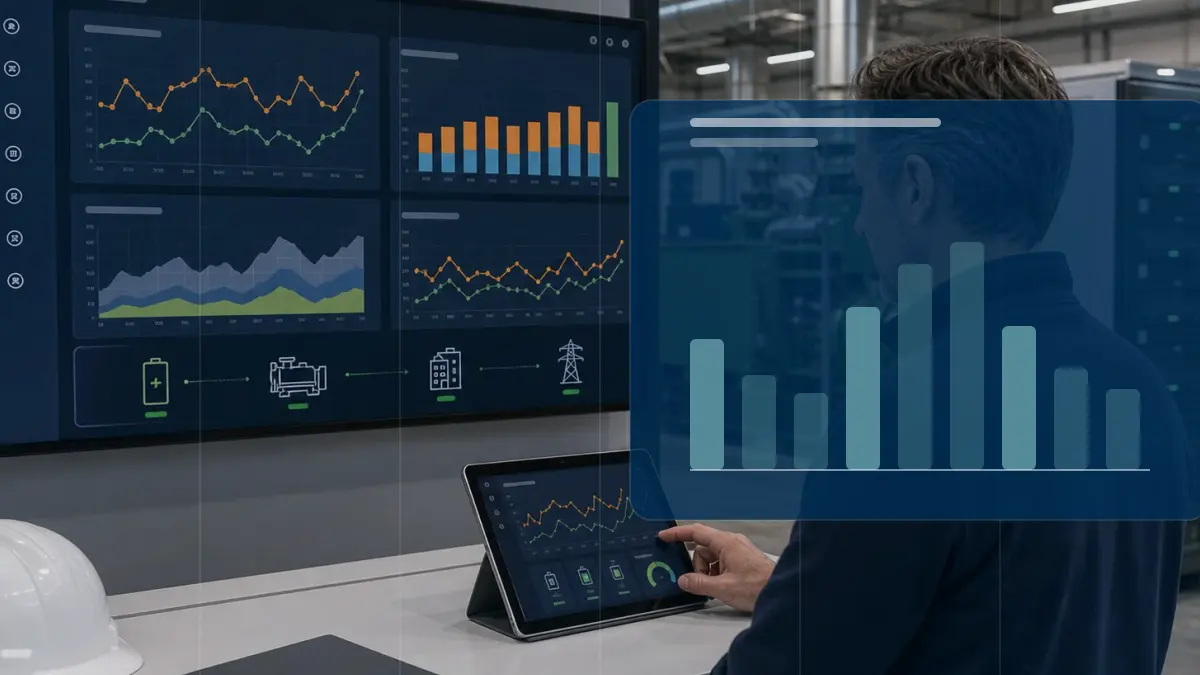
Monetising energy flexibility: scattered information versus Energy Intelligence
In the Netherlands, more and more companies can deliberately steer their electricity consumption or generation, for example with a battery, cooling, a heat pump, charging hubs or a process that can wait. That ability to shift is called energy flexibility. As long as it stays unused, it earns nothing. At the same time the grid keeps filling up and prices move more sharply per hour. As a result, several markets demand exactly that ability to shift, creating an earning side for those who offer it.
- There are five main routes: dynamic or imbalance contracts, balancing markets (FCR, aFRR, mFRR), congestion services via GOPACS, capacity or peak avoidance on your connection, and energy arbitrage.
- You can stack value streams, but the same megawatt at the same moment can only be offered in one market; using it twice is not allowed.
- You need controllable capacity, metering at the right time interval, and usually a market party or aggregator to gain access to the markets.
Insight
Traditional approach
Information is scattered across portals, documents, invoices or separate spreadsheets.
Modern approach
Data, context and interpretation are brought together into a clear decision picture.
Decision-making
Traditional approach
Choices are made based on averages, assumptions or occasional analyses.
Modern approach
Scenarios, KPIs and current measurement data make the trade-off more concrete and repeatable.
Follow-up
Traditional approach
Actions often stay non-committal or disappear into separate reports.
Modern approach
Follow-up actions, monitoring and reporting are linked to the same energy data.
Through which routes does value arise?
Flexibility is rewarded in different places, each with its own mechanism. With a dynamic or imbalance contract, your price follows the market per hour or per quarter hour: shifting consumption to cheap moments then pays off directly. On TenneT's balancing markets (FCR, aFRR and mFRR) you are paid for quickly ramping capacity up or down to keep the grid frequency at 50 hertz. Via GOPACS, parties offer flexibility to resolve local grid congestion; grid operators ask specifically for consumption or generation to be adjusted. On your own connection you can avoid peaks and so avoid transport costs or a heavier connection. Finally, energy arbitrage exploits price differences between moments.
- Dynamic or imbalance contract: your price follows the market, shifting pays off.
- Balancing markets FCR, aFRR and mFRR: payment for quickly ramping capacity up or down.
- Congestion services via GOPACS: being paid to help resolve local grid congestion.
- Capacity or peak avoidance on the connection: avoiding transport costs and a heavier connection.
- Energy arbitrage: exploiting price differences between moments, for example with storage.
What do you need to get started?
Value only arises once three things are in place. First, controllable capacity: an installation or process you can reliably ramp up or down on request, without harming your operations. Second, metering at the right time interval, usually per quarter hour, so your effort is visible and settleable. Third, access to the market. Most routes are not reached directly, but through a market party: a supplier for a dynamic or imbalance contract, or an aggregator that bundles the flexibility of several companies into a package large enough for the balancing markets. That party arranges the market connection, the control and the settlement. On GOPACS, market parties bid on your behalf.
- Controllable capacity you can reliably ramp up or down on request.
- Metering at the right time interval, usually per quarter hour, for settlement.
- A market party or aggregator that arranges market access and control.
- Insight into your own profile: when and how much you can shift without disruption.
What should you watch out for?
You can stack value streams, but not use them twice. The same megawatt at the same moment can only sit in one market at a time; if you promise it to the balancing market, it is not also available at that moment for a congestion service or arbitrage. A well considered distribution over time is therefore the core. Also watch reliability: on the balancing markets and in capacity contracts you often commit to delivering capacity on request, and failing to deliver can mean a penalty or exclusion. Read your contracts carefully: durations, notice periods and obligations differ greatly by route. Also weigh the risk. Market prices move, and a route that looks attractive today may turn out differently next season.
- Stacking is allowed, using twice is not: one megawatt sits in one market per moment.
- Reliability counts: actually deliver committed capacity, or face a penalty.
- Contract terms differ: watch duration, notice period and obligations.
- Market prices move; spread your effort and reassess the routes periodically.
Curious what this looks like with your own data?
In a no-obligation call, a specialist looks at your meters, sites and energy questions with you. Response within one business day.
Search the knowledge base
Find the answer to your question.
Search using your own words. Abbreviations and spelling variants are recognised, so EMS also finds the articles on energy management systems.
Topic