
SDE++: a guide for businesses
Direct answer
The SDE++ (Stimulering Duurzame Energieproductie en Klimaattransitie, the Dutch sustainable energy and climate transition scheme) is a government operating subsidy covering the unprofitable component: the gap between the cost price of a sustainable technology and the market revenue it earns. It targets businesses and non-profit organisations generating renewable energy at scale or reducing CO2 emissions. The Netherlands Enterprise Agency (RVO) administers the scheme and allocates the budget per application round.
- Clear definition
- Data-driven assessment
- Risks and opportunities visible
- Practical next steps
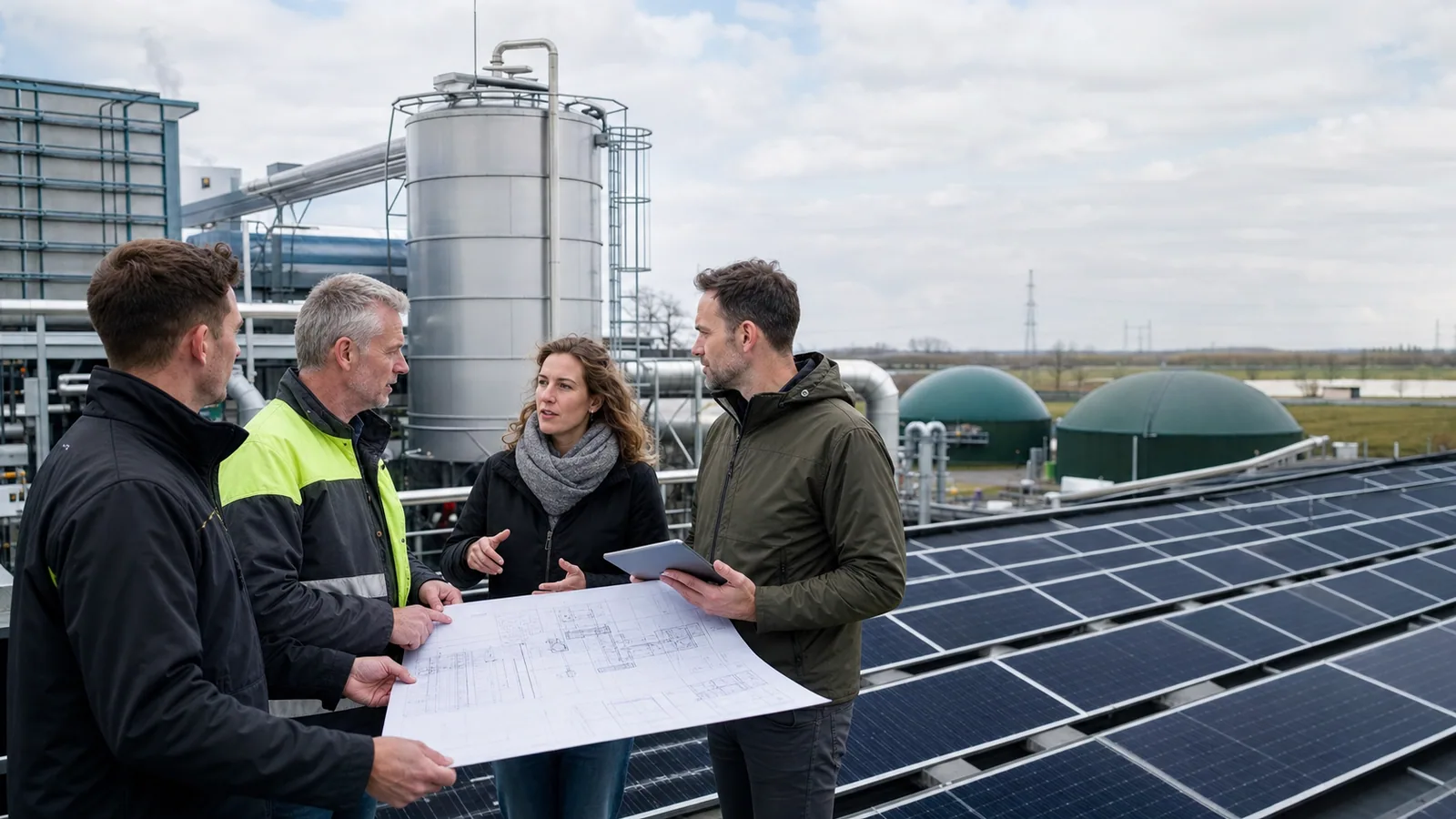
SDE++: scattered information versus Energy Intelligence
Many sustainable projects are technically feasible but not yet financially viable. Picture a company that wants to fill its roof with solar panels or put residual heat to use, but finds that the revenue does not cover the costs. This scheme exists to bridge exactly that gap: it makes projects viable that would otherwise stall. If you understand the mechanism, you can assess a project realistically, choose the right application phase and prepare a strong application in time.
- The subsidy moves with the market: when energy prices are low you receive a higher top-up, when prices are high a lower one. RVO sets the correction annually.
- Applications run in phases. If the budget is exceeded, RVO ranks applications by subsidy intensity, expressed in euros per tonne of CO2 avoided.
- You apply with all required permits in place and before entering into irreversible investment commitments; otherwise RVO rejects the application.
Insight
Traditional approach
Information is scattered across portals, documents, invoices or separate spreadsheets.
Modern approach
Data, context and interpretation are brought together into a clear decision picture.
Decision-making
Traditional approach
Choices are made based on averages, assumptions or occasional analyses.
Modern approach
Scenarios, KPIs and current measurement data make the trade-off more concrete and repeatable.
Follow-up
Traditional approach
Actions often stay non-committal or disappear into separate reports.
Modern approach
Follow-up actions, monitoring and reporting are linked to the same energy data.
How does the SDE++ work?
The SDE++ is an operating subsidy: you receive a payment per unit of energy produced or per quantity of CO2 avoided, not a one-off amount towards the investment. In the award decision, RVO sets the maximum per calendar year. You receive advance payments based on your actual production. If the market price rises, the top-up falls through the correction amount. If the market price falls, the top-up rises. The scheme therefore only covers the unprofitable part of your project. The level differs per application round and per technology, so always check the current conditions and categories with RVO. You can apply in five main categories.
- Renewable electricity, for example solar PV from 15 kilowatt peak and wind energy
- Renewable heat
- Renewable gas
- Low-carbon heat
- Low-carbon production, including CO2 capture and storage
When and how do you apply?
The scheme usually opens once a year in an application round with a fixed total budget, divided into phases. Projects that request little subsidy per tonne of CO2 avoided may submit in an early phase; more expensive technologies follow in later phases. If the budget is exceeded on a given day, RVO ranks that day's applications by subsidy intensity. Only the intended producer can apply: the party that will commission and operate the installation itself. Prepare your application well in advance, because permits and project development take months and missing documents lead to rejection.
- Obtain all required permits before submitting the subsidy application
- Do not enter into irreversible investment commitments before applying; European state aid rules prohibit this
- Use RVO's calculation tool to determine your subsidy intensity and thus your application phase
- Solar PV requires a minimum peak capacity and a large-consumer grid connection
- A free advisory meeting with RVO is available before the round opens
What should you watch out for?
The SDE++ primarily rewards cost-effective CO2 reduction. That improves the odds for proven technologies but reduces them for more expensive options. Since the 2023 round, RVO therefore reserves budget within so-called fences for the domains of low-temperature heat, high-temperature heat and molecules. This gives room to technologies that are more expensive today but remain essential for the energy transition. For solar PV, note the distinction between grid delivery and own consumption: different base energy prices and correction amounts apply, and the exact treatment varies per round. Finally, weigh up the obligations: the subsidy follows your actual production and you account for it annually.
- Ranking by subsidy intensity: cheaper CO2 reduction is served first
- Fences create room for heat and molecule technologies that will be indispensable later
- For solar PV, grid delivery counts differently from own consumption
- If you produce less than awarded, you also receive less subsidy
- Check the current categories and conditions with RVO for each application round
Curious what this looks like with your own data?
In a no-obligation call, a specialist looks at your meters, sites and energy questions with you. Response within one business day.
Search the knowledge base
Find the answer to your question.
Search using your own words. Abbreviations and spelling variants are recognised, so EMS also finds the articles on energy management systems.
Topic