
ESCO model: a guide for businesses
Direct answer
The ESCO model is a contract structure in which an energy service company (ESCo) designs, implements and manages energy saving measures in a building or process and contractually guarantees the energy performance. The agreements are laid down in an energy performance contract (EPC). The ESCo is paid partly from the savings actually achieved and therefore carries risk for the result itself.
- Clear definition
- Data-driven assessment
- Risks and opportunities visible
- Practical next steps
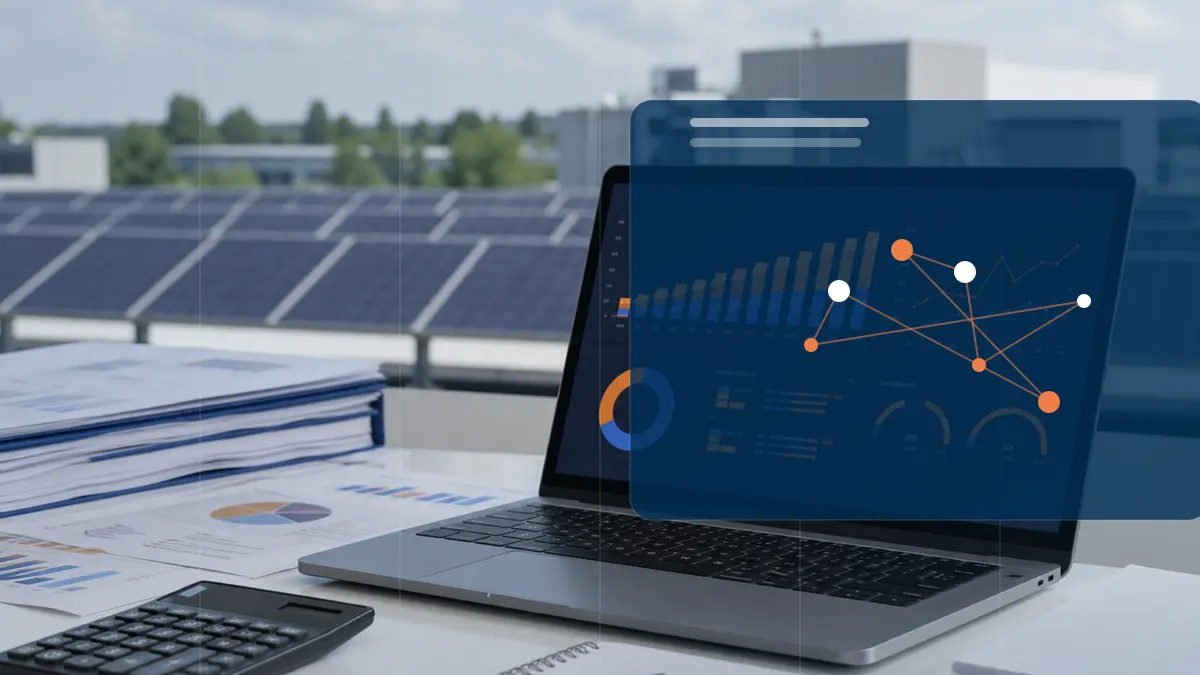
ESCO model: scattered information versus Energy Intelligence
Many organisations want to make their buildings more sustainable but lack the technical knowledge, staff capacity or investment budget to do it themselves. Think of a municipality with dozens of properties, or a care institution with outdated installations. The ESCO model emerged to remove that barrier: a specialised party takes over the entire process, from design to multi-year maintenance, and links its remuneration to the result. The European Energy Efficiency Directive also asks member states to promote the market for energy performance contracts.
- The core is the energy performance contract: the ESCo guarantees an agreed level of energy performance and carries the technical risk if it is not achieved.
- Savings are established through measurement and verification against a predefined reference situation (baseline), often following the international IPMVP protocol.
- The model suits organisations with substantial property portfolios and a long horizon, such as municipalities, healthcare institutions, schools and industrial companies.
Insight
Traditional approach
Information is scattered across portals, documents, invoices or separate spreadsheets.
Modern approach
Data, context and interpretation are brought together into a clear decision picture.
Decision-making
Traditional approach
Choices are made based on averages, assumptions or occasional analyses.
Modern approach
Scenarios, KPIs and current measurement data make the trade-off more concrete and repeatable.
Follow-up
Traditional approach
Actions often stay non-committal or disappear into separate reports.
Modern approach
Follow-up actions, monitoring and reporting are linked to the same energy data.
How does an energy performance contract work?
An energy performance contract starts with a reference situation, the baseline: the energy consumption of the building or process before the measures. On that basis the ESCo guarantees an agreed performance, laid down in measurable performance indicators. If the guarantee is not met, that is the ESCo's risk, not yours. Measurement and verification is therefore the heart of the contract. This is often done according to the international IPMVP protocol: the parties agree in advance what is measured, within which measurement boundary, and how corrections are made for factors such as weather or changed use. The ESCo usually also provides multi-year management and maintenance and can arrange financing if desired. Payment comes wholly or partly from the savings the project delivers.
- The baseline records consumption before the measures and is the yardstick for the guarantee.
- Performance is measured and verified periodically, often according to IPMVP.
- The ESCo carries the technical risk if the guarantee is not achieved.
- Management, maintenance and possibly financing sit with the same party.
How does it differ from EaaS and a maintenance contract?
Under an ordinary maintenance contract you pay a fixed fee for agreed work. The maintenance provider promises effort, not an energy result. If consumption disappoints, that is your problem. In the ESCO model the remuneration is tied to the result actually achieved, and that changes the incentive fundamentally: the provider only earns well if you genuinely save. Energy as a Service (EaaS) goes a step further. There you buy an outcome as a service, for example lighting, heating or cooling for a periodic fee, while the provider often remains the owner of the installations. The ESCO model is more specific: it revolves around a guaranteed energy performance based on a performance contract, usually applied to your own building and installations.
- Maintenance contract: obligation of effort, fixed fee, no savings guarantee.
- ESCO model: obligation of result, remuneration tied to measured savings.
- EaaS: outcome as a service for a periodic fee, installations often owned by the provider.
- Combinations exist; the contract text determines who carries which risk.
Who is it suitable for and what are the points of attention?
The ESCO model mainly suits organisations with substantial property and a long usage horizon: municipalities, healthcare institutions, schools, property owners and industrial companies with energy-intensive installations. They benefit from being unburdened, having one responsible party and certainty about the result. There are also drawbacks. The contracts run long, from a few years up to fifteen years or more, and therefore tie you to one party for a long time. Contract formation is complex: guarantees, measurement agreements and liability must be legally watertight, which takes time and expert guidance. In practice, disputes often arise afterwards about the baseline. If the use of the building changes, for example through higher occupancy or different opening hours, the reference must be adjusted. Therefore agree in advance how such changes will be handled.
- Suitable for municipalities, healthcare, education, property owners and industry.
- Strength: one party is responsible for design, implementation and result.
- Drawback: long-term commitment and complex contract formation.
- Common point of dispute in practice: adjusting the baseline when use changes.
Curious what this looks like with your own data?
In a no-obligation call, a specialist looks at your meters, sites and energy questions with you. Response within one business day.
Search the knowledge base
Find the answer to your question.
Search using your own words. Abbreviations and spelling variants are recognised, so EMS also finds the articles on energy management systems.
Topic