
Financing sustainability for SMEs: a guide for businesses
Direct answer
SME sustainability financing covers the funding sources a small or medium-sized business uses to pay for investments in energy saving and renewable generation. The main routes in the Netherlands are own funds, a bank loan or green finance, a loan backed by a government guarantee, leasing, and arrangements where an external party finances the installation. Subsidies and tax schemes further reduce the amount you need to finance yourself.
- Clear definition
- Data-driven assessment
- Risks and opportunities visible
- Practical next steps
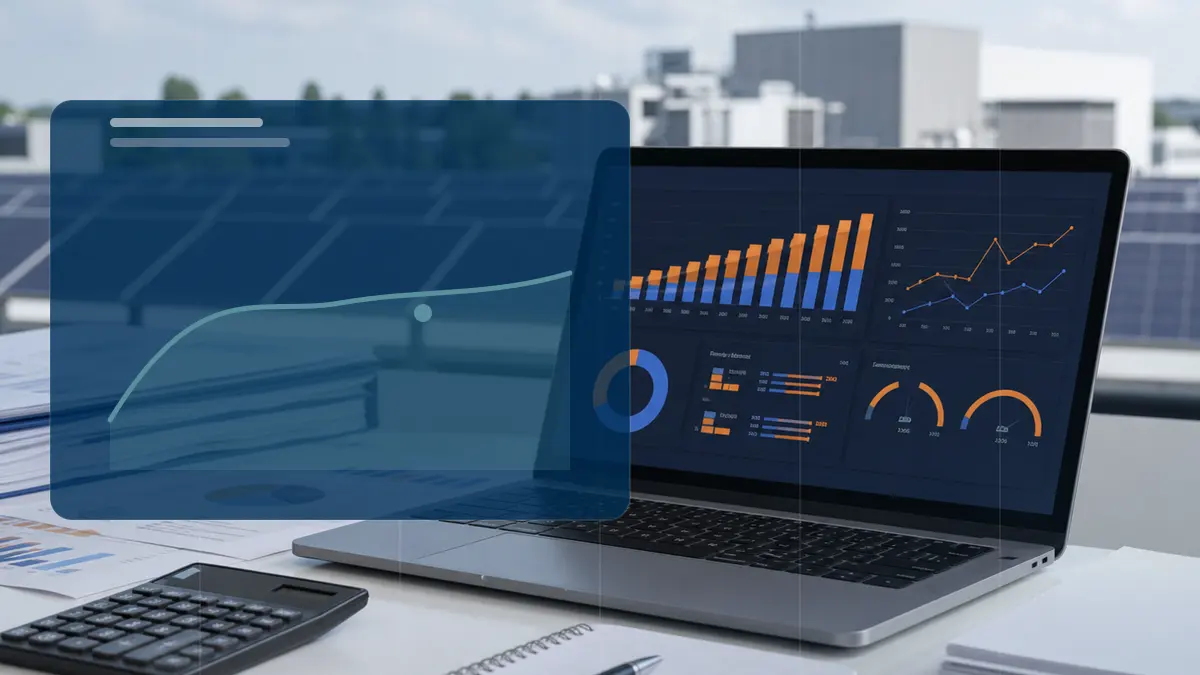
Financing sustainability for SMEs: scattered information versus Energy Intelligence
Many SMEs want to become more sustainable but hesitate at the size of the investment. Picture a bakery considering an electric oven and solar panels while its savings are also needed for stock and staff. Paying everything from your own pocket is rarely necessary. A range of routes exists to spread the investment or reduce the lender's risk. Businesses that know these routes and substantiate their application properly get sustainability financed more often, without straining day-to-day operations.
- Under the Dutch Green Projects Scheme, an accredited green fund can request a green certificate, making your sustainable project eligible for a loan at a lower interest rate than the market rate.
- If you lack sufficient collateral, your lender can apply for a partial government guarantee for a sustainability loan through the BMKB-G, the green window of the Dutch SME credit guarantee scheme; you do not apply for this guarantee yourself.
- A financing application supported by measured energy data and a well-calculated business case makes the expected savings credible and increases the chance of approval.
Insight
Traditional approach
Information is scattered across portals, documents, invoices or separate spreadsheets.
Modern approach
Data, context and interpretation are brought together into a clear decision picture.
Decision-making
Traditional approach
Choices are made based on averages, assumptions or occasional analyses.
Modern approach
Scenarios, KPIs and current measurement data make the trade-off more concrete and repeatable.
Follow-up
Traditional approach
Actions often stay non-committal or disappear into separate reports.
Modern approach
Follow-up actions, monitoring and reporting are linked to the same energy data.
Which financing routes are available to your SME?
You can choose from several routes, often in combination. Own funds are the simplest path but tie up working capital. A bank loan spreads the investment over several years. For sustainable projects there is also green finance: under the Dutch Green Projects Scheme, an accredited green fund requests a green certificate, after which your project qualifies for a loan at a lower interest rate than the market rate. If you lack sufficient collateral, your lender can call on the BMKB-G, the green window of the Dutch SME credit guarantee scheme (BMKB), in which the government acts as partial guarantor. Leasing or hire purchase links payments to the use of the installation. With Energy as a Service or an ESCO arrangement, an external party invests in the installation and you pay for the delivered service or performance.
- Own funds: quick to arrange, but at the expense of your working capital.
- Green finance: a loan with a green certificate arranged via an accredited green fund, at a lower interest rate than the market rate.
- BMKB-G: a partial government guarantee that your lender applies for when collateral falls short.
- Leasing or hire purchase: paying in instalments, linked to the installation.
- Energy as a Service or ESCO: an external party invests and delivers the savings as a service.
How do subsidies and tax schemes strengthen your financing?
Subsidies and tax schemes are rarely the whole solution, but they are an important stackable factor. A subsidy reduces the amount you need to finance, which makes the loan smaller and the business case stronger. Tax schemes for sustainable investments reduce taxable profit and so improve cash flow in the years after the investment. Lenders take this into account: an application that already incorporates subsidies and tax benefits shows you have prepared the project seriously. Do check the conditions. Not every scheme can be combined with every other one, and many schemes require you to apply before entering into commitments. Schemes also change: under the current decision, the tax benefits for green savings and investments behind the Green Projects Scheme will end in 2028. Always check the current status with the Netherlands Enterprise Agency (RVO).
- Subsidies reduce the amount to be financed and thereby directly strengthen your application.
- Tax schemes for sustainable investments improve cash flow after the investment.
- Not all schemes can be combined; check the conditions per scheme with RVO.
- Many schemes require an application before you enter into commitments.
Why do the business case and energy data decide your application?
A lender primarily assesses whether your business can repay the loan. With sustainability investments, part of that repayment capacity comes from the energy savings themselves, so you must make those savings credible. Measured energy data are more convincing than assumptions: if you know your current consumption per hour, you can substantiate what a heat pump, solar panels or a battery will actually deliver. A good business case describes the investment, the expected savings, the chosen financing mix and the risks, including the scenario in which savings fall short. After the investment, measurement remains valuable. Monitoring lets you demonstrate that the installation performs as promised. That helps with follow-up financing and with performance agreements in an ESCO contract, where payment is linked to delivered performance.
- First map your current energy consumption, preferably per hour or per quarter-hour.
- Substantiate the expected savings with measured data rather than standard figures alone.
- Include the scenario in which savings fall short in your business case.
- Keep monitoring after delivery to demonstrate actual performance.
Curious what this looks like with your own data?
In a no-obligation call, a specialist looks at your meters, sites and energy questions with you. Response within one business day.
Search the knowledge base
Find the answer to your question.
Search using your own words. Abbreviations and spelling variants are recognised, so EMS also finds the articles on energy management systems.
Topic