
Energy-as-a-Service (EaaS): a guide for businesses
Direct answer
Energy-as-a-Service (EaaS) is a contract model in which a service provider finances, installs and operates energy assets, while you pay per service delivered or per performance achieved. You do not invest yourself in solar panels, a battery or charging points. The provider usually remains the owner and carries the technical risk. You pay a periodic fee for as long as the contract runs.
- Clear definition
- Data-driven assessment
- Risks and opportunities visible
- Practical next steps
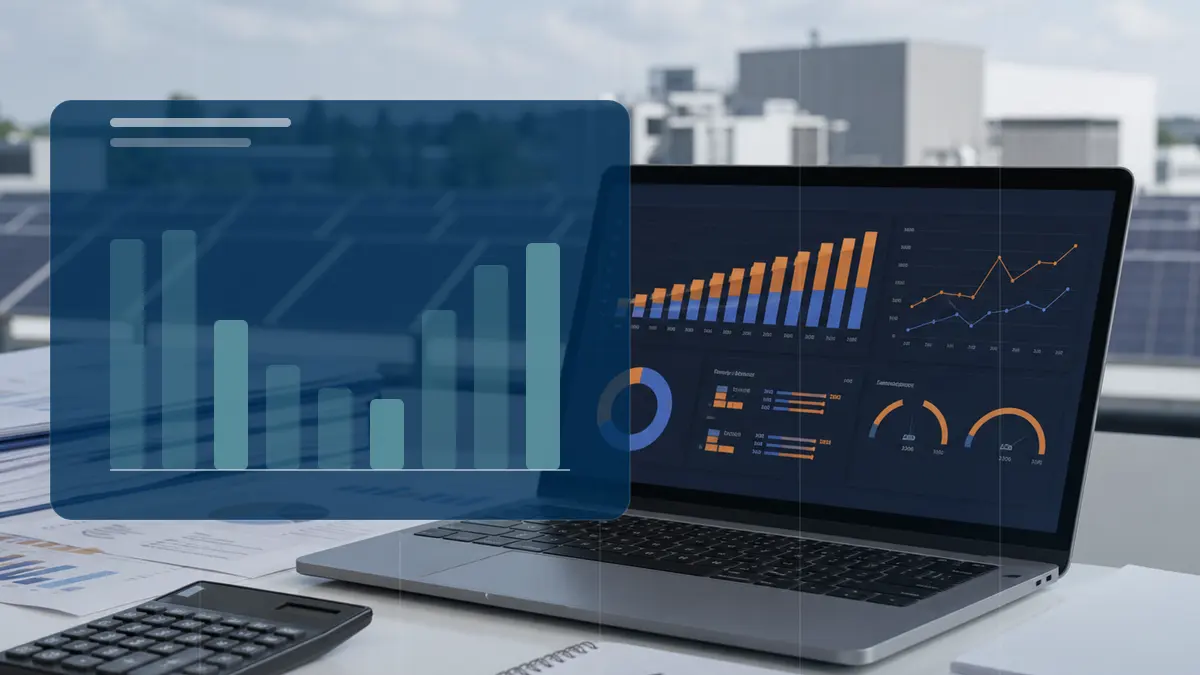
Energy-as-a-Service (EaaS): scattered information versus Energy Intelligence
Many businesses want to decarbonise but prefer to keep their capital available for core activities. Picture a logistics company that wants solar panels, a battery and charging points, but has no technical team to manage them. This service model exists for that situation: a specialised party takes over the investment and the operation, and you simply consume the result. The model originates in the built environment and now also appears in lighting, heating, batteries and charging infrastructure in the Netherlands.
- The provider finances, installs and maintains the assets; you pay a periodic fee per service or per performance.
- Unlike a standard lease, the provider also carries the performance risk: if the asset underdelivers, that affects the provider.
- Check the contract term, the total cost over the full contract period and the conditions for early termination or relocation.
Insight
Traditional approach
Information is scattered across portals, documents, invoices or separate spreadsheets.
Modern approach
Data, context and interpretation are brought together into a clear decision picture.
Decision-making
Traditional approach
Choices are made based on averages, assumptions or occasional analyses.
Modern approach
Scenarios, KPIs and current measurement data make the trade-off more concrete and repeatable.
Follow-up
Traditional approach
Actions often stay non-committal or disappear into separate reports.
Modern approach
Follow-up actions, monitoring and reporting are linked to the same energy data.
How does an EaaS contract work?
The service provider designs, finances, installs and operates the asset at your site. You pay a fixed periodic fee or a rate per unit, for example per kilowatt hour generated, per light point or per charging session. The asset usually remains the property of the provider, who also handles maintenance and monitoring. The contract contains performance commitments: what the asset must deliver as a minimum and what happens if it does not. Because the provider recovers its investment through the fees, these contracts typically have a long term. At the end of the term there are usually three routes: extend, buy out the asset or have it removed. Agree those routes upfront, including the conditions attached to each.
- The provider usually remains the legal owner of the asset on your roof or premises.
- You pay per unit or a fixed periodic fee, depending on the service.
- Performance commitments define what the asset must deliver as a minimum.
- At the end of the term you can usually extend, buy out the asset or have it removed.
How does it differ from leasing and from an ESCO performance contract?
A standard lease is primarily a financing tool: it spreads the payments, but operation and performance risk usually stay with you. An ESCO (Energy Service Company) works with an energy performance contract (EPC): it guarantees an agreed level of energy savings in a building and provides multi-year operation and maintenance, with financing as an option. EaaS is the broader umbrella: you buy a complete service, including operation, and pay according to usage or performance. A frequently mentioned advantage is that the asset can stay off your balance sheet. That is not automatic: the accounting assessment, including under IFRS 16, determines whether the contract counts as a lease.
- With a standard lease you mainly finance; operation and performance risk usually stay with you.
- An ESCO guarantees an agreed level of energy savings in an energy performance contract and provides operation and maintenance.
- EaaS goes further: the provider operates the asset and you only buy the outcome.
- Whether the contract stays off your balance sheet depends on the accounting assessment, including under IFRS 16.
What are the drawbacks and points of attention?
Being unburdened comes at a price. Through the fee you also pay for the provider's financing, risk and margin. Over the full term, the total cost can therefore end up higher than investing yourself. A long-term contract also binds you to one party for years: switching is difficult and you depend on the provider's continuity. Review the exit conditions upfront for situations such as relocation, sale of the building or insolvency of the provider. In the Netherlands the model appears in lighting, rooftop solar, heating systems, batteries and charging infrastructure, often in offices, industry and public-sector buildings. According to the Netherlands Enterprise Agency (RVO), the Dutch market for energy performance contracts is small and stable compared with other European countries.
- Calculate the total cost over the full term and compare it with investing yourself.
- Check the exit conditions for relocation, sale of the building or insolvency of the provider.
- Assess the financial continuity of the provider; the contract often runs for many years.
- Have an adviser with contract experience review the performance commitments and liability clauses.
Curious what this looks like with your own data?
In a no-obligation call, a specialist looks at your meters, sites and energy questions with you. Response within one business day.
Search the knowledge base
Find the answer to your question.
Search using your own words. Abbreviations and spelling variants are recognised, so EMS also finds the articles on energy management systems.
Topic