
Market dynamics
Article 9 of 20 · Energy markets and market dynamicsPPA Power Purchase Agreement explained for businesses
Direct answer
A PPA (Power Purchase Agreement) is a long-term contract in which a buyer purchases electricity, often renewable, directly from a producer at an agreed price and duration. The term usually runs for several years. This gives the buyer price certainty and demonstrably green power, while the producer gains the revenue certainty needed to finance a solar or wind farm.
- Clear definition
- Data-driven assessment
- Risks and opportunities visible
- Practical next steps
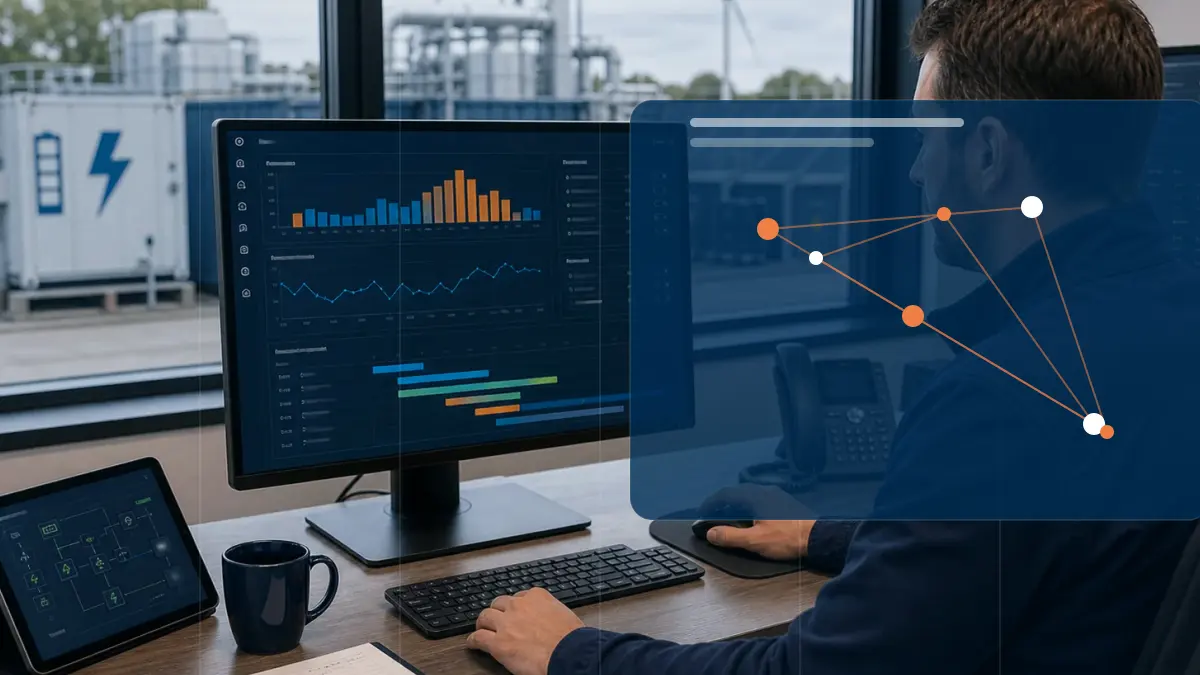
PPA Power Purchase Agreement explained: scattered information versus Energy Intelligence
Businesses want to know where their power comes from and what it will cost in the coming years. Yet the wholesale price moves sharply and subsidies for renewable generation are declining. Without an agreement in advance, a new solar or wind farm is therefore hard to finance. A PPA fills that gap: a producer and a buyer, for example a factory or data centre, agree on a price and duration together. It matters to large consumers, project developers and financiers seeking certainty.
- A PPA fixes the price, volume and duration between producer and buyer for several years, outside the short-term prices of the energy market.
- Green origin is proven with guarantees of origin (GvO's); in the Netherlands these are issued by VertiCer and can be traded separately from the power itself.
- A PPA is either physical (the power is actually delivered) or financial, also called virtual (only the price difference is settled, the power flows through the market).
Insight
Traditional approach
Information is scattered across portals, documents, invoices or separate spreadsheets.
Modern approach
Data, context and interpretation are brought together into a clear decision picture.
Decision-making
Traditional approach
Choices are made based on averages, assumptions or occasional analyses.
Modern approach
Scenarios, KPIs and current measurement data make the trade-off more concrete and repeatable.
Follow-up
Traditional approach
Actions often stay non-committal or disappear into separate reports.
Modern approach
Follow-up actions, monitoring and reporting are linked to the same energy data.
How does a PPA work?
With a PPA, a buyer signs a contract directly with a producer of electricity, usually a solar or wind farm. They set out how much power is delivered, at what price and for how many years. That price can be fixed or move with the market within agreed limits. As a result, the buyer depends less on the fluctuating wholesale price. Green origin is arranged separately with guarantees of origin: each GvO represents one megawatt-hour of renewable energy and proves where and how it was produced. In the Netherlands, VertiCer issues these certificates. A PPA and its accompanying GvO's can be negotiated together or separately.
- Buyer and producer fix the price, volume and duration for several years.
- The price is fixed or moves with the market within agreed limits.
- GvO's prove the green origin; VertiCer issues them, one GvO represents one megawatt-hour.
- Power and GvO's can be traded together or separately.
Why do companies enter into a PPA?
With a PPA a buyer secures years of price certainty and protects itself against sharp price peaks on the energy market. At the same time it makes its consumption demonstrably green through the accompanying GvO's, which helps with sustainability targets and reporting. For the producer, the PPA is often the key to financing: a bank is more willing to lend when revenue is fixed for years. Especially now that subsidies for renewable generation are declining, a long-term price contract with a buyer is becoming a common alternative for getting a solar or wind farm off the ground. In this way a PPA connects a company's wish to become more sustainable with a developer's need for certainty.
- Price certainty for the buyer over a longer period.
- Demonstrably green power through GvO's, usable for sustainability targets.
- Revenue certainty that lets the producer secure financing.
- An alternative now that subsidies for renewable generation are declining.
Physical or financial, and what should you watch for?
A PPA comes in two main forms. With a physical PPA, the power is actually delivered to the buyer. With a financial or virtual PPA, the producer delivers to the market and the parties only settle the difference between the agreed price and the market price; the buyer simply buys its power from its own supplier. With both forms, watch the duration, because it ties you in for a long time. Also consider volume risk, because solar and wind do not yield the same amount every year, and profile risk, because generation and consumption do not always coincide. Finally, the creditworthiness of the counterparty matters: a contract of years is only as strong as the party that honours it.
- Physical PPA: the power is actually delivered to the buyer.
- Financial or virtual PPA: only the price difference with the market is settled.
- Watch the duration, volume risk and profile risk.
- Weigh the creditworthiness of the counterparty.
Curious what this looks like with your own data?
In a no-obligation call, a specialist looks at your meters, sites and energy questions with you. Response within one business day.
Search the knowledge base
Find the answer to your question.
Search using your own words. Abbreviations and spelling variants are recognised, so EMS also finds the articles on energy management systems.
Topic