
ISDE: a guide for businesses
Direct answer
The ISDE (Investment Subsidy for Sustainable Energy and Energy Saving) is a Dutch government subsidy scheme, administered by the Netherlands Enterprise Agency (RVO), for investments in sustainable heat and energy saving. Business users can apply for heat pumps, solar water heaters and small wind turbines. The amount depends on the type of appliance and changes each year; you must apply before making the investment.
- Clear definition
- Data-driven assessment
- Risks and opportunities visible
- Practical next steps
ISDE: scattered information versus Energy Intelligence
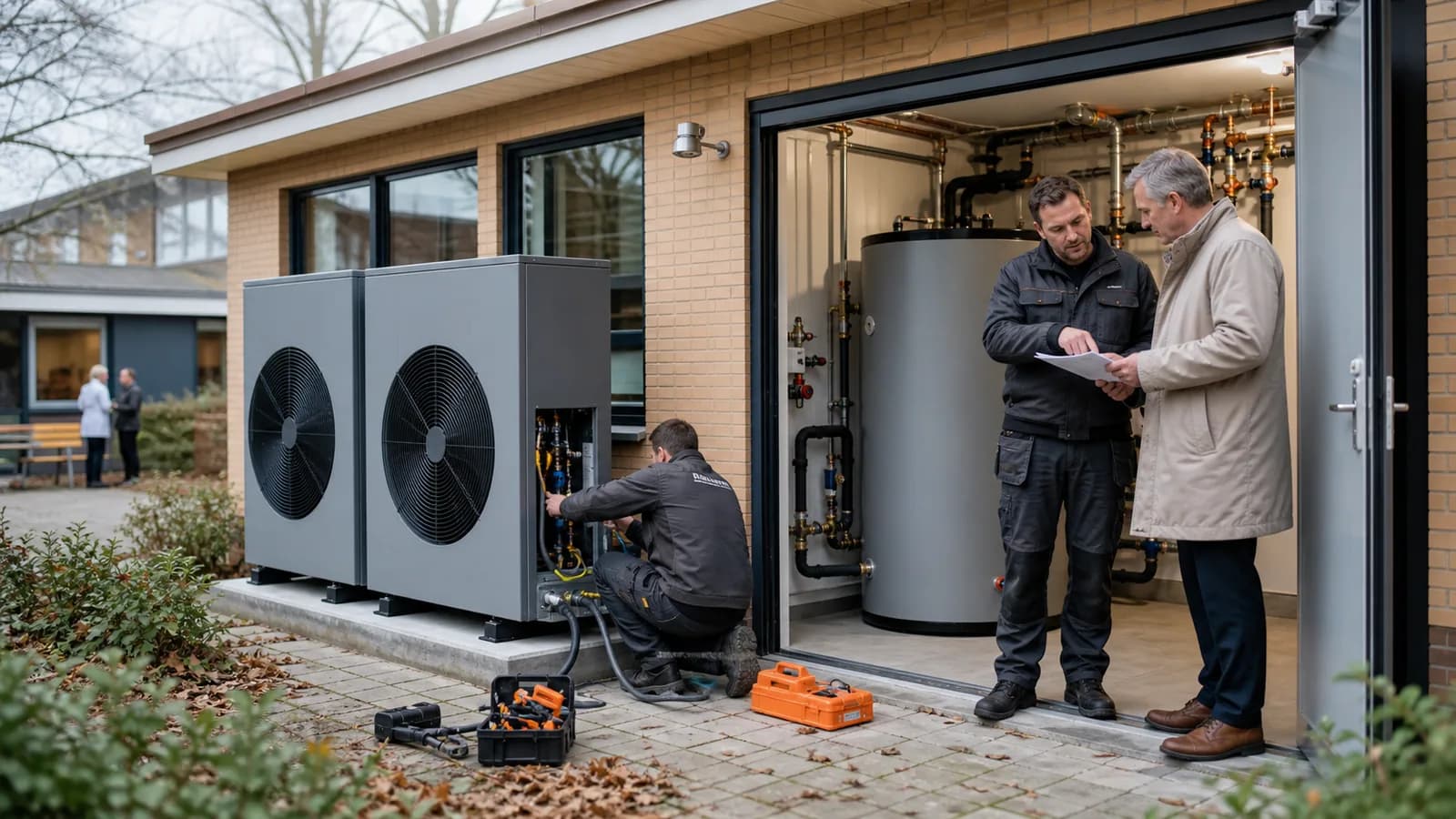
Many commercial buildings in the Netherlands still run on natural gas heating. The government wants building owners to switch to sustainable heat and lowers the investment threshold through the ISDE. Picture a business owner replacing the gas boiler in an office with a heat pump: the subsidy makes that step financially more attractive. The scheme exists for both homeowners and business users, but the conditions and the moment of application differ strongly between the two groups. Knowing the process prevents a rejected application.
- Business users apply for the ISDE before purchase or installation; RVO rejects applications submitted afterwards.
- For businesses the scheme covers heat pumps, solar water heaters and small wind turbines; business insulation falls under the Energy Investment Allowance (EIA) instead.
- You apply through RVO's online portal using eHerkenning; heat pumps and solar water heaters must appear on RVO's current registration code list.
Insight
Traditional approach
Information is scattered across portals, documents, invoices or separate spreadsheets.
Modern approach
Data, context and interpretation are brought together into a clear decision picture.
Decision-making
Traditional approach
Choices are made based on averages, assumptions or occasional analyses.
Modern approach
Scenarios, KPIs and current measurement data make the trade-off more concrete and repeatable.
Follow-up
Traditional approach
Actions often stay non-committal or disappear into separate reports.
Modern approach
Follow-up actions, monitoring and reporting are linked to the same energy data.
How does the ISDE work for business users?
The ISDE reimburses part of an investment in sustainable heating technology. For business users this covers heat pumps, solar water heaters and small wind turbines. Insulation measures fall outside the ISDE for businesses; the Energy Investment Allowance (EIA) exists as a tax route for those. Heat pumps and solar water heaters must appear on RVO's registration code list; for a small wind turbine you submit technical documentation instead. The subsidy amount depends on the type of appliance, for example the kind of heat pump, its energy label and its capacity. The amounts change each year, so always check the current conditions with RVO. The government makes new budget available every year and RVO processes applications in order of receipt. A collective measure is also possible, such as one large heat pump serving multiple addresses in a building.
- Eligible for businesses: heat pumps, solar water heaters and small wind turbines
- Business insulation falls under the EIA, not the ISDE
- Heat pumps and solar water heaters must appear on RVO's registration code list
- Subsidy amounts differ per appliance and change each year
- Collective measures serving multiple addresses are possible
How does the application process work?
One golden rule applies to business users: apply for the subsidy before you sign a quotation, reserve an appliance or have it installed. RVO rejects applications submitted afterwards. This is the exact opposite of the route for homeowners, who apply after installation. You submit the application through RVO's online portal and log in with eHerkenning; applicants without a Dutch Chamber of Commerce (KVK) number, such as holiday home owners, use DigiD. After submission you receive a confirmation and RVO assesses your application. RVO advises waiting with the installation until the decision has arrived. After installation you request final assessment, supplying the invoice, proof of payment and the installation address. For a heat pump a commissioning form is also required. RVO pays out the subsidy only after this final assessment.
- Apply first, then commission the work: the reverse order is rejected
- Log in with eHerkenning, or with DigiD if you have no KVK number
- Preferably wait with installation until RVO has issued its decision
- Payment follows the final assessment with invoice and proof of payment
What should you pay attention to?
The ISDE lowers the threshold for moving away from natural gas and runs for multiple years, with new budget each year. You can include several appliances at several addresses in a single application. That makes the scheme practical for organisations with multiple sites. There are also points of attention. Technical conditions apply per appliance, such as requirements for the energy label or capacity. For an air-to-water heat pump RVO additionally requires confirmation from the grid operator that the gas meter at that location will be removed. Because conditions and amounts change annually, planning the application pays off: first check the current appliance list and conditions with RVO, and only then submit the application. This prevents a formal error or a wrongly timed application from costing you the subsidy.
- A single application can cover several appliances and addresses
- Technical requirements apply per appliance, for example label and capacity
- For an air-to-water heat pump the gas meter at the location must be removed
- Conditions and amounts change each year: check them with RVO
Curious what this looks like with your own data?
In a no-obligation call, a specialist looks at your meters, sites and energy questions with you. Response within one business day.
Search the knowledge base
Find the answer to your question.
Search using your own words. Abbreviations and spelling variants are recognised, so EMS also finds the articles on energy management systems.
Topic