
Is a dynamic energy contract right for my business?
Direct answer
A dynamic energy contract suits your business if you can shift consumption to cheap hours, or if you have on-site generation or storage. The supply price follows the wholesale market: hourly or quarter-hourly for electricity, daily for gas. Without flexibility or insight into your consumption profile, you mainly carry the price swings without capturing the benefits.
- Clear definition
- Data-driven assessment
- Risks and opportunities visible
- Practical next steps
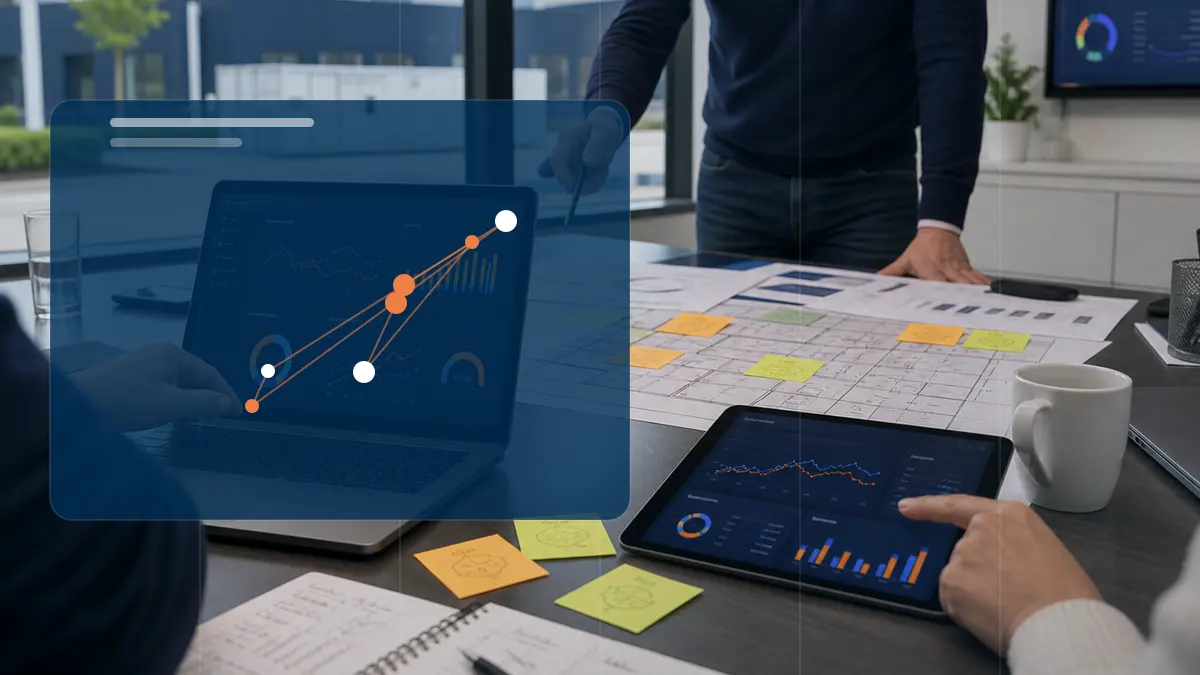
Is a dynamic energy contract right for my business: scattered information versus Energy Intelligence
More and more businesses receive a dynamic offer at contract renewal, alongside fixed or variable tariffs. Picture a manufacturer running cold stores at night, or an office with solar panels and charging points. Choosing can quickly feel like betting on the energy market. It does not have to: with a handful of concrete decision factors, such as your consumption profile, your flexibility and your risk appetite, you can determine on solid grounds which contract form fits your operations.
- Favourable with steerable consumption: processes, cooling, charging or storage that can shift to cheap hours.
- Risk: price spikes feed directly into your costs and your energy budget becomes less predictable.
- First step: analyse your consumption profile on hourly data before choosing a contract form.
Insight
Traditional approach
Information is scattered across portals, documents, invoices or separate spreadsheets.
Modern approach
Data, context and interpretation are brought together into a clear decision picture.
Decision-making
Traditional approach
Choices are made based on averages, assumptions or occasional analyses.
Modern approach
Scenarios, KPIs and current measurement data make the trade-off more concrete and repeatable.
Follow-up
Traditional approach
Actions often stay non-committal or disappear into separate reports.
Modern approach
Follow-up actions, monitoring and reporting are linked to the same energy data.
How does a dynamic energy contract work?
With a dynamic energy contract you pay no fixed supply price. The price follows the spot market, the wholesale market where suppliers buy their energy one day ahead. For electricity, the price changes throughout the day. Since October 2025 the European day-ahead market has worked with quarter-hourly prices: 96 prices per day instead of 24 hourly prices. Whether you settle per hour or per quarter-hour depends on your contract and your meter. For gas, one price applies per day. Tariffs are always known one day in advance. On top of this you pay the usual fixed components, such as grid charges, energy tax and a supplier margin. Only the supply component moves with the market.
- Electricity price changes per hour or per quarter-hour, gas price per day
- Prices come from the day-ahead market and are known one day in advance
- Since October 2025 the European day-ahead market uses quarter-hourly prices
- Grid charges, taxes and the supplier margin remain fixed components
When does it suit your business, and when not?
A dynamic contract can fit if your business can steer its consumption. Think of cooling, heat pumps, electric charging, battery storage or processes that are not tied to a fixed time slot. It can also be interesting with your own solar panels, although you then receive the market price of the moment for exported power, which can be low or even negative on sunny afternoons. It fits less well if your consumption is locked into expensive hours, if you must guard a strict energy budget, or if nobody in your organisation follows the prices. Price spikes feed straight through into your costs. Without steering or automation you carry the risk but miss the benefit.
- Favourable: shiftable consumption such as cooling, charging and battery storage
- Favourable: on-site generation you can align with market prices
- Unfavourable: fixed consumption during expensive hours and a need for budget certainty
- Unfavourable: no time, people or automation to act on prices
How do you make the decision?
Start with your consumption profile. Request your metering data at hourly resolution, via your supplier or metering company, and see when your business uses most energy. Does that consumption coincide with typically cheap hours, such as moments with plenty of sun or wind, or can you shift it there? Then a dynamic contract is worth investigating. Next, weigh the alternatives. A fixed contract gives budget certainty for an agreed period. A variable contract follows the market more slowly, usually per month or per half year. A combination is also possible: partly fixed and partly dynamic, so you spread the risk. Finally, decide who or what does the steering: manual planning, smart equipment or an energy management system.
- Step 1: analyse your consumption profile on hourly data
- Step 2: test whether you can shift or automate consumption
- Step 3: compare with fixed, variable and partly dynamic contracts
- Step 4: arrange the steering before the contract starts
Curious what this looks like with your own data?
In a no-obligation call, a specialist looks at your meters, sites and energy questions with you. Response within one business day.
Search the knowledge base
Find the answer to your question.
Search using your own words. Abbreviations and spelling variants are recognised, so EMS also finds the articles on energy management systems.
Topic