
How much CO2 does my business emit?
Direct answer
You answer the question of how much CO2 your business emits by multiplying all your consumption data, such as kilowatt hours, cubic metres of gas and kilometres driven, by an emission factor per unit. The GHG Protocol divides emissions into three scopes: own fuels and processes, purchased electricity and heat, and the value chain. For the Netherlands, the standard emission factors are published on co2emissiefactoren.nl.
- Clear definition
- Data-driven assessment
- Risks and opportunities visible
- Practical next steps
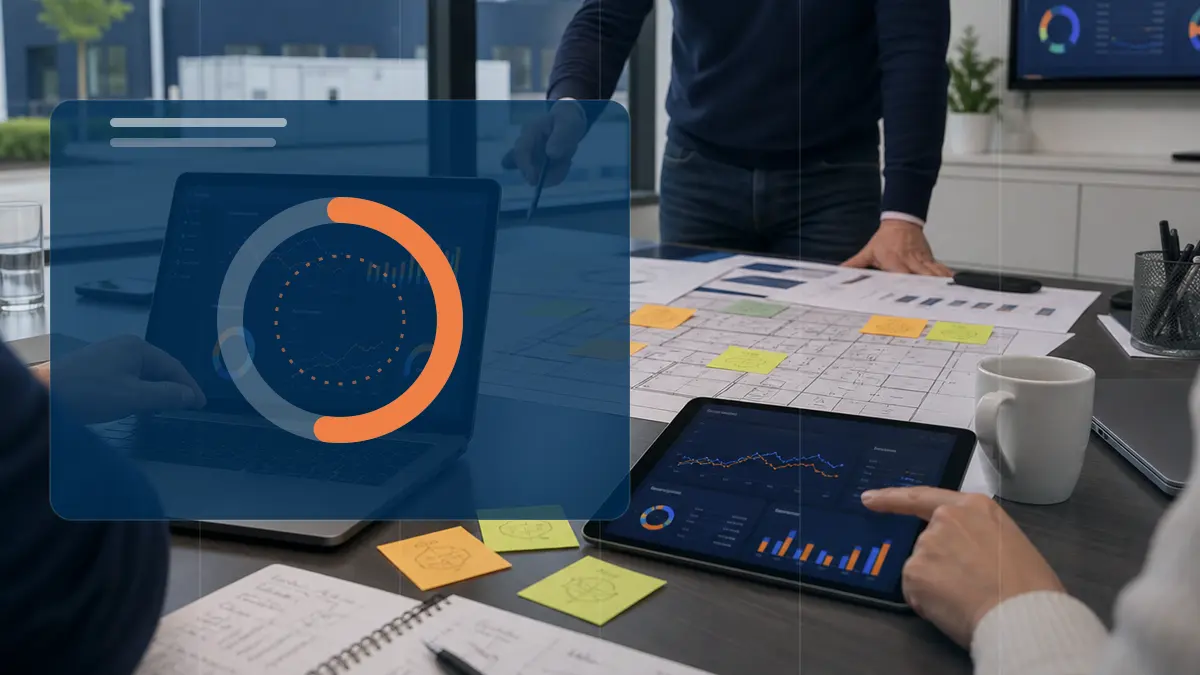
How much CO2 does my business emit: scattered information versus Energy Intelligence
More and more business owners are asked by customers, banks or contracting authorities to share their CO2 emissions. Large companies covered by the European CSRD directive must also report on their chain partners and pass that question on to their suppliers. Picture an installation company that suddenly has to submit a carbon footprint with a tender. Whoever only starts measuring at that point is already behind. This overview shows step by step how to reach a reliable answer.
- The GHG Protocol divides company emissions into scope 1 (own fuels and processes), scope 2 (purchased electricity and heat) and scope 3 (the value chain, from procurement to product use).
- The calculation formula is always the same: activity data multiplied by an emission factor. For the Dutch market, a public, free list of emission factors is maintained on co2emissiefactoren.nl.
- Electricity produces two results: location based uses the average grid mix, market based reflects your own purchasing, including guarantees of origin.
Insight
Traditional approach
Information is scattered across portals, documents, invoices or separate spreadsheets.
Modern approach
Data, context and interpretation are brought together into a clear decision picture.
Decision-making
Traditional approach
Choices are made based on averages, assumptions or occasional analyses.
Modern approach
Scenarios, KPIs and current measurement data make the trade-off more concrete and repeatable.
Follow-up
Traditional approach
Actions often stay non-committal or disappear into separate reports.
Modern approach
Follow-up actions, monitoring and reporting are linked to the same energy data.
Step 1: set your boundaries with the three GHG Protocol scopes
The GHG Protocol Corporate Standard is the international accounting standard for company emissions. It divides emissions into three scopes. Scope 1 covers direct emissions from sources you own or control: natural gas for heating, fuel for company vehicles and process emissions. Scope 2 covers the indirect emissions from purchased electricity, heat and steam. Scope 3 covers all remaining value chain emissions, from purchased goods and business travel to the use of your products. First define your organisational boundaries: which sites and activities you include. Then start with scopes 1 and 2, because you already hold that data in house. For many businesses, scope 3 is the largest part of the footprint, but it requires supplier data and comes at a later stage.
- Scope 1: own fuels and processes, such as natural gas and the company diesel van
- Scope 2: purchased electricity, heat and steam
- Scope 3: value chain emissions at suppliers, transport, business travel and product use
- Define your organisational boundaries before you start calculating
Step 2: collect your data and calculate with emission factors
The calculation method is the same for every source: activity data multiplied by an emission factor gives CO2 emissions in kilograms or tonnes. Activity data comes from energy invoices, meter readings, fuel cards and mileage records of business travel. For the Dutch market, a public and free list of emission factors is available on co2emissiefactoren.nl, also downloadable as an Excel file. With electricity, mind the difference between two methods. Location based, you calculate with the average emission factor of the Dutch grid. Market based, you calculate with your own purchasing: electricity with guarantees of origin for renewable energy then counts lower. The GHG Protocol asks you to report both results where possible. Generic calculation tools and CO2 portals use the same official factors and save a lot of manual work.
- Formula: consumption per unit multiplied by the emission factor per unit
- Data sources: energy invoices, meter readings, fuel cards and mileage records
- Dutch emission factors: public list on co2emissiefactoren.nl
- Electricity: calculate both the location based and the market based result
- Guarantees of origin only affect the market based result
Step 3: record your baseline and put the figure to use
A carbon footprint is rarely without consequence. Large companies covered by the European CSRD directive also report on their value chain and therefore increasingly ask suppliers for emission figures. For SMEs, the voluntary European VSME standard exists for this purpose. Businesses bidding for contracts from public authorities and large clients will encounter the CO2 Performance Ladder: a Dutch certification instrument that provides an award advantage with hundreds of contracting authorities and requires a substantiated footprint. Banks and insurers also increasingly ask for climate data when financing. Treat the first calculation as a baseline: record which year, which scopes and which method you used. Repeat the calculation annually with the same assumptions, so you can demonstrate progress and target the largest sources.
- CSRD covered customers ask suppliers for emission data from the chain
- CO2 Performance Ladder: award advantage in tenders, substantiated footprint required
- Banks and insurers increasingly ask for climate data when financing
- Record year, scopes and method, and repeat the calculation annually
Curious what this looks like with your own data?
In a no-obligation call, a specialist looks at your meters, sites and energy questions with you. Response within one business day.
Search the knowledge base
Find the answer to your question.
Search using your own words. Abbreviations and spelling variants are recognised, so EMS also finds the articles on energy management systems.
Topic